Please wait while the formulary information is being retrieved.
Drug overview for FLUTICASONE-SALMETEROL (fluticasone propionate/salmeterol xinafoate):
Generic name: FLUTICASONE PROPIONATE/SALMETEROL XINAFOATE (floo-TIK-a-sone/sal-MEE-ter-ol)
Drug class: Orally Inhaled Steroids
Therapeutic class: Respiratory Therapy Agents
Fluticasone propionate is a synthetic trifluorinated glucocorticoid. Salmeterol xinafoate, a synthetic sympathomimetic amine, is a relatively selective, long-acting beta2-adrenergic agonist. The drug is structurally and pharmacologically similar to the short-acting beta2-adrenergic agonist albuterol.
No enhanced Uses information available for this drug.
Generic name: FLUTICASONE PROPIONATE/SALMETEROL XINAFOATE (floo-TIK-a-sone/sal-MEE-ter-ol)
Drug class: Orally Inhaled Steroids
Therapeutic class: Respiratory Therapy Agents
Fluticasone propionate is a synthetic trifluorinated glucocorticoid. Salmeterol xinafoate, a synthetic sympathomimetic amine, is a relatively selective, long-acting beta2-adrenergic agonist. The drug is structurally and pharmacologically similar to the short-acting beta2-adrenergic agonist albuterol.
No enhanced Uses information available for this drug.
DRUG IMAGES
 FLUTICASONE-SALMETEROL 250-50
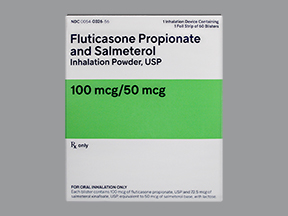 FLUTICASONE-SALMETEROL 100-50
The following indications for FLUTICASONE-SALMETEROL (fluticasone propionate/salmeterol xinafoate) have been approved by the FDA:
Indications:
Bronchospasm prevention with COPD
Maintenance therapy for asthma
Professional Synonyms:
COPD with bronchospasms prophylaxis
Therapy to achieve long-term asthma control
Indications:
Bronchospasm prevention with COPD
Maintenance therapy for asthma
Professional Synonyms:
COPD with bronchospasms prophylaxis
Therapy to achieve long-term asthma control
The following dosing information is available for FLUTICASONE-SALMETEROL (fluticasone propionate/salmeterol xinafoate):
Dosage of salmeterol xinafoate is expressed in terms of salmeterol. Unless otherwise stated, the dose of fluticasone propionate administered as Although each blister of the double-foil blister strip in the Serevent(R) an aerosol via metered-dose inhaler with a hydrofluoroalkane (HFA) Diskus(R) device contains 50 mcg of salmeterol as salmeterol xinafoate propellant is expressed as the amount of drug delivered from the actuator inhalation powder, the precise amount of drug delivered to the lungs with of the inhaler per metered spray; the dose of fluticasone propionate (and each activation of the Diskus(R) device depends on factors such as the of salmeterol in the combination preparation Advair(R)) administered as an oral inhalation powder is expressed as the nominal (labeled) dose contained patient's inspiratory flow. (See Chemistry and Stability: Chemistry.)
in each foil-wrapped blister. The manufacturer states that spacer devices Each blister of the foil blister strip in the Advair(R) Diskus(R) device should not be used with Advair(R) or Flovent(R) Diskus(R).
contains 50 mcg of salmeterol as salmeterol xinafoate and 100, 250, or 500 Each actuation of the commercially available fluticasone propionate HFA mcg of fluticasone propionate; however, the precise amount of each drug delivered to the lungs with each activation of the Diskus(R) device depends oral inhalation aerosol labeled as containing 44, 110, or 220 mcg of fluticasone propionate per metered spray delivers 50, 125, or 250 mcg from on factors such as the patient's inspiratory flow. (See Chemistry and Stability: Chemistry.) the valve, respectively, and 44, 110, or 220 mcg from the actuator,
respectively. The 10.6-g (labeled as containing 44 mcg of fluticasone Each actuation of the AirDuo(R) RespiClick(R) device contains 14 mcg of propionate) or 12-g canister (labeled as containing 110 or 220 mcg of fluticasone propionate) delivers 120 metered sprays of fluticasone salmeterol as salmeterol xinafoate and 55, 113, or 232 mcg of fluticasone propionate.
propionate; however, the precise amount of each drug delivered to the lungs
with each actuation of the RespiClick(R) device depends on factors such as Each actuation of the oral aerosol inhaler containing the fixed combination the patient's inspiratory flow.
of fluticasone propionate and salmeterol xinafoate delivers 50, 125, or 250 Each actuation of the oral aerosol inhaler of the fixed combination of mcg of fluticasone propionate and 25 mcg of salmeterol from the valve. Dosages of fluticasone propionate and salmeterol in the fixed-combination salmeterol and fluticasone propionate (Advair(R) HFA) delivers 50, 125, or 250 mcg of fluticasone propionate and 25 mcg of salmeterol from the valve. inhalation aerosol are expressed in terms of drug delivered from the Dosages of salmeterol and fluticasone propionate in the fixed-combination mouthpiece; each actuation of the inhaler delivers 45, 115, or 230 mcg of fluticasone propionate and 21 mcg of salmeterol from the mouthpiece.
The inhalation aerosol are expressed in terms of drug delivered from the commercially available inhalation aerosol of fluticasone propionate in mouthpiece; each actuation of the inhaler delivers 45, 115, or 230 mcg of fixed combination with salmeterol delivers 60 or 120 metered sprays per 8- fluticasone propionate and 21 mcg of salmeterol from the mouthpiece. The commercially available inhalation aerosol of salmeterol in fixed or 12-g canister, respectively.
combination with fluticasone propionate delivers 60 or 120 metered sprays per 8- or 12-g canister, respectively. With commercially available fluticasone propionate inhalation powder (Flovent(R) Diskus(R), Advair(R) Diskus(R)) delivered via the Diskus(R)
device, the amount of drug delivered to the lungs depends on factors such The manufacturer states that adjustment of salmeterol dosage alone or in as the patient's inspiratory flow. Using standardized in vitro testing at a fixed combination with fluticasone propionate is not necessary in geriatric flow rate of 60 L per minute for 2 seconds, the Flovent(R) Diskus(R) patients.
labeled as containing 50, 100, or 250 mcg of fluticasone propionate delivers 46, 94, or 235 mcg of fluticasone propionate, respectively. In adults with obstructive lung disease and severely compromised lung function (FEV1 20-30% of predicted), mean peak inspiratory flow through the Diskus(R) device was 82.4 L/minute.
In children 4 and 8 years of age with asthma, mean peak inspiratory flow through the Diskus(R) device was 70 and 104 L/minute, respectively. Using standardized in vitro testing at a flow rate of 60 L per minute for 2 seconds, the Advair(R) Diskus(R) device delivered 93, 233, and 465 mcg of fluticasone propionate and 45 mcg of salmeterol per activation from a Diskus(R) labeled as containing 100, 250, or 500 mcg of fluticasone propionate and 50 mcg of salmeterol, respectively. In adults with obstructive lung disease and severely compromised lung function (FEV1 20-30% of predicted), mean peak inspiratory flow through the Diskus(R) device was 82.4
L/minute for Advair(R). In adults and adolescents with asthma, mean peak inspiratory flow through the Diskus(R) device was 122.2 L/minute.
In a group of children 4 years of age, mean peak inspiratory flow through the Advair(R) Diskus(R) device averaged 75.5 L/minute; in children 8 years of age, mean peak inspiratory flow averaged 107.3 L/minute.
The pharmacokinetics of salmeterol or salmeterol in fixed combination with fluticasone have not been studied in patients with hepatic impairment. Since salmeterol and fluticasone propionate are cleared predominantly by hepatic metabolism, impaired liver function theoretically may lead to accumulation of the drugs in plasma. Therefore, the manufacturers recommend that patients with hepatic disease be monitored closely while receiving salmeterol therapy.
The pharmacokinetics of salmeterol in fixed combination with fluticasone have not been studied in patients with renal impairment. Therefore, there are no specific dosage recommendations for such patients.
in each foil-wrapped blister. The manufacturer states that spacer devices Each blister of the foil blister strip in the Advair(R) Diskus(R) device should not be used with Advair(R) or Flovent(R) Diskus(R).
contains 50 mcg of salmeterol as salmeterol xinafoate and 100, 250, or 500 Each actuation of the commercially available fluticasone propionate HFA mcg of fluticasone propionate; however, the precise amount of each drug delivered to the lungs with each activation of the Diskus(R) device depends oral inhalation aerosol labeled as containing 44, 110, or 220 mcg of fluticasone propionate per metered spray delivers 50, 125, or 250 mcg from on factors such as the patient's inspiratory flow. (See Chemistry and Stability: Chemistry.) the valve, respectively, and 44, 110, or 220 mcg from the actuator,
respectively. The 10.6-g (labeled as containing 44 mcg of fluticasone Each actuation of the AirDuo(R) RespiClick(R) device contains 14 mcg of propionate) or 12-g canister (labeled as containing 110 or 220 mcg of fluticasone propionate) delivers 120 metered sprays of fluticasone salmeterol as salmeterol xinafoate and 55, 113, or 232 mcg of fluticasone propionate.
propionate; however, the precise amount of each drug delivered to the lungs
with each actuation of the RespiClick(R) device depends on factors such as Each actuation of the oral aerosol inhaler containing the fixed combination the patient's inspiratory flow.
of fluticasone propionate and salmeterol xinafoate delivers 50, 125, or 250 Each actuation of the oral aerosol inhaler of the fixed combination of mcg of fluticasone propionate and 25 mcg of salmeterol from the valve. Dosages of fluticasone propionate and salmeterol in the fixed-combination salmeterol and fluticasone propionate (Advair(R) HFA) delivers 50, 125, or 250 mcg of fluticasone propionate and 25 mcg of salmeterol from the valve. inhalation aerosol are expressed in terms of drug delivered from the Dosages of salmeterol and fluticasone propionate in the fixed-combination mouthpiece; each actuation of the inhaler delivers 45, 115, or 230 mcg of fluticasone propionate and 21 mcg of salmeterol from the mouthpiece.
The inhalation aerosol are expressed in terms of drug delivered from the commercially available inhalation aerosol of fluticasone propionate in mouthpiece; each actuation of the inhaler delivers 45, 115, or 230 mcg of fixed combination with salmeterol delivers 60 or 120 metered sprays per 8- fluticasone propionate and 21 mcg of salmeterol from the mouthpiece. The commercially available inhalation aerosol of salmeterol in fixed or 12-g canister, respectively.
combination with fluticasone propionate delivers 60 or 120 metered sprays per 8- or 12-g canister, respectively. With commercially available fluticasone propionate inhalation powder (Flovent(R) Diskus(R), Advair(R) Diskus(R)) delivered via the Diskus(R)
device, the amount of drug delivered to the lungs depends on factors such The manufacturer states that adjustment of salmeterol dosage alone or in as the patient's inspiratory flow. Using standardized in vitro testing at a fixed combination with fluticasone propionate is not necessary in geriatric flow rate of 60 L per minute for 2 seconds, the Flovent(R) Diskus(R) patients.
labeled as containing 50, 100, or 250 mcg of fluticasone propionate delivers 46, 94, or 235 mcg of fluticasone propionate, respectively. In adults with obstructive lung disease and severely compromised lung function (FEV1 20-30% of predicted), mean peak inspiratory flow through the Diskus(R) device was 82.4 L/minute.
In children 4 and 8 years of age with asthma, mean peak inspiratory flow through the Diskus(R) device was 70 and 104 L/minute, respectively. Using standardized in vitro testing at a flow rate of 60 L per minute for 2 seconds, the Advair(R) Diskus(R) device delivered 93, 233, and 465 mcg of fluticasone propionate and 45 mcg of salmeterol per activation from a Diskus(R) labeled as containing 100, 250, or 500 mcg of fluticasone propionate and 50 mcg of salmeterol, respectively. In adults with obstructive lung disease and severely compromised lung function (FEV1 20-30% of predicted), mean peak inspiratory flow through the Diskus(R) device was 82.4
L/minute for Advair(R). In adults and adolescents with asthma, mean peak inspiratory flow through the Diskus(R) device was 122.2 L/minute.
In a group of children 4 years of age, mean peak inspiratory flow through the Advair(R) Diskus(R) device averaged 75.5 L/minute; in children 8 years of age, mean peak inspiratory flow averaged 107.3 L/minute.
The pharmacokinetics of salmeterol or salmeterol in fixed combination with fluticasone have not been studied in patients with hepatic impairment. Since salmeterol and fluticasone propionate are cleared predominantly by hepatic metabolism, impaired liver function theoretically may lead to accumulation of the drugs in plasma. Therefore, the manufacturers recommend that patients with hepatic disease be monitored closely while receiving salmeterol therapy.
The pharmacokinetics of salmeterol in fixed combination with fluticasone have not been studied in patients with renal impairment. Therefore, there are no specific dosage recommendations for such patients.
Fluticasone propionate alone and in fixed combination with salmeterol is administered as a microcrystalline suspension by oral inhalation using an oral aerosol inhaler with hydrofluoroalkane (HFA; non-chlorofluorocarbon) propellant or as the inhalation powder using the Diskus(R) device that delivers the drug from foil-wrapped blisters. Fluticasone propionate in fixed combination with salmeterol xinafoate is also administered as an inhalation powder using the Diskus(R) device that delivers the drugs from foil-wrapped blisters. Salmeterol xinafoate is administered by oral inhalation using a special preloaded oral inhaler (Serevent(R) or Advair(R) Diskus(R), or AirDuo(R) RespiClick(R)) that delivers powdered drug alone or in fixed combination with fluticasone propionate.
The manufacturer of the Diskus(R) devices states that spacer devices should not be used with Serevent(R) or Advair(R) Diskus(R). The manufacturer of the RespiClick(R) device states that spacers or volume holding chambers should not be used with AirDuo(R) RespiClick(R). Salmeterol/fluticasone propionate inhalation aerosol (Advair(R) HFA) should only be used with the actuator supplied with the product.
Before each inhalation, the inhaler must be shaken well for 5 seconds. The aerosol inhaler should be test sprayed 4 times into the air (away from the face) before initial use, and shaken well for 5 seconds before each spray. If the inhaler has not been used for more than 4 weeks or if the inhaler was dropped, the inhaler should be test sprayed twice into the air (away from the face) and shaken well for 5 seconds before each spray.
The cap covering the mouthpiece should be slipped off the mouthpiece; the strap on the cap will stay attached to the mouthpiece. The patient should look for foreign objects inside the inhaler prior to use, and should check to see that the canister is fully seated within the actuator. After exhaling as completely as possible, the patient should place the mouthpiece of the inhaler well into the mouth and close the lips firmly around it.
Then the patient should inhale deeply through the mouth while actuating the inhaler. The patient should remove the mouthpiece from the mouth and hold the breath for as long as possible, up to 10 seconds, and exhale slowly. It is recommended that 30 seconds elapse between inhalations.
Rinsing the mouth after inhalation of salmeterol/fluticasone propionate inhalation aerosol and spitting out the water are advised. The opening for the spray of the metal canister and the mouthpiece should be wiped with a dry cotton swab and dampened tissue, respectively, at least once a week after the evening dose. The actuator should be allowed to air-dry overnight.
When the dose counter on the inhaler reads ''020,'' the patient should contact the pharmacy for a refill or consult their clinician to determine whether a refill is needed. The inhaler should be discarded when the dose counter reads ''000.'' The counter should never be altered or removed from the canister.
For administration of salmeterol xinafoate alone (Serevent(R)) or in combination with fluticasone propionate (Advair(R)) inhalation powder via the Diskus(R) device, the patient should hold the device in one hand, put the thumb of the other hand on the thumbgrip, and push the thumbgrip until the mouthpiece appears and snaps into position. The lever on the Diskus(R) should then be depressed in a direction away from the patient while the inhaler is held in a level, horizontal position; the lever pierces the foil blister and releases the powdered drug into an exit port. To avoid releasing and wasting additional doses of the drug, the patient should not tilt or close the Diskus(R) device, play with the lever, or advance the lever more than once at this point.
A dose counter will advance each time the lever is depressed. Before inhaling the dose, the patient should exhale as completely as possible; the patient should not exhale into the Diskus(R) device because pressure from the exhalation will interfere with proper inhaler operation. The patient should then place the mouthpiece of the inhaler between the lips and inhale deeply and quickly through the inhaler with a steady, even breath; pressure from the inhalation will disperse drug from the exit port into the air stream created by the patient's inhalation.
The patient should remove the inhaler from the mouth, hold his or her breath for 10 seconds (or as long as comfortable), and then exhale slowly. While most patients can taste or feel a dose of drug delivered from the Diskus(R) device, they should be instructed not to use another dose even if they do not perceive that the dose has been delivered. Rinsing the mouth after inhalation of salmeterol in fixed combination with fluticasone propionate is advised.
The Diskus(R) device may be closed and reset for the next dose by sliding the thumbgrip towards the patient as far as it will go. The inhaler should not be washed but should be stored in a dry place away from direct heat or sunlight. The inhaler should be discarded when every blister has been used, or 4 or 6 weeks after removal of the Advair(R) Diskus(R) or Serevent(R) Diskus(R), respectively, from its foil overwrap pouch.
The inhaler should not be taken apart. For instructions on use of the AirDuo(R) RespiClick(R) oral inhaler, the manufacturer's labeling should be consulted. To obtain optimal benefit, the patient should be given a copy of the product-specific patient instructions and medication guide provided by the manufacturer. (See Asthma-related Death and Life-threatening Events under Cautions: Respiratory Effects.)
The manufacturer of the Diskus(R) devices states that spacer devices should not be used with Serevent(R) or Advair(R) Diskus(R). The manufacturer of the RespiClick(R) device states that spacers or volume holding chambers should not be used with AirDuo(R) RespiClick(R). Salmeterol/fluticasone propionate inhalation aerosol (Advair(R) HFA) should only be used with the actuator supplied with the product.
Before each inhalation, the inhaler must be shaken well for 5 seconds. The aerosol inhaler should be test sprayed 4 times into the air (away from the face) before initial use, and shaken well for 5 seconds before each spray. If the inhaler has not been used for more than 4 weeks or if the inhaler was dropped, the inhaler should be test sprayed twice into the air (away from the face) and shaken well for 5 seconds before each spray.
The cap covering the mouthpiece should be slipped off the mouthpiece; the strap on the cap will stay attached to the mouthpiece. The patient should look for foreign objects inside the inhaler prior to use, and should check to see that the canister is fully seated within the actuator. After exhaling as completely as possible, the patient should place the mouthpiece of the inhaler well into the mouth and close the lips firmly around it.
Then the patient should inhale deeply through the mouth while actuating the inhaler. The patient should remove the mouthpiece from the mouth and hold the breath for as long as possible, up to 10 seconds, and exhale slowly. It is recommended that 30 seconds elapse between inhalations.
Rinsing the mouth after inhalation of salmeterol/fluticasone propionate inhalation aerosol and spitting out the water are advised. The opening for the spray of the metal canister and the mouthpiece should be wiped with a dry cotton swab and dampened tissue, respectively, at least once a week after the evening dose. The actuator should be allowed to air-dry overnight.
When the dose counter on the inhaler reads ''020,'' the patient should contact the pharmacy for a refill or consult their clinician to determine whether a refill is needed. The inhaler should be discarded when the dose counter reads ''000.'' The counter should never be altered or removed from the canister.
For administration of salmeterol xinafoate alone (Serevent(R)) or in combination with fluticasone propionate (Advair(R)) inhalation powder via the Diskus(R) device, the patient should hold the device in one hand, put the thumb of the other hand on the thumbgrip, and push the thumbgrip until the mouthpiece appears and snaps into position. The lever on the Diskus(R) should then be depressed in a direction away from the patient while the inhaler is held in a level, horizontal position; the lever pierces the foil blister and releases the powdered drug into an exit port. To avoid releasing and wasting additional doses of the drug, the patient should not tilt or close the Diskus(R) device, play with the lever, or advance the lever more than once at this point.
A dose counter will advance each time the lever is depressed. Before inhaling the dose, the patient should exhale as completely as possible; the patient should not exhale into the Diskus(R) device because pressure from the exhalation will interfere with proper inhaler operation. The patient should then place the mouthpiece of the inhaler between the lips and inhale deeply and quickly through the inhaler with a steady, even breath; pressure from the inhalation will disperse drug from the exit port into the air stream created by the patient's inhalation.
The patient should remove the inhaler from the mouth, hold his or her breath for 10 seconds (or as long as comfortable), and then exhale slowly. While most patients can taste or feel a dose of drug delivered from the Diskus(R) device, they should be instructed not to use another dose even if they do not perceive that the dose has been delivered. Rinsing the mouth after inhalation of salmeterol in fixed combination with fluticasone propionate is advised.
The Diskus(R) device may be closed and reset for the next dose by sliding the thumbgrip towards the patient as far as it will go. The inhaler should not be washed but should be stored in a dry place away from direct heat or sunlight. The inhaler should be discarded when every blister has been used, or 4 or 6 weeks after removal of the Advair(R) Diskus(R) or Serevent(R) Diskus(R), respectively, from its foil overwrap pouch.
The inhaler should not be taken apart. For instructions on use of the AirDuo(R) RespiClick(R) oral inhaler, the manufacturer's labeling should be consulted. To obtain optimal benefit, the patient should be given a copy of the product-specific patient instructions and medication guide provided by the manufacturer. (See Asthma-related Death and Life-threatening Events under Cautions: Respiratory Effects.)
No dosing information available.
No generic dosing information available.
The following drug interaction information is available for FLUTICASONE-SALMETEROL (fluticasone propionate/salmeterol xinafoate):
There are 0 contraindications.
There are 0 severe interactions.
There are 0 moderate interactions.
The following contraindication information is available for FLUTICASONE-SALMETEROL (fluticasone propionate/salmeterol xinafoate):
Drug contraindication overview.
Primary treatment of severe acute asthmatic attacks or status asthmaticus when intensive measures (e.g., oxygen, parenteral bronchodilators, IV corticosteroids) are required. Fluticasone propionate in fixed combination with salmeterol is contraindicated as primary treatment of status asthmaticus or other acute episodes of asthma or chronic obstructive pulmonary disease (COPD) when intensive measures are required. Known hypersensitivity to fluticasone propionate or any ingredient (e.g., milk protein) in the formulation. When fluticasone propionate is used in fixed combination with salmeterol, contraindications associated with salmeterol should be considered.
Primary treatment of severe acute asthmatic attacks or status asthmaticus when intensive measures (e.g., oxygen, parenteral bronchodilators, IV corticosteroids) are required. Fluticasone propionate in fixed combination with salmeterol is contraindicated as primary treatment of status asthmaticus or other acute episodes of asthma or chronic obstructive pulmonary disease (COPD) when intensive measures are required. Known hypersensitivity to fluticasone propionate or any ingredient (e.g., milk protein) in the formulation. When fluticasone propionate is used in fixed combination with salmeterol, contraindications associated with salmeterol should be considered.
There are 1 contraindications.
Absolute contraindication.
| Contraindication List |
|---|
| Congenital long QT syndrome |
There are 5 severe contraindications.
Adequate patient monitoring is recommended for safer drug use.
| Severe List |
|---|
| Acute asthma attack |
| Chronic myocardial ischemia |
| Exacerbation of chronic obstructive pulmonary disease |
| Hypokalemia |
| Prolonged QT interval |
There are 4 moderate contraindications.
Clinically significant contraindication, where the condition can be managed or treated before the drug may be given safely.
| Moderate List |
|---|
| Diabetes mellitus |
| Hypertension |
| Seizure disorder |
| Thyrotoxicosis |
The following adverse reaction information is available for FLUTICASONE-SALMETEROL (fluticasone propionate/salmeterol xinafoate):
Adverse reaction overview.
Adverse effects occurring in more than 3% of patients older than 12 years of age receiving fluticasone propionate HFA oral inhalation aerosol in controlled clinical trials include upper respiratory tract infection, headache, throat irritation, upper respiratory inflammation, sinusitis/sinus infection, candidiasis (including oral candidiasis), cough, hoarseness/dysphonia, and bronchitis. Adverse effects reported in clinical trials with fluticasone propionate HFA inhalation aerosol in pediatric patients (4-11 years of age) generally were similar to those observed in adolescents and adults. Adverse effects occurring in more than 3% of patients receiving fluticasone propionate oral inhalation powder in controlled clinical trials include upper respiratory tract infection, throat irritation, sinusitis/sinus infection, upper respiratory inflammation, rhinitis, viral respiratory infection, cough, bronchitis, oral candidiasis, nausea and vomiting, GI discomfort and pain, viral GI infection, musculoskeletal pain, muscle injury, headache, fever, and viral infection.
Adverse effects occurring in more than 3% of patients older than 12 years of age receiving fluticasone propionate HFA oral inhalation aerosol in controlled clinical trials include upper respiratory tract infection, headache, throat irritation, upper respiratory inflammation, sinusitis/sinus infection, candidiasis (including oral candidiasis), cough, hoarseness/dysphonia, and bronchitis. Adverse effects reported in clinical trials with fluticasone propionate HFA inhalation aerosol in pediatric patients (4-11 years of age) generally were similar to those observed in adolescents and adults. Adverse effects occurring in more than 3% of patients receiving fluticasone propionate oral inhalation powder in controlled clinical trials include upper respiratory tract infection, throat irritation, sinusitis/sinus infection, upper respiratory inflammation, rhinitis, viral respiratory infection, cough, bronchitis, oral candidiasis, nausea and vomiting, GI discomfort and pain, viral GI infection, musculoskeletal pain, muscle injury, headache, fever, and viral infection.
There are 42 severe adverse reactions.
| More Frequent | Less Frequent |
|---|---|
| None. | None. |
| Rare/Very Rare |
|---|
|
Adrenocortical insufficiency Anaphylaxis Angina Angioedema Asthma exacerbation Atrial fibrillation Bronchitis Cardiac arrhythmia Cataracts Central serous chorioretinopathy Chest pain Conjunctivitis Edema Esophageal candidiasis Extrasystoles Glaucoma Hypercortisolism Hyperglycemia Hypersensitivity angiitis Hypersensitivity drug reaction Hypertension Hypokalemia Hypotension Hypothalamic-pituitary insufficiency Immunosuppression Influenza Keratitis Laryngismus Ocular pain Osteopenia Osteoporosis Paradoxical bronchospasm Pneumonia Prolonged QT interval Seizure disorder Sinusitis Skin and skin structure infection Skin rash Stridor Upper respiratory infection Urticaria Ventricular tachycardia |
There are 72 less severe adverse reactions.
| More Frequent | Less Frequent |
|---|---|
|
Bronchitis Cough Headache disorder Myalgia Oral candidiasis Pharyngeal candidiasis Pharyngitis Sinusitis Upper respiratory infection |
Back pain Cough Cramps Dizziness Influenza Nasal congestion Nausea Nervousness Palpitations Rhinitis Sore throat Tachycardia Tremor Voice change |
| Rare/Very Rare |
|---|
|
Aggressive behavior Agitation Arthralgia Blurred vision Bruising Contact dermatitis Dental caries Dental discoloration Depression Diarrhea Dizziness Drowsy Dyspepsia Dyspnea Earache Ecchymosis Eczema Eosinophilia Facial edema Fatigue Fever Hyperkinesis Hypertension Insomnia Irritability Laryngitis Malaise Muscle rigidity Musculoskeletal pain Myalgia Nausea Oral candidiasis Pain in oropharynx Paresthesia Pruritus of skin Rhinitis Rhinorrhea Skin rash Sleep disorder Sore throat Symptoms of anxiety Thrombophlebitis Toothache Urinary tract infection Urticaria Viral infection Vomiting Weight gain Xerostomia |
The following precautions are available for FLUTICASONE-SALMETEROL (fluticasone propionate/salmeterol xinafoate):
Safety and efficacy of fluticasone propionate inhalation aerosol or powder alone in children younger than 4 years of age have not been established. Safety and efficacy of the inhalation powder containing fluticasone propionate in fixed combination with salmeterol (Advair(R) Diskus(R)) in children younger than 4 years of age have not been established. Safety and efficacy of the inhalation aerosol containing fluticasone propionate in fixed combination with salmeterol (Advair(R) HFA) in children younger than 12 years of age have not been established.
Use of the inhalation powder containing fluticasone propionate in children 4-11 years of age is supported by data from several clinical trials. Use of fluticasone propionate inhalation aerosol or the inhalation powder containing fluticasone propionate in fixed combination with salmeterol (Advair(R) Diskus(R)) in children 4-11 years of age is supported by data from several clinical trials and by extrapolation of efficacy data from older patients. The adverse effect profile of Flovent(R) HFA in pediatric patients (4-11 years of age) generally is similar to that observed in adolescents and adults.
Use of corticosteroids or inadequate control of chronic diseases (e.g., asthma) may lead to suppression of growth in children and adolescents. Therefore, children receiving prolonged therapy with orally inhaled fluticasone propionate should be monitored periodically (e.g., via stadiometry) for possible adverse effects on growth and development. The benefits of corticosteroid therapy should be weighed against the possibility of growth suppression and the risks associated with alternative therapies. Children should be maintained on the lowest possible dosage of fluticasone propionate that controls asthma symptoms.
Contraindicated
Severe Precaution
Management or Monitoring Precaution
Use of the inhalation powder containing fluticasone propionate in children 4-11 years of age is supported by data from several clinical trials. Use of fluticasone propionate inhalation aerosol or the inhalation powder containing fluticasone propionate in fixed combination with salmeterol (Advair(R) Diskus(R)) in children 4-11 years of age is supported by data from several clinical trials and by extrapolation of efficacy data from older patients. The adverse effect profile of Flovent(R) HFA in pediatric patients (4-11 years of age) generally is similar to that observed in adolescents and adults.
Use of corticosteroids or inadequate control of chronic diseases (e.g., asthma) may lead to suppression of growth in children and adolescents. Therefore, children receiving prolonged therapy with orally inhaled fluticasone propionate should be monitored periodically (e.g., via stadiometry) for possible adverse effects on growth and development. The benefits of corticosteroid therapy should be weighed against the possibility of growth suppression and the risks associated with alternative therapies. Children should be maintained on the lowest possible dosage of fluticasone propionate that controls asthma symptoms.
Contraindicated
| None |
Severe Precaution
| None |
Management or Monitoring Precaution
| None |
Category C. There are no adequate and well-controlled studies of salmeterol in pregnant women. Because of the potential for beta-agonist interference with uterine contractility, use of salmeterol during labor should be restricted to those patients in whom the benefits clearly outweigh the risks.
The drug should be used during other stages of pregnancy only if the potential benefit justifies the potential risk to the fetus. Salmeterol in fixed combination with fluticasone propionate inhalation aerosol (Advair(R) HFA) should be used during pregnancy only if the potential benefit justifies the potential risk to the fetus. In pregnant women with poorly or moderately controlled asthma, there is an increased risk of adverse perinatal events such as preeclampsia in the mother, and prematurity, low birth weight, and small size for gestational age in the neonate.
Pregnant women with asthma should be closely monitored and dosage of medications should be adjusted as needed to maintain optimal asthma control. Reproduction studies in male and female rats using oral salmeterol dosages of up to 2 mg/kg daily (representing 160 times the recommended clinical dosage on a mg/m2 basis) have not revealed evidence of harm to the fetus. Dutch rabbit fetuses exposed to oral salmeterol dosages of at least 1 mg/kg (representing 50 times the maximum recommended daily inhalation dosage based on comparison of AUC data) exhibited characteristic effects of beta-receptor stimulation, including precocious eyelid openings, cleft palate, sternebral fusion, limb and paw flexures, and delayed ossification of the frontal cranial bones.
No teratogenic effects were observed at oral salmeterol doses of 0.6 mg/kg (20 times the maximum recommended daily inhalation dosage based on comparison of AUC data). Delayed ossification of the frontal bones was seen in the fetuses of New Zealand White rabbits given oral salmeterol dosages of 10 mg/kg (representing 1600 times the maximum recommended daily inhalation dosage on a mg/m2 basis).
Extensive use of other beta-agonists has provided no evidence that these class effects in animals are relevant to use in humans. In reproduction studies in mice and rats, no evidence of an increased toxicity was associated with the use of salmeterol combined with fluticasone propionate when compared with toxicity observed from the components administered separately. Teratogenicity (i.e., cleft palate), fetal death, or increased implantation loss has been observed in mice receiving a subcutaneous dosage of 150 mcg/kg of fluticasone propionate (representing approximately less than the maximum recommended daily inhalation dosage in adults on a mcg/m2 basis) combined with a 10 mg/kg oral dosage of salmeterol (representing approximately 410 times the maximum recommended daily inhalation dosage in adults on a mg/m2 basis), but these effects did not occur when lower dosages of fluticasone propionate (up to 40 mcg/kg subcutaneously, representing less than the maximum recommended daily inhalation dosage in adults on a mcg/m2 basis) were combined with lower dosages of salmeterol (up to 1.4 mg/kg orally, representing approximately 55 times the maximum recommended daily inhalation dosage in adults on a mg/m2 basis).
Reproduction studies in rats receiving subcutaneous dosages of fluticasone propionate of up to 30 mcg/kg (representing less than the maximum recommended daily inhalation dosage in adults on a mcg/m2 basis) combined with dosages of up to 1 mg/kg of salmeterol (approximately 80 times the recommended daily inhalation dosage in adults on a mg/m2 basis) did not reveal evidence of teratogenicity. Delayed ossification, changes in the occipital bone, umbilical hernia, decreased placental or fetal weight, and maternal toxicity have been observed in rats receiving subcutaneous dosages of fluticasone propionate 100 mcg/kg (representing less than the maximum recommended daily inhalation dosage in adults on a mcg/m2 basis) combined with oral salmeterol dosages of 10 mg/kg (approximately 810 times the maximum recommended daily inhalation dosage in adults on a mg/m2 basis).
The drug should be used during other stages of pregnancy only if the potential benefit justifies the potential risk to the fetus. Salmeterol in fixed combination with fluticasone propionate inhalation aerosol (Advair(R) HFA) should be used during pregnancy only if the potential benefit justifies the potential risk to the fetus. In pregnant women with poorly or moderately controlled asthma, there is an increased risk of adverse perinatal events such as preeclampsia in the mother, and prematurity, low birth weight, and small size for gestational age in the neonate.
Pregnant women with asthma should be closely monitored and dosage of medications should be adjusted as needed to maintain optimal asthma control. Reproduction studies in male and female rats using oral salmeterol dosages of up to 2 mg/kg daily (representing 160 times the recommended clinical dosage on a mg/m2 basis) have not revealed evidence of harm to the fetus. Dutch rabbit fetuses exposed to oral salmeterol dosages of at least 1 mg/kg (representing 50 times the maximum recommended daily inhalation dosage based on comparison of AUC data) exhibited characteristic effects of beta-receptor stimulation, including precocious eyelid openings, cleft palate, sternebral fusion, limb and paw flexures, and delayed ossification of the frontal cranial bones.
No teratogenic effects were observed at oral salmeterol doses of 0.6 mg/kg (20 times the maximum recommended daily inhalation dosage based on comparison of AUC data). Delayed ossification of the frontal bones was seen in the fetuses of New Zealand White rabbits given oral salmeterol dosages of 10 mg/kg (representing 1600 times the maximum recommended daily inhalation dosage on a mg/m2 basis).
Extensive use of other beta-agonists has provided no evidence that these class effects in animals are relevant to use in humans. In reproduction studies in mice and rats, no evidence of an increased toxicity was associated with the use of salmeterol combined with fluticasone propionate when compared with toxicity observed from the components administered separately. Teratogenicity (i.e., cleft palate), fetal death, or increased implantation loss has been observed in mice receiving a subcutaneous dosage of 150 mcg/kg of fluticasone propionate (representing approximately less than the maximum recommended daily inhalation dosage in adults on a mcg/m2 basis) combined with a 10 mg/kg oral dosage of salmeterol (representing approximately 410 times the maximum recommended daily inhalation dosage in adults on a mg/m2 basis), but these effects did not occur when lower dosages of fluticasone propionate (up to 40 mcg/kg subcutaneously, representing less than the maximum recommended daily inhalation dosage in adults on a mcg/m2 basis) were combined with lower dosages of salmeterol (up to 1.4 mg/kg orally, representing approximately 55 times the maximum recommended daily inhalation dosage in adults on a mg/m2 basis).
Reproduction studies in rats receiving subcutaneous dosages of fluticasone propionate of up to 30 mcg/kg (representing less than the maximum recommended daily inhalation dosage in adults on a mcg/m2 basis) combined with dosages of up to 1 mg/kg of salmeterol (approximately 80 times the recommended daily inhalation dosage in adults on a mg/m2 basis) did not reveal evidence of teratogenicity. Delayed ossification, changes in the occipital bone, umbilical hernia, decreased placental or fetal weight, and maternal toxicity have been observed in rats receiving subcutaneous dosages of fluticasone propionate 100 mcg/kg (representing less than the maximum recommended daily inhalation dosage in adults on a mcg/m2 basis) combined with oral salmeterol dosages of 10 mg/kg (approximately 810 times the maximum recommended daily inhalation dosage in adults on a mg/m2 basis).
While it is not known whether fluticasone propionate is distributed into milk in humans, the drug is distributed into milk in rats. In addition, other corticosteroids are distributed into milk. Data also are not available on the effects of the drug on the breast-fed child or on milk production.
Since data are not available on the use of fluticasone propionate oral inhalation aerosol in nursing women, caution is advised if the drug is administered in nursing women. The benefits of breast-feeding should be considered along with the woman's clinical need for fluticasone propionate oral inhalation and any potential adverse effects on the breast-fed child from the drug or underlying maternal condition. It is not known whether salmeterol xinafoate or fluticasone propionate is distributed into human milk.
However, salmeterol is distributed into milk in rats. Corticosteroids, other than fluticasone propionate, are distributed into human milk. Effects of salmeterol xinafoate or fluticasone propionate on breast-fed infants or milk production also are not known.
The benefits of breast-feeding and the woman's clinical need for salmeterol xinafoate or fluticasone propionate should be considered along with any potential adverse effects on the breast-fed infant from the drugs or from the underlying maternal condition. Since no data from controlled trials are available on the use of such preparations in nursing women, caution is advised if salmeterol alone or salmeterol in fixed combination with fluticasone propionate is administered in nursing women.
Precaution Exists
Precaution exists. (No data or inconclusive human data.) Use of this drug by breast feeding mothers should be evaluated carefully.
Since data are not available on the use of fluticasone propionate oral inhalation aerosol in nursing women, caution is advised if the drug is administered in nursing women. The benefits of breast-feeding should be considered along with the woman's clinical need for fluticasone propionate oral inhalation and any potential adverse effects on the breast-fed child from the drug or underlying maternal condition. It is not known whether salmeterol xinafoate or fluticasone propionate is distributed into human milk.
However, salmeterol is distributed into milk in rats. Corticosteroids, other than fluticasone propionate, are distributed into human milk. Effects of salmeterol xinafoate or fluticasone propionate on breast-fed infants or milk production also are not known.
The benefits of breast-feeding and the woman's clinical need for salmeterol xinafoate or fluticasone propionate should be considered along with any potential adverse effects on the breast-fed infant from the drugs or from the underlying maternal condition. Since no data from controlled trials are available on the use of such preparations in nursing women, caution is advised if salmeterol alone or salmeterol in fixed combination with fluticasone propionate is administered in nursing women.
Precaution Exists
Precaution exists. (No data or inconclusive human data.) Use of this drug by breast feeding mothers should be evaluated carefully.
| Drug Name | Excretion Potential | Effect on Infant | Notes |
|---|---|---|---|
| Fluticasone (inhal, Nasal) | Unknown. It is unknown whether the drug is excreted in human breast milk. | It is not known whether this drug has an adverse effect on the nursing infant. (No data or inconclusive human data) | Insuff human data avail; significant exposure to a nursing infant is unlikely |
| Salmeterol | Unknown. It is unknown whether the drug is excreted in human breast milk. | It is not known whether this drug has an adverse effect on the nursing infant. (No data or inconclusive human data) | Insufficient human data available |
Although no overall differences in safety and efficacy of orally inhaled fluticasone propionate alone or fluticasone propionate in fixed combination with salmeterol as the inhalation aerosol (Advair(R) HFA) were observed relative to younger adults, the possibility that some older patients may exhibit increased sensitivity to the drug cannot be ruled out. Experience with the inhalation powder containing fluticasone propionate in fixed combination with salmeterol (Advair(R) Diskus(R)) in those 65 years of age or older with asthma is insufficient to determine whether geriatric patients respond differently than younger patients. In clinical studies evaluating the inhalation powder containing fluticasone propionate in fixed combination with salmeterol for COPD, patients 65 years of age or older experienced a higher incidence of serious adverse effects compared with those younger than 65 years of age, although the distribution of adverse effects was similar in the two groups.
Dosage of fluticasone propionate HFA inhalation aerosol in geriatric patients should be selected with caution, reflecting the greater frequency of decreased hepatic function, presence of coexisting conditions, or other drug therapies in such patients. Dosage adjustments based solely on age are not recommended in geriatric patients receiving fluticasone propionate inhalation powder alone or fluticasone propionate inhalation powder or aerosol in fixed combination with salmeterol.
Precaution Exists
Geriatric management or monitoring precaution exists.
Dosage of fluticasone propionate HFA inhalation aerosol in geriatric patients should be selected with caution, reflecting the greater frequency of decreased hepatic function, presence of coexisting conditions, or other drug therapies in such patients. Dosage adjustments based solely on age are not recommended in geriatric patients receiving fluticasone propionate inhalation powder alone or fluticasone propionate inhalation powder or aerosol in fixed combination with salmeterol.
Precaution Exists
Geriatric management or monitoring precaution exists.
| Drug Name | Narrative | REN | HEP | CARDIO | NEURO | PULM | ENDO |
|---|---|---|---|---|---|---|---|
| Fluticasone (inh) | Musculoskeletal-Use with caution in patients with osteoporosis. Decreases in bone mineral density (BMD) has been observed with long-term administration of products containing inhaled corticosteroids. | N | N | N | N | N | Y |
| Salmeterol | Cardiovascular-Use caution in severe cardiovascular diseases, particularly coronary insufficiency, since beta-agonists increase heart rate and blood pressure. Endocrine-Use caution in poorly controlled hyperthyroidism or diabetes. | N | N | Y | N | N | Y |
The following prioritized warning is available for FLUTICASONE-SALMETEROL (fluticasone propionate/salmeterol xinafoate):
No warning message for this drug.
No warning message for this drug.
The following icd codes are available for FLUTICASONE-SALMETEROL (fluticasone propionate/salmeterol xinafoate)'s list of indications:
| Bronchospasm prevention with COPD | |
| J44 | Other chronic obstructive pulmonary disease |
| J44.8 | Other specified chronic obstructive pulmonary disease |
| J44.89 | Other specified chronic obstructive pulmonary disease |
| J44.9 | Chronic obstructive pulmonary disease, unspecified |
| Maintenance therapy for asthma | |
| J45 | Asthma |
| J45.2 | Mild intermittent asthma |
| J45.20 | Mild intermittent asthma, uncomplicated |
| J45.3 | Mild persistent asthma |
| J45.30 | Mild persistent asthma, uncomplicated |
| J45.4 | Moderate persistent asthma |
| J45.40 | Moderate persistent asthma, uncomplicated |
| J45.5 | Severe persistent asthma |
| J45.50 | Severe persistent asthma, uncomplicated |
| J45.9 | Other and unspecified asthma |
| J45.90 | Unspecified asthma |
| J45.909 | Unspecified asthma, uncomplicated |
Formulary Reference Tool