Please wait while the formulary information is being retrieved.
Drug overview for VECAMYL (mecamylamine hcl):
Generic name: MECAMYLAMINE HCL (MEK-a-MIL-a-meen)
Drug class: Hypotensives - Ganglionic Blockers
Therapeutic class: Cardiovascular Therapy Agents
No enhanced Introduction information available for this drug.
No enhanced Uses information available for this drug.
Generic name: MECAMYLAMINE HCL (MEK-a-MIL-a-meen)
Drug class: Hypotensives - Ganglionic Blockers
Therapeutic class: Cardiovascular Therapy Agents
No enhanced Introduction information available for this drug.
No enhanced Uses information available for this drug.
DRUG IMAGES
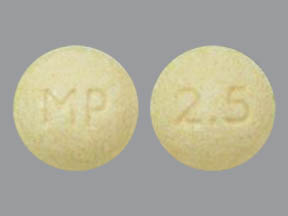 VECAMYL 2.5 MG TABLET
The following indications for VECAMYL (mecamylamine hcl) have been approved by the FDA:
Indications:
Hypertension
Professional Synonyms:
Elevated blood pressure
Essential hypertension
Hyperpiesia
Hyperpiesis
Hypertensive disorder
Systemic arterial hypertension
Indications:
Hypertension
Professional Synonyms:
Elevated blood pressure
Essential hypertension
Hyperpiesia
Hyperpiesis
Hypertensive disorder
Systemic arterial hypertension
The following dosing information is available for VECAMYL (mecamylamine hcl):
No enhanced Dosing information available for this drug.
No enhanced Administration information available for this drug.
| DRUG LABEL | DOSING TYPE | DOSING INSTRUCTIONS |
|---|---|---|
| VECAMYL 2.5 MG TABLET | Maintenance | Adults take 1 tablet (2.5 mg) by oral route once daily |
No generic dosing information available.
The following drug interaction information is available for VECAMYL (mecamylamine hcl):
There are 0 contraindications.
There are 0 severe interactions.
There are 2 moderate interactions.
The clinician should assess the patient’s characteristics and take action as needed. Actions required for moderate interactions include, but are not limited to, discontinuing one or both agents, adjusting dosage, altering administration.
| Drug Interaction | Drug Names |
|---|---|
| Tizanidine/Selected Antihypertensives SEVERITY LEVEL: 3-Moderate Interaction: Assess the risk to the patient and take action as needed. MECHANISM OF ACTION: Tizanidine is an alpha-2 agonist. Concurrent use with antihypertensive agents may result in additive effects on blood pressure.(1) CLINICAL EFFECTS: Concurrent use of antihypertensives and tizanidine may result in hypotension.(1) PREDISPOSING FACTORS: None determined. PATIENT MANAGEMENT: Patients receiving concurrent therapy should be monitored for hypotension. The risk of hypotension may be decreased by careful titration of tizanidine dosages and monitoring for hypotension prior to dose advancement. Counsel patients about the risk of orthostatic hypotension.(1) DISCUSSION: Severe hypotension has been reported following the addition of tizanidine to existing lisinopril therapy.(2-4) |
ONTRALFY, TIZANIDINE HCL, ZANAFLEX |
| Apomorphine/Selected Antihypertensives and Vasodilators SEVERITY LEVEL: 3-Moderate Interaction: Assess the risk to the patient and take action as needed. MECHANISM OF ACTION: Apomorphine causes dose-dependent decreases in blood pressure. Concurrent use with antihypertensive agents may result in additive effects on blood pressure.(1) CLINICAL EFFECTS: Concurrent use of antihypertensives and apomorphine may result in orthostatic hypotension with or without dizziness, nausea, or syncope.(1) PREDISPOSING FACTORS: The risk of orthostatic hypotension may be increased during dose escalation of apomorphine and in patients with renal or hepatic impairment.(1) PATIENT MANAGEMENT: Patients receiving concurrent therapy should be monitored for hypotension. Counsel patients about the risk of orthostatic hypotension.(1) DISCUSSION: Healthy volunteers who took sublingual nitroglycerin (0.4 mg) concomitantly with apomorphine experienced a mean largest decrease in supine systolic blood pressure (SBP) of 9.7 mm Hg and in supine diastolic blood pressure (DBP) of 9.3 mm Hg, and a mean largest decrease in standing SBP and DBP of 14.3 mm Hg and 13.5 mm Hg, respectively. The maximum decrease in SBP and DBP was 65 mm Hg and 43 mm Hg, respectively. When apomorphine was taken alone, the mean largest decrease in supine SBP and DBP was 6.1 mm Hg and 7.3 mm Hg, respectively, and in standing SBP and DBP was 6.7 mm Hg and 8.4 mm Hg, respectively.(1) |
APOKYN, APOMORPHINE HCL, ONAPGO |
The following contraindication information is available for VECAMYL (mecamylamine hcl):
Drug contraindication overview.
No enhanced Contraindications information available for this drug.
No enhanced Contraindications information available for this drug.
There are 4 contraindications.
Absolute contraindication.
| Contraindication List |
|---|
| 30 day risk period post-myocardial infarction |
| Coronary artery disease |
| Glaucoma |
| Pyloroduodenal obstruction |
There are 1 severe contraindications.
Adequate patient monitoring is recommended for safer drug use.
| Severe List |
|---|
| Kidney disease with reduction in glomerular filtration rate (GFr) |
There are 5 moderate contraindications.
Clinically significant contraindication, where the condition can be managed or treated before the drug may be given safely.
| Moderate List |
|---|
| Alcohol intoxication |
| Benign prostatic hyperplasia |
| Bladder outflow obstruction |
| Hyponatremia |
| Urethral stricture |
The following adverse reaction information is available for VECAMYL (mecamylamine hcl):
Adverse reaction overview.
No enhanced Common Adverse Effects information available for this drug.
No enhanced Common Adverse Effects information available for this drug.
There are 10 severe adverse reactions.
| More Frequent | Less Frequent |
|---|---|
|
Hypotension Orthostatic hypotension |
Dysuria |
| Rare/Very Rare |
|---|
|
Altered mental status Chorea Paralytic ileus Pulmonary edema Pulmonary fibrosis Seizure disorder Tremor |
There are 11 less severe adverse reactions.
| More Frequent | Less Frequent |
|---|---|
|
Constipation Drowsy Fatigue |
Xerostomia |
| Rare/Very Rare |
|---|
|
Abnormal sexual function Anorexia Blurred vision Erectile dysfunction Libido changes Nausea Vomiting |
The following precautions are available for VECAMYL (mecamylamine hcl):
No enhanced Pediatric Use information available for this drug.
Contraindicated
Severe Precaution
Management or Monitoring Precaution
Contraindicated
| None |
Severe Precaution
| None |
Management or Monitoring Precaution
| None |
No enhanced Pregnancy information available for this drug.
No enhanced Lactation information available for this drug.
No enhanced Geriatric Use information available for this drug.
The following prioritized warning is available for VECAMYL (mecamylamine hcl):
No warning message for this drug.
No warning message for this drug.
The following icd codes are available for VECAMYL (mecamylamine hcl)'s list of indications:
| Hypertension | |
| I10 | Essential (primary) hypertension |
| I11 | Hypertensive heart disease |
| I11.0 | Hypertensive heart disease with heart failure |
| I11.9 | Hypertensive heart disease without heart failure |
| I12 | Hypertensive chronic kidney disease |
| I12.0 | Hypertensive chronic kidney disease with stage 5 chronic kidney disease or end stage renal disease |
| I12.9 | Hypertensive chronic kidney disease with stage 1 through stage 4 chronic kidney disease, or unspecified chronic kidney disease |
| I13 | Hypertensive heart and chronic kidney disease |
| I13.0 | Hypertensive heart and chronic kidney disease with heart failure and stage 1 through stage 4 chronic kidney disease, or unspecified chronic kidney disease |
| I13.1 | Hypertensive heart and chronic kidney disease without heart failure |
| I13.10 | Hypertensive heart and chronic kidney disease without heart failure, with stage 1 through stage 4 chronic kidney disease, or unspecified chronic kidney disease |
| I13.11 | Hypertensive heart and chronic kidney disease without heart failure, with stage 5 chronic kidney disease, or end stage renal disease |
| I13.2 | Hypertensive heart and chronic kidney disease with heart failure and with stage 5 chronic kidney disease, or end stage renal disease |
| I15.1 | Hypertension secondary to other renal disorders |
| I1A.0 | Resistant hypertension |
Formulary Reference Tool