
Please wait while the formulary information is being retrieved.
Drug overview for THERALITH XR (pyridoxine hcl/magnesium citrate/mag oxide/potassium citrate):
Generic name: PYRIDOXINE HCL/MAGNESIUM CITRATE/MAG OXIDE/POTASSIUM CITRATE
Drug class: Bicarbonates
Therapeutic class: Alternative Therapy
Potassium supplements are used as a source of potassium, an essential Vitamin B6 (as pyridoxine, pyridoxal, and pyridoxamine) is a water-soluble, B complex vitamin. nutrient cation.
No enhanced Uses information available for this drug.
Generic name: PYRIDOXINE HCL/MAGNESIUM CITRATE/MAG OXIDE/POTASSIUM CITRATE
Drug class: Bicarbonates
Therapeutic class: Alternative Therapy
Potassium supplements are used as a source of potassium, an essential Vitamin B6 (as pyridoxine, pyridoxal, and pyridoxamine) is a water-soluble, B complex vitamin. nutrient cation.
No enhanced Uses information available for this drug.
DRUG IMAGES
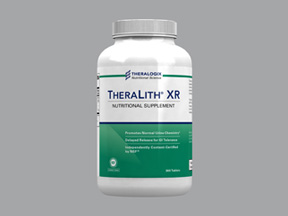 THERALITH XR TABLET
The following indications for THERALITH XR (pyridoxine hcl/magnesium citrate/mag oxide/potassium citrate) have been approved by the FDA:
Indications:
None.
Professional Synonyms:
None.
Indications:
None.
Professional Synonyms:
None.
The following dosing information is available for THERALITH XR (pyridoxine hcl/magnesium citrate/mag oxide/potassium citrate):
Dosage of potassium supplements is usually expressed as mEq of potassium and depends on the requirements of the individual patient. The normal adult daily requirement and the usual dietary intake of potassium is 40-80 mEq; infants may require 2-3 mEq/kg or 40 mEq/m2 daily. Potassium replacement requirements can be estimated only by initial clinical condition and response, ECG monitoring, and/or plasma potassium determinations.
Prophylactic administration of potassium supplements may be necessary in some patients in order to maintain plasma potassium concentration above 3.0 mEq/L. The average oral dosage of potassium supplements for the prevention of hypokalemia is about 20 mEq daily, and the usual oral dosage of potassium for the treatment of potassium depletion is 40-100 mEq or more daily.
However, it is important to remember that dosage must be individualized for each patient. Forty mEq of potassium is provided by approximately:
*3.9 g of potassium acetate
*4.0 g of potassium bicarbonate
*3.0 g of potassium chloride
*4.3 g of potassium citrate
*9.4 g of potassium gluconate
*5.4 g of monobasic potassium phosphate
*3.5 g of dibasic potassium phosphate
Oral potassium supplements are usually administered in 2-4 doses daily. To avoid serious hyperkalemia, replacement of potassium deficits must be undertaken gradually usually over a 3- to 7-day period depending on the severity of the deficit. Potassium dosage for adults should usually not exceed 150 mEq daily, and the dosage for young children should not exceed 3 mEq/kg daily.
Close monitoring of the ECG and plasma potassium concentrations is essential during IV administration of potassium.
Although pyridoxine was previously considered nontoxic even at high dosages, current evidence indicates that chronic administration of large dosages (e.g., 2 g daily) for the management of various conditions can cause severe adverse neurologic effects, and the risk to benefit of such dosages must be carefully weighed. (See Chronic Toxicity.)
Prophylactic administration of potassium supplements may be necessary in some patients in order to maintain plasma potassium concentration above 3.0 mEq/L. The average oral dosage of potassium supplements for the prevention of hypokalemia is about 20 mEq daily, and the usual oral dosage of potassium for the treatment of potassium depletion is 40-100 mEq or more daily.
However, it is important to remember that dosage must be individualized for each patient. Forty mEq of potassium is provided by approximately:
*3.9 g of potassium acetate
*4.0 g of potassium bicarbonate
*3.0 g of potassium chloride
*4.3 g of potassium citrate
*9.4 g of potassium gluconate
*5.4 g of monobasic potassium phosphate
*3.5 g of dibasic potassium phosphate
Oral potassium supplements are usually administered in 2-4 doses daily. To avoid serious hyperkalemia, replacement of potassium deficits must be undertaken gradually usually over a 3- to 7-day period depending on the severity of the deficit. Potassium dosage for adults should usually not exceed 150 mEq daily, and the dosage for young children should not exceed 3 mEq/kg daily.
Close monitoring of the ECG and plasma potassium concentrations is essential during IV administration of potassium.
Although pyridoxine was previously considered nontoxic even at high dosages, current evidence indicates that chronic administration of large dosages (e.g., 2 g daily) for the management of various conditions can cause severe adverse neurologic effects, and the risk to benefit of such dosages must be carefully weighed. (See Chronic Toxicity.)
The acetate, bicarbonate, chloride, citrate, and gluconate salts of potassium are administered orally. Potassium chloride, potassium acetate, and potassium phosphate may be administered by slow IV infusion. Rarely, potassium-containing injections are given by hypodermoclysis, in which case potassium concentrations should not exceed 10 mEq/L in order to avoid local pain.
Whenever possible, potassium supplements should be given orally since the relatively slow absorption from the GI tract prevents sudden, large increases in plasma potassium concentrations. Oral potassium supplements should preferably be administered as liquid with or after meals with a full glass of water or fruit juice to minimize the possibility of GI irritation and a saline cathartic effect. Enteric-coated (no longer commercially available in the US) and wax matrix tablets must be swallowed and not allowed to dissolve in the mouth.
Other commercially available oral dosage forms of potassium should be dissolved and/or diluted and administered according to the instructions of the manufacturer. Potassium for injection concentrates must be diluted with a compatible IV solution prior to administration. Diluted solutions of potassium acetate, potassium chloride, and potassium phosphate for injection concentrates must be administered slowly.
Potassium injections should generally be administered only in patients with adequate urine flow. In dehydrated patients, 1 liter of potassium-free fluid should be administered prior to initiating potassium therapy. Generally, potassium concentrations in IV fluids should not exceed 40 mEq/L and the rate of administration should not exceed 20 mEq/hour.
However, higher potassium concentrations (e.g., 60-80 mEq/L) administered more rapidly occasionally may be needed initially in cases of severe hypokalemia and associated cardiac arrhythmias or for the management of diabetic ketoacidosis or the diuretic phase of acute renal failure. Local vascular intolerance may limit the ability to administer such concentrated solutions. In such cases, use of a large vein with a relatively high blood flow (e.g., femoral vein) or splitting and administering the dose in less concentrated solutions via 2 veins simultaneously can be considered.
Administration of such concentrated potassium solutions via a subclavian, jugular, or right atrial catheter should be avoided since local potassium concentrations achieved in the heart may be high and potentially cardiotoxic. The ECG should be monitored closely when the rate of IV potassium administration exceeds 20 mEq/hour. Peaking of the T wave or other ECG changes associated with hyperkalemia (see Cautions: Hyperkalemia) indicate that the rate of potassium infusion is excessive and should be reduced.
Viaflex(R) Plus containers of potassium chloride injections should be checked for minute leaks by firmly squeezing the bag. The injection should be discarded if the container seal is not intact or leaks are found or if the solution is cloudy or contains a precipitate. The injection in plastic containers should not be used in series connections with other plastic containers, since such use could result in air embolism from residual air being drawn from the primary container before administration of fluid from the secondary container is complete.
Oral administration of potassium supplements or ingestion of potassium-rich foods should replace IV potassium therapy as soon as possible. Pyridoxine hydrochloride is usually administered orally; however, the drug may be given by IM, IV, or subcutaneous injection when oral administration is not feasible. In infants with seizures, pyridoxine hydrochloride should be administered by IM or IV injection.
Whenever possible, potassium supplements should be given orally since the relatively slow absorption from the GI tract prevents sudden, large increases in plasma potassium concentrations. Oral potassium supplements should preferably be administered as liquid with or after meals with a full glass of water or fruit juice to minimize the possibility of GI irritation and a saline cathartic effect. Enteric-coated (no longer commercially available in the US) and wax matrix tablets must be swallowed and not allowed to dissolve in the mouth.
Other commercially available oral dosage forms of potassium should be dissolved and/or diluted and administered according to the instructions of the manufacturer. Potassium for injection concentrates must be diluted with a compatible IV solution prior to administration. Diluted solutions of potassium acetate, potassium chloride, and potassium phosphate for injection concentrates must be administered slowly.
Potassium injections should generally be administered only in patients with adequate urine flow. In dehydrated patients, 1 liter of potassium-free fluid should be administered prior to initiating potassium therapy. Generally, potassium concentrations in IV fluids should not exceed 40 mEq/L and the rate of administration should not exceed 20 mEq/hour.
However, higher potassium concentrations (e.g., 60-80 mEq/L) administered more rapidly occasionally may be needed initially in cases of severe hypokalemia and associated cardiac arrhythmias or for the management of diabetic ketoacidosis or the diuretic phase of acute renal failure. Local vascular intolerance may limit the ability to administer such concentrated solutions. In such cases, use of a large vein with a relatively high blood flow (e.g., femoral vein) or splitting and administering the dose in less concentrated solutions via 2 veins simultaneously can be considered.
Administration of such concentrated potassium solutions via a subclavian, jugular, or right atrial catheter should be avoided since local potassium concentrations achieved in the heart may be high and potentially cardiotoxic. The ECG should be monitored closely when the rate of IV potassium administration exceeds 20 mEq/hour. Peaking of the T wave or other ECG changes associated with hyperkalemia (see Cautions: Hyperkalemia) indicate that the rate of potassium infusion is excessive and should be reduced.
Viaflex(R) Plus containers of potassium chloride injections should be checked for minute leaks by firmly squeezing the bag. The injection should be discarded if the container seal is not intact or leaks are found or if the solution is cloudy or contains a precipitate. The injection in plastic containers should not be used in series connections with other plastic containers, since such use could result in air embolism from residual air being drawn from the primary container before administration of fluid from the secondary container is complete.
Oral administration of potassium supplements or ingestion of potassium-rich foods should replace IV potassium therapy as soon as possible. Pyridoxine hydrochloride is usually administered orally; however, the drug may be given by IM, IV, or subcutaneous injection when oral administration is not feasible. In infants with seizures, pyridoxine hydrochloride should be administered by IM or IV injection.
No dosing information available.
No generic dosing information available.
The following drug interaction information is available for THERALITH XR (pyridoxine hcl/magnesium citrate/mag oxide/potassium citrate):
There are 0 contraindications.
There are 2 severe interactions.
These drug interactions can produce serious consequences in most patients. Actions required for severe interactions include, but are not limited to, discontinuing one or both agents, adjusting dosage, altering administration scheduling, and providing additional patient monitoring. Review the full interaction monograph for more information.
| Drug Interaction | Drug Names |
|---|---|
| Oral Phosphate Supplements; Urinary pH Modifiers/Aluminum; Calcium; Magnesium SEVERITY LEVEL: 2-Severe Interaction: Action is required to reduce the risk of severe adverse interaction. MECHANISM OF ACTION: Medications containing significant amounts of aluminum, calcium, or magnesium may bind to the phosphate and prevent its absorption.(1) CLINICAL EFFECTS: Concurrent use of medications containing significant amounts of aluminum, calcium, or magnesium may result in decreased effectiveness of phosphate supplements and urinary pH modifiers high in phosphate.(1) PREDISPOSING FACTORS: None determined. PATIENT MANAGEMENT: Patients receiving phosphate supplements or urinary pH modifiers high in phosphate should be instructed to avoid medications containing aluminum, calcium, or magnesium.(1) If concurrent use cannot be avoided, separate the administration of phosphate containing products by as much time as possible from medications containing aluminum, calcium, or magnesium. Some phosphate laxative products used as phosphate supplements may contain sufficient quantities of phosphate to interact as well. DISCUSSION: The manufacturer of K-Phos states that products containing aluminum, calcium, or magnesium may bind to the phosphate and prevent its absorption. Therefore, patients receiving phosphate supplements and urinary pH modifiers high in phosphate should be instructed to avoid products containing aluminum, calcium, or magnesium.(1) |
K-PHOS NO.2, K-PHOS ORIGINAL, POTASSIUM PHOSPHATE, SODIUM PHOSPHATE DIBASIC, UROQID-ACID NO.2 |
| Dextroamphetamine Transdermal/Urinary Alkalinizers SEVERITY LEVEL: 2-Severe Interaction: Action is required to reduce the risk of severe adverse interaction. MECHANISM OF ACTION: Urinary alkalinizers decrease the renal elimination of dextroamphetamine.(1) CLINICAL EFFECTS: Concurrent use of dextroamphetamine and urinary alkalinizers may result in increased dextroamphetamine levels and side effects. PREDISPOSING FACTORS: None determined. PATIENT MANAGEMENT: Coadministration of dextroamphetamine with urinary alkalinizing agents should be avoided.(1) DISCUSSION: Concurrent use of alkalinizing agents with dextroamphetamine decreases the renal elimination of dextroamphetamine. Co-administration of these should be avoided because of the potential of increased actions of dextroamphetamine.(1) |
XELSTRYM |
There are 27 moderate interactions.
The clinician should assess the patient’s characteristics and take action as needed. Actions required for moderate interactions include, but are not limited to, discontinuing one or both agents, adjusting dosage, altering administration.
| Drug Interaction | Drug Names |
|---|---|
| Sympathomimetics/Urinary Alkalinizers SEVERITY LEVEL: 3-Moderate Interaction: Assess the risk to the patient and take action as needed. MECHANISM OF ACTION: Unionized sympathomimetic amines will be reabsorbed into systemic circulation from the distal tubules of the kidneys. CLINICAL EFFECTS: Enhanced sympathomimetic activity and increased risk of sympathomimetic toxicity. PREDISPOSING FACTORS: None determined. PATIENT MANAGEMENT: Watch patient for enhanced sympathomimetic side effects when urinary alkalinizers are concomitantly used. A lower dose of certain sympathomimetics may be required. DISCUSSION: Signs and symptoms of sympathomimetic toxicity include euphoria, confusion, delirium, hallucinations and nervousness. |
AKOVAZ, ARYNTA, BENZPHETAMINE HCL, EMERPHED, EPHEDRINE HCL, EPHEDRINE SULFATE, EPHEDRINE SULFATE-0.9% NACL, EPHEDRINE SULFATE-NACL, LISDEXAMFETAMINE DIMESYLATE, MIDODRINE HCL, REZIPRES, VYVANSE |
| Tetracyclines/Divalent & Trivalent Cations SEVERITY LEVEL: 3-Moderate Interaction: Assess the risk to the patient and take action as needed. MECHANISM OF ACTION: Di- and trivalent cations may form chelation complexes with tetracyclines, preventing their absorption.(1,2) CLINICAL EFFECTS: Simultaneous administration of di- or trivalent cations may result in decreased levels of and therapeutics effects from tetracyclines. PREDISPOSING FACTORS: None determined. PATIENT MANAGEMENT: Administer tetracyclines at least two hours before or after the di- or trivalent cations. When used for the treatment of H. pylori infection, tetracyclines and bismuth should be given simultaneously. The US manufacturer of omadacycline states to fast for at least four hours, administer omadacycline, and then wait four hours before taking di- or trivalent cations.(21) The US manufacturer of ferric maltose recommends separation of ferric maltose by at least 4 hours.(22) DISCUSSION: Concurrent administration of aluminum hydroxide or divalent cations (such as calcium, magnesium, or zinc) has been shown to significantly decrease the gastrointestinal absorption of tetracycline.(3-5) Concurrent administration of tetracycline and magnesium-aluminum hydroxide gel has been shown to decrease the tetracycline area-under-curve (AUC) by 90%.(6) Magnesium-aluminum silicate has been shown to decrease the AUC of tetracycline by 27%.(7) Demeclocycline(8,9) methacycline,(10) chlortetracycline,(11) and oxytetracycline(10,12) have been shown to interact with aluminum hydroxide and/or dairy products. Doxycycline has been reported to interact with aluminum hydroxide gel.(13) Aluminum magnesium hydroxide has been shown to decrease doxycycline absorption by 84%.(14) Minocycline absorption has been shown to be impaired by aluminum, calcium, and magnesium.(15) Bismuth subsalicylate has been shown to decrease absorption of doxycycline and tetracycline by 37%(16) and 34%,(17) respectively. Since sucralfate is an aluminum salt of a sulfated disaccharide, it may also prevent absorption of tetracyclines. This complex has been used to provide site-specific delivery of tetracycline to gastric ulcers in the treatment of Helicobacter pylori gastric ulcer disease and may be useful in some indications.(18) Quinapril tablets contain a high percentage of magnesium and have been shown to decrease the absorption of tetracycline by 28-37%.(19) Lanthanum is expected to interact with tetracyclines as well.(20) |
AVIDOXY, AVIDOXY DK, BENZODOX 30, BENZODOX 60, BISMUTH-METRONIDAZOLE-TETRACYC, DEMECLOCYCLINE HCL, DORYX, DORYX MPC, DOXYCYCLINE HYCLATE, DOXYCYCLINE IR-DR, DOXYCYCLINE MONOHYDRATE, EMROSI, MINOCYCLINE ER, MINOCYCLINE HCL, MINOCYCLINE HCL ER, MONDOXYNE NL, MORGIDOX, NUZYRA, ORACEA, OXYTETRACYCLINE HCL, PYLERA, SEYSARA, TARGADOX, TETRACYCLINE HCL, XIMINO |
| Penicillamine, Oral/Polyvalent Cations SEVERITY LEVEL: 3-Moderate Interaction: Assess the risk to the patient and take action as needed. MECHANISM OF ACTION: Penicillamine chelates with polyvalent cations such as aluminum, calcium, iron, magnesium, and zinc in the GI tract reducing the absorption of the penicillamine. CLINICAL EFFECTS: Reduced (to 30% of fasting) bioavailability of penicillamine with decreased pharmacologic response. PREDISPOSING FACTORS: None determined. PATIENT MANAGEMENT: In order to assure systemic absorption and maximal effectiveness from penicillamine, counsel patient to separate penicillamine by at least 1 hour before or 1 hours after any medications or products containing polyvalent cations such as antacids or mineral supplements. Monitor clinical status for decreased effectiveness and adjust the penicillamine dose if necessary. DISCUSSION: Clinical studies with polyvalent cations have not been conducted. Multivitamins with low doses of cations including iron and zinc may decrease penicillamine absorption so insure patient is aware of the risks. |
CUPRIMINE, D-PENAMINE, DEPEN, PENICILLAMINE, PENICILLAMINE(D-) |
| Slt Cation-Donating Antacids/Polystyrene Sulfonate SEVERITY LEVEL: 3-Moderate Interaction: Assess the risk to the patient and take action as needed. MECHANISM OF ACTION: Polystyrene sulfonate may bind the cation from the antacid, resulting in increased intestinal absorption of non-neutralized bicarbonate, which may result in systemic alkalosis and decreased potassium binding by polystyrene sulfonate. Intestinal obstruction has occurred with aluminum hydroxide because of concretion. CLINICAL EFFECTS: Simultaneous oral use may result in metabolic alkalosis and a decrease in the potassium lowering effect of polystyrene sulfonate. Intestinal obstruction has been reported with aluminum hydroxide. PREDISPOSING FACTORS: Patients with renal failure may be at a higher risk of systemic alkalosis. PATIENT MANAGEMENT: Consider the use of alternative agents to cation-donating antacids in patients receiving oral polystyrene sulfonate when possible. If concurrent use is required, separate the dosing by several hours.(1) Some vitamin preparations may contain sufficient quantities of calcium and/or magnesium salts with antacid properties to interact as well. DISCUSSION: In a study in 11 patients with decreased renal function, the administration of magnesium hydroxide and sodium polystyrene sulfonate produced moderate to moderately severe metabolic alkalosis.(2) There are case reports documenting this affect as well.(3-7) Intestinal obstruction has been reported with aluminum hydroxide and sodium polystyrene sulfonate.(8) If the polystyrene sulfonate is administered rectally, a clinically significant interaction is not likely to occur. |
KIONEX, SODIUM POLYSTYRENE SULFONATE, SPS |
| Quinidine/Urinary Alkalinizers SEVERITY LEVEL: 3-Moderate Interaction: Assess the risk to the patient and take action as needed. MECHANISM OF ACTION: Quinidine elimination is impaired by urinary alkalinization. CLINICAL EFFECTS: Potentiation of quinidine effects may be observed. PREDISPOSING FACTORS: None determined. PATIENT MANAGEMENT: Monitoring quinidine levels and cardiac function may be indicated. The quinidine dose may need to be adjusted when a urinary alkalinizer is started or stopped. DISCUSSION: Additional documentation is necessary to confirm this potential interaction. |
NUEDEXTA, QUINIDINE GLUCONATE, QUINIDINE SULFATE |
| Levodopa/Pyridoxine SEVERITY LEVEL: 3-Moderate Interaction: Assess the risk to the patient and take action as needed. MECHANISM OF ACTION: Pyridoxine increases levodopa metabolism, decreasing the amount of levodopa available to the central nervous system. CLINICAL EFFECTS: The pharmacologic effects of levodopa may be decreased. PREDISPOSING FACTORS: None determined. PATIENT MANAGEMENT: Avoid pyridoxine in patients receiving levodopa alone; however, the interaction can be minimized by giving levodopa with a peripheral decarboxylase inhibitor (e.g. carbidopa, benserazide). Treatment with combination carbidopa-levodopa may contribute to reduced vitamin B6 levels. Higher doses of carbidopa-levodopa may increase the risk of vitamin B6 deficiency. Seizures associated with vitamin B6 deficiency have been reported in the postmarketing setting. In patients taking combination therapy with carbidopa/levodopa, evaluate vitamin B6 levels periodically while on treatment or if symptoms associated with vitamin B6 deficiency are identified. Supplement with vitamin B6 as necessary. DISCUSSION: In patients with Parkinson's disease, as little as 10 mg of pyridoxine may reverse the clinical benefits as well as the adverse effects of levodopa. Coadministration of levodopa with either carbidopa or benserazide has minimized the effects of this interaction. |
INBRIJA, LEVODOPA |
| Itraconazole; Ketoconazole/Agents Affecting Gastric pH SEVERITY LEVEL: 3-Moderate Interaction: Assess the risk to the patient and take action as needed. MECHANISM OF ACTION: Antacids, buffers in didanosine products, H2 antagonists, and proton-pump inhibitors increase the stomach pH. Quinapril tablets may contain a high percentage of magnesium. Since some orally administered azole antifungal agents require an acidic medium for optimal absorption, agents may decrease the absorption of azole antifungal agents. CLINICAL EFFECTS: Simultaneous administration of an antacid, buffered didanosine, a H2 antagonist, or a proton-pump inhibitor may result in decreased therapeutic effects of the azole antifungal. PREDISPOSING FACTORS: None determined. PATIENT MANAGEMENT: If the concurrent administration of these two agents cannot be avoided, consider administering two capsules of glutamic acid hydrochloride 15 minutes before administering the antifungal and separate the administration times of the antifungal and the agent affecting gastric pH by at least two hours. DISCUSSION: Itraconazole, ketoconazole, and posaconazole require an acidic medium for predictable dissolution and absorption decreases as pH increases and proton pump inhibitors are expected to decrease their absorption.(1-4) In a study in 11 healthy subjects, omeprazole (40 mg daily) decreased the maximum concentration (Cmax) and area-under-curve (AUC) of itraconazole (200 mg single dose) by 66% and 64%, respectively.(5) In a study in 15 healthy subjects, omeprazole (40 mg daily) had no effect on the pharmacokinetics of itraconazole solution.(6) In a study in 9 healthy subjects, omeprazole (60 mg) decreased the AUC of ketoconazole (200 mg single dose) by 83.4% compared to control (ketoconazole alone). Administration of Coca-Cola (240 ml) with ketoconazole and omeprazole raised ketoconazole AUC to 65% of control values.(7) Omeprazole has been shown to have no significant effect on the absorption of fluconazole(8) or voriconazole.(9) Case reports and in-vivo studies have documented significant decreases in ketoconazole levels during concurrent therapy with H-2 antagonists, including cimetidine and ranitidine. Concurrent administration of itraconazole and famotidine resulted in a significant decrease in itraconazole levels, but no significant changes in famotidine levels. An interaction should be expected to occur between both ketoconazole or itraconazole and the other H-2 antagonists.(10-14) In randomized, open-labeled, cross-over study in 12 healthy subjects, simultaneous administration of an antacid decreased the area-under-curve (AUC) and maximum concentration (Cmax) of a single dose of itraconazole (200 mg) by 66% and 70%, respectively. Time to Cmax (Tmax) increased by 70%.(15) This interaction has also been reported in a case report.(16) In a study in 3 subjects, simultaneous administration of a combination aluminum hydroxide/magnesium hydroxide (30 ml) decreased the AUC of a single dose of ketoconazole (200 mg) by 41%.(172) In a case report, a patient receiving concurrent ketoconazole with aluminum hydroxide, cimetidine, and sodium bicarbonate did not respond to therapy until cimetidine was discontinued and the administration time of aluminum hydroxide and cimetidine was changed to 2 hours after ketoconazole. In a follow-up study in 2 subjects, concurrent cimetidine and sodium hydroxide lowered ketoconazole levels.(18) In a study in 14 subjects, simultaneous administration of aluminum hydroxide/magnesium hydroxide (20 ml, 1800 mg/1200 mg) had no significant effects on fluconazole pharmacokinetics.(3) In a randomized, open-label, cross-over study in 6 subjects, simultaneous administration of itraconazole with buffered didanosine tablets resulted in undetectable levels of itraconazole.(19) In a randomized cross-over study in 12 HIV-positive subjects, administration of buffered didanosine tablets 2 hours after ketoconazole had no effects on ketoconazole levels.(20) In a randomized, cross-over, open-label study in 24 healthy subjects, simultaneous administration of enteric-coated didanosine had no effect on ketoconazole pharmacokinetics.(21) One or more of the drug pairs linked to this monograph have been included in a list of interactions that could be considered for classification as "non-interruptive" in EHR systems. This DDI subset was vetted by an expert panel commissioned by the U.S. Office of the National Coordinator (ONC) for Health Information Technology. |
ITRACONAZOLE, ITRACONAZOLE MICRONIZED, KETOCONAZOLE, SPORANOX, TOLSURA |
| Quinine/Aluminum and Magnesium Antacids; Lanthanum SEVERITY LEVEL: 3-Moderate Interaction: Assess the risk to the patient and take action as needed. MECHANISM OF ACTION: Aluminum and magnesium antacids may delay or decrease the absorption of quinine. CLINICAL EFFECTS: Concurrent use of antacids may result in decreased levels and effectiveness of quinine. PREDISPOSING FACTORS: None determined. PATIENT MANAGEMENT: The US manufacturer of quinine states that concurrent use with aluminum or magnesium containing antacids should be avoided. Some vitamin preparations may contain sufficient quantities of magnesium salts with antacid properties to interact as well. DISCUSSION: Aluminum and magnesium antacids have been shown to decrease quinine absorption in rats. |
QUALAQUIN, QUININE HCL, QUININE SULFATE |
| Mycophenolate/Aluminum & Magnesium Antacids; Lanthanum; Sevelamer SEVERITY LEVEL: 3-Moderate Interaction: Assess the risk to the patient and take action as needed. MECHANISM OF ACTION: Aluminum or magnesium antacids and non-calcium containing phosphate binders such as lanthanum and sevelamer decrease the absorption of mycophenolate.(1-3) CLINICAL EFFECTS: The simultaneous administration of mycophenolate with aluminum or magnesium antacids and non-calcium containing phosphate binders such as lanthanum and sevelamer may decrease the levels of mycophenolate and its clinical effects. PREDISPOSING FACTORS: None determined. PATIENT MANAGEMENT: The US manufacturer of mycophenolate mofetil states that calcium free phosphate binders, such as sevelamer, should not be administered simultaneously with mycophenolate mofetil. Administer sevelamer at least 2 hours after administration of mycophenolate mofetil to decrease the extent of the interaction.(1) The US manufacturer of mycophenolate sodium states that mycophenolate sodium should not be administered simultaneously with antacids. Administer aluminum or magnesium containing antacids at least 2 hours after mycophenolate.(2) Close monitoring of mycophenolic acid levels may be warranted in patients on mycophenolate mofetil therapy that are initiating or discontinuing concurrent therapy with these agents. Patients on concurrent therapies may also require higher doses of mycophenolate mofetil in order to achieve desired blood levels. DISCUSSION: In a study in 10 rheumatoid arthritis patients, the simultaneous administration of mycophenolate and Maalox TC (an antacid containing magnesium and aluminum hydroxide) resulted in decreases in the maximum concentration (Cmax) and area-under-curve (AUC) of mycophenolate by 33% and 17%, respectively.(1,2) In a study of 3 adult patients and 6 pediatric patients with stable renal graft function receiving mycophenolate mofetil, sevelamer (3-4 capsules of 403 mg twice daily) decreased the AUC and Cmax of mycophenolic acid by 26% and 36%, respectively.(1,3) In a study in 12 stable renal transplant patients, administration of magnesium-aluminum-containing antacids (30 ml) increased the Cmax and AUC of a single dose of mycophenolate sodium by 25% and 37%, respectively.(2) |
CELLCEPT, MYCOPHENOLATE MOFETIL, MYCOPHENOLIC ACID, MYFORTIC, MYHIBBIN |
| Gabapentin/Aluminum; Magnesium-Containing Compounds SEVERITY LEVEL: 3-Moderate Interaction: Assess the risk to the patient and take action as needed. MECHANISM OF ACTION: Aluminum or magnesium containing products may reduce the bioavailability of gabapentin.(1) CLINICAL EFFECTS: Simultaneous administration of aluminum or magnesium containing products and gabapentin may result in decreased absorption of gabapentin by 20% and reduce its clinical effectiveness.(1) PREDISPOSING FACTORS: None determined. PATIENT MANAGEMENT: If the use of both medications is unavoidable, it is recommended that gabapentin be taken at least 2 hours following the administration of aluminum or magnesium containing products.(1) DISCUSSION: In 16 subjects, Maalox reduced the bioavailability of gabapentin by about 20%. The reduction was only 5% when gabapentin was administered 2 hours after the Maalox dose. It is for this reason that the manufacturer of gabapentin recommends that it be taken at least 2 hours after the administration of aluminum or magnesium containing products.(1) |
GABAPENTIN, GABAPENTIN ER, GABARONE, GRALISE, HORIZANT, NEURONTIN |
| Amprenavir; Atazanavir/Antacids; Buffered Formulations SEVERITY LEVEL: 3-Moderate Interaction: Assess the risk to the patient and take action as needed. MECHANISM OF ACTION: Antacids increase gastric pH. As gastric pH increases, the solubility of atazanavir decreases.(1,2) The exact mechanism behind the interaction between amprenavir and antacids is unknown. CLINICAL EFFECTS: Simultaneous administration of amprenavir or atazanavir with antacids or buffered formulations may result in decreased levels and effectiveness of amprenavir(3) and atazanavir.(1,2) PREDISPOSING FACTORS: None determined. PATIENT MANAGEMENT: The manufacturer of amprenavir states that amprenavir should be administered 1 hour before or after antacids or buffered formulations such as didanosine.(3) The manufacturer of atazanavir states that atazanavir should be administered 2 hours before or 1 hour after antacids or buffered formulations.(1,2) Some vitamin preparations may contain sufficient quantities of calcium and/or magnesium salts with antacid properties to interact as well. DISCUSSION: Simultaneous administration of atazanavir with didanosine buffered tablets decreased atazanavir area-under-curve (AUC), maximum concentration (Cmax) and minimum concentration (Cmin) by 87%, 89% and 84%, respectively. Administration of atazanavir 1 hour after didanosine buffered tablets had no significant effect on atazanavir pharmacokinetics.(1) Other buffered formulations and antacids are expected to substantially decrease atazanavir concentrations and therapeutic effectiveness as well.(1,2) |
ATAZANAVIR SULFATE, EVOTAZ, REYATAZ |
| Selected Cephalosporins/Aluminum; Magnesium Compounds SEVERITY LEVEL: 3-Moderate Interaction: Assess the risk to the patient and take action as needed. MECHANISM OF ACTION: Aluminum and magnesium containing antacids may form chelation complexes with some cephalosporins, preventing their absorption.(1,2) CLINICAL EFFECTS: Simultaneous administration of an aluminum and/or magnesium containing antacid with some cephalosporins may result in decreased levels and effectiveness of the cephalosporin.(1,2) PREDISPOSING FACTORS: None determined. PATIENT MANAGEMENT: The manufacturer of cefdinir recommends that cefdinir be taken at least 2 hours before or after an aluminum and/or magnesium containing antacid.(1) It would be prudent to separate the administration of cefaclor by at least this amount of time as well.(2) DISCUSSION: Simultaneous administration of cefdinir (300 mg) with Maalox TC (30 ml) decreased cefdinir area-under-curve (AUC) and maximum concentration (Cmax) by 40%.(1) In a study in 15 healthy subjects, simultaneous administration of cefaclor advanced formulation (500 mg) with Maalox TC decreased the extent of cefaclor absorption.(2) |
CEFACLOR, CEFACLOR ER, CEFDINIR |
| Oral Bisphosphonates/Oral Multivalent Cations SEVERITY LEVEL: 3-Moderate Interaction: Assess the risk to the patient and take action as needed. MECHANISM OF ACTION: Multivalent cations may bind to and inhibit the absorption of oral bisphosphonates.(1-6) CLINICAL EFFECTS: Simultaneous administration of products containing multivalent cations may result in decreased levels of and clinical effects from oral bisphosphonates.(1-6) PREDISPOSING FACTORS: None determined. PATIENT MANAGEMENT: Instruct patients to separate the administration times of products containing multivalent cations and oral bisphosphonates. Manufacturer recommendations regarding the separation of administration times of oral bisphosphonates and multivalent cations vary. Do NOT give multivalent cation-containing products: - until at least 30 minutes after taking alendronate(1) - within 2 hours of etidronate(2) - until at least 1 hour after taking ibandronate(3) - until at least 30 minutes after taking risedronate(4) - within 2 hours of tiludronate(5) DISCUSSION: Multivalent cations may bind to and inhibit the absorption of oral bisphosphonates, resulting in decreased levels of and clinical effects from these agents.(1-6) Administration of aluminum- or magnesium-containing antacids 1 hour before tiludronate decreased the bioavailability of tiludronate by 60%.(5) |
ACTONEL, ALENDRONATE SODIUM, ATELVIA, BINOSTO, FOSAMAX, FOSAMAX PLUS D, IBANDRONATE SODIUM, RISEDRONATE SODIUM, RISEDRONATE SODIUM DR |
| Chloroquine; Hydroxychloroquine/Di-; Trivalent Cations SEVERITY LEVEL: 3-Moderate Interaction: Assess the risk to the patient and take action as needed. MECHANISM OF ACTION: Di- and trivalent cations such as aluminum, calcium, lanthanum, and magnesium may adsorb chloroquine and hydroxychloroquine; preventing their absorption.(1-5) The adsorption may also limit the effectiveness of the di- or trivalent cation.(1) CLINICAL EFFECTS: Simultaneous administration of di- or trivalent cations may result in decreased levels and effectiveness of chloroquine and hydroxychloroquine(2-5) and decreased effectiveness of the di- or trivalent cation.(1) PREDISPOSING FACTORS: None determined. PATIENT MANAGEMENT: Instruct patients to separate the administration times of these medicines by 2 to 4 hours.(2,3) DISCUSSION: Adsorption of chloroquine by magnesium trisilicate was found to decrease hydrochloric acid uptake and decrease the amount of magnesium released in an acidic environment.(1) In a study, calcium carbonate, kaolin, and magnesium trisilicate were found to decrease the absorption of chloroquine by 52.8%, 46.5%, and 31.3%, respectively.(3) Magnesium trisilicate and magnesium oxide have been shown to decrease the release of chloroquine from tablets and to adsorb chloroquine after its release.(4) In a study in 6 subjects, magnesium trisilicate and kaolin decreased the area-under-curve (AUC) of chloroquine by 18.2% and 28.6%, respectively.(5) |
CHLOROQUINE PHOSPHATE, HYDROXYCHLOROQUINE SULFATE, PLAQUENIL, SOVUNA |
| Oral Iron Supplements/Antacids and Selected Minerals SEVERITY LEVEL: 3-Moderate Interaction: Assess the risk to the patient and take action as needed. MECHANISM OF ACTION: Some antacids may bind to iron, preventing its absorption. Alterations in gastric pH by antacids may also play a role. Iron may bind to other minerals such as calcium, manganese, tin, and zinc in the GI tract. CLINICAL EFFECTS: Simultaneous administration of an antacid or minerals may decrease the absorption of orally administered iron. PREDISPOSING FACTORS: The interaction with some combinations may be affected by the presence or absence of food. PATIENT MANAGEMENT: Iron supplements should not be taken within 1 hour before or 2 hours after antacids, calcium, manganese, or zinc.(1) Some vitamin preparations may contain sufficient quantities of calcium and/or magnesium salts with antacid properties to interact as well. DISCUSSION: Magnesium hydroxide has been shown to inhibit the absorption of elemental iron,(2) although other studies have shown conflicting results.(3,4) Sodium bicarbonate has been shown to decrease the absorption of iron by 50%.(3) In a study in 61 healthy subjects, calcium citrate, calcium carbonate, and calcium phosphate inhibited iron absorption when taken with food. However, in the fasted state, calcium carbonate had no effect on iron absorption. In the fasted state, calcium citrate and calcium phosphate decreased iron absorption by 49% and 62%, respectively,(6) In a study in 23 healthy subjects, calcium acetate and calcium carbonate decreased the area-under-curve (AUC) of elemental iron (65 mg) by 27% and 19%, respectively.(7) In a study, manganese decreased iron absorption. A ratio of 5:1 of zinc:iron decreased iron absorption by 56%.(8) In a study, inorganic iron decreased zinc absorption.(9) In another study, ferrous sulfate decreased the absorption of zinc sulfate in a concentration dependent manner; however, heme chloride had no effect on zinc sulfate.(10) In a study in premature infants, administration of liquid zinc and iron supplements between feedings decreased iron uptake; however, no effect was seen when the supplements were mixed with feedings.(11) One or more of the drug pairs linked to this monograph have been included in a list of interactions that could be considered for classification as "non-interruptive" in EHR systems. This DDI subset was vetted by an expert panel commissioned by the U.S. Office of the National Coordinator (ONC) for Health Information Technology. |
ACCRUFER, AUROVELA 24 FE, AUROVELA FE, AURYXIA, AVERI, BALCOLTRA, BLISOVI 24 FE, BLISOVI FE, CHARLOTTE 24 FE, FEIRZA, FERRIC CITRATE, FINZALA, GALBRIELA, GEMMILY, HAILEY 24 FE, HAILEY FE, JOYEAUX, JUNEL FE, JUNEL FE 24, KAITLIB FE, LARIN 24 FE, LARIN FE, LEVONORG-ETH ESTRAD-FE BISGLYC, LO LOESTRIN FE, LOESTRIN FE, MIBELAS 24 FE, MICROGESTIN FE, MINZOYA, NORETHIN-ETH ESTRA-FERROUS FUM, NORETHINDRONE-E.ESTRADIOL-IRON, TARINA 24 FE, TARINA FE, TARINA FE 1-20 EQ, TAYTULLA, TILIA FE, TRI-LEGEST FE, VELPHORO, WYMZYA FE, XARAH FE, XELRIA FE |
| Eltrombopag/Polyvalent Cations SEVERITY LEVEL: 3-Moderate Interaction: Assess the risk to the patient and take action as needed. MECHANISM OF ACTION: Eltrombopag chelates polyvalent cations such as aluminum, calcium, iron, magnesium, selenium, and zinc.(1) CLINICAL EFFECTS: Simultaneous administration of eltrombopag and polyvalent cations may decrease the absorption and clinical effects of eltrombopag. PREDISPOSING FACTORS: None determined. PATIENT MANAGEMENT: The US manufacturer of eltrombopag states that it should be administered at least 2 hours before or 4 hours after any medications or products containing polyvalent cations such as antacids or mineral supplements.(1) DISCUSSION: In a crossover study in 25 healthy subjects, administration of eltrombopag with an antacid (1524 mg aluminum hydroxide/1425 mg magnesium carbonate/sodium alginate) decreased eltrombopag levels by 70%.(1,2) |
ALVAIZ, ELTROMBOPAG OLAMINE, PROMACTA |
| Selected Oral Quinolones/Selected Oral Cations SEVERITY LEVEL: 3-Moderate Interaction: Assess the risk to the patient and take action as needed. MECHANISM OF ACTION: Aluminum, calcium, iron, lanthanum, magnesium, and zinc may form chelation compounds with the quinolones.(1-40) CLINICAL EFFECTS: Simultaneous administration or administration of products containing aluminum, calcium, iron, lanthanum, magnesium, and/or zinc close to the administration time of an oral quinolone may result in decreased absorption and clinical effectiveness of the quinolone. PREDISPOSING FACTORS: None determined. PATIENT MANAGEMENT: If possible, avoid concurrent therapy with quinolones and cation-containing products. If it is necessary to administer these agents concurrently, follow the manufacturers' recommendations regarding timing of administration of the quinolone and cation-containing products. Manufacturer recommendations regarding the separation of administration times of quinolones and products containing aluminum, calcium, iron, lanthanum, magnesium, and/or zinc vary: ---Do not give ciprofloxacin for at least 2 hours before or 6 hours after oral cations.(1) ---Do not give delafloxacin for at least 2 hours before or 6 hours after oral cations.(2) ---Do not give enoxacin for at least 2 hours before or 8 hours after oral cations.(3) ---Do not give levofloxacin for at least 2 hours before or 2 hours after oral cations.(4) ---Do not give nalidixic acid for at least 2 hours before or 2 hours after oral cations.(5) ---Do not give norfloxacin for at least 2 hours before or 2 hours after oral cations.(6) ---Do not give ofloxacin for at least 2 hours before or 2 hours after oral cations.(7) ---Do not give sparfloxacin for at least 4 hours before oral cations.(8) ---Do not give sitafloxacin for at least 2 hours before or 2 hours after oral cations.(9) The US manufacturer of lanthanum recommends that quinolones be taken at least 1 hour before or 4 hours after lanthanum;(10) however, it would be prudent to follow the specific quinolone manufacturers' recommendations regarding concurrent administration of cations. The US manufacturer of ferric maltose recommends separation of ferric maltose by at least 4 hours. For quinolones not listed above, separate their administration from oral cations by as much time as feasible. DISCUSSION: Aluminum, calcium, iron, magnesium, and zinc products have been shown to form chelation compounds with quinolone antibiotics, resulting in decreased absorption of the quinolone.(1-40) Treatment failures have been reported.(11-12) In a study in 12 healthy subjects, simultaneous administration of didanosine chewable tablets, which contain aluminum and magnesium, decreased ciprofloxacin area-under-curve (AUC) and maximum concentration (Cmax) by 92% and 98%, respectively.(14) The administration of ciprofloxacin 2 hours prior to Videx chewable/dispersible tablets decreased ciprofloxacin concentrations by 26%.(15,16) In a study in healthy subjects, pretreatment with an antacid containing aluminum-magnesium hydroxide at 5-10 minutes, 2 hours, and 4 hours before a single dose of ciprofloxacin decreased ciprofloxacin AUC by 84.9%, 76.8%, and 30%, respectively. There was no effect when the antacid was administered 6 hours before or 2 hours after.(17) In a study in 12 healthy subjects, aluminum hydroxide decreased ciprofloxacin AUC by 85%.(18) In a study in patients on continuous ambulatory peritoneal dialysis, peak levels of ciprofloxacin were decreased by 67% to 92% in patients receiving aluminum-containing antacids.(19) In a study in 15 healthy subjects, simultaneous administration of calcium acetate decreased the bioavailability of ciprofloxacin by 51%.(20) In a study in 6 healthy males, simultaneous administration of calcium carbonate decreased ciprofloxacin Cmax and AUC by 40% and 43%, respectively.(21) In a study in 12 healthy subjects, calcium carbonate decreased ciprofloxacin AUC by 40%.(18) In a study in 13 healthy males, calcium carbonate had no effect on ciprofloxacin bioavailability when administered 2 hours prior to the antibiotic.(22,23) In a study in healthy males, simultaneous administration of calcium polycarbophil decreased ciprofloxacin AUC by 50%.(24) In a study in 8 healthy males, simultaneous administration of ferrous fumarate (200 mg) decreased ciprofloxacin AUC by 70%.(25) In a study in healthy subjects, ferrous gluconate decreased ciprofloxacin bioavailability by 50%; however, no significant effects were seen with iron-ovotransferrin.(26) In a study in 8 healthy subjects, ferrous sulfate decreased the Cmax and AUC of simultaneously administered ciprofloxacin by 54% and 57%, respectively.(27) In a study in 8 healthy subjects, administration of ferrous sulfate decreased the Cmax and AUC of ciprofloxacin by 33% and 46%, respectively. Administration of ferrous gluconate decreased the Cmax and AUC of ciprofloxacin by 57% and 67%, respectively. Administration of a multivitamin product containing calcium, copper, iron, magnesium, manganese, and zinc decreased the Cmax and AUC of ciprofloxacin by 53% and 56%, respectively.(28) In a study in 12 healthy males, ferrous sulfate decreased ciprofloxacin AUC by 63%.(29) In a study in 12 healthy subjects, lanthanum carbonate decreased the area-under-curve (AUC) and maximum concentration (Cmax) of concurrently administered ciprofloxacin by 54% and 56%, respectively.(30) In a study in 12 healthy males, a multivitamin containing zinc decreased ciprofloxacin AUC by 22%.(29) In a study in 12 healthy subjects, an antacid containing aluminum-magnesium hydroxide had no effect on the pharmacokinetics of intravenous enoxacin.(31) In a study in 10 healthy subjects, administration of an aluminum-magnesium hydroxide antacid 0.5 hours or 2 hours before oral enoxacin (400 mg single dose) decreased the AUC of enoxacin by 73% and 43%, respectively. There were no significant effects on enoxacin AUC when the antacid was administered 8 hours before or 2 hours after enoxacin.(32) In a study in 9 healthy subjects, colloidal aluminum phosphate had no effect on the amount of enoxacin absorbed; however, ferrous sulfate (1050 mg) decreased the amount of enoxacin absorption by 10%.(33) In a study in 5 healthy subjects and 5 patients with cystic fibrosis, separation of levofloxacin (750 mg) and calcium carbonate (500 mg 3 times daily with meals) by 2 hours resulted in no interaction in healthy subjects; however, levofloxacin levels were not bioequivalent in patients with cystic fibrosis.(34) Concurrent magnesium-aluminum hydroxide or calcium have been shown to decrease the bioavailability of norfloxacin by 91.0% and 63.5%, respectively.(35) Concurrent zinc has been shown to decrease the bioavailability of norfloxacin.(36) In a study in 8 healthy subjects, ferrous sulfate decreased the Cmax and AUC of simultaneously administered norfloxacin by 75% and 73%, respectively.(27) Simultaneous aluminum phosphate was found to decrease the rate, but not the extent, of absorption of ofloxacin.(37) In a study in 8 healthy subjects, ferrous sulfate decreased the Cmax and AUC of simultaneously administered norfloxacin by 36% and 25%, respectively.(27) In an in vitro study, ferrous sulfate, aluminum hydroxide, and calcium carbonate decreased ofloxacin availability by 32.6%, 30.7%, and 26.2%, respectively. However, in vivo tests showed a significant effect with only aluminum hydroxide.(38) In a study in 9 healthy subjects, simultaneous administration colloidal aluminum phosphate had no effect on ofloxacin (200 mg) absorption; however, ferrous sulfate (1050 mg) decreased the ofloxacin fraction of dose absorbed by 10.85%.(33) In a study in 16 subjects, administration of either aluminum-magnesium hydroxide or calcium carbonate at least 2 hours before or after ofloxacin administration had no significant effects on ofloxacin levels.(39) The administration of an antacid containing aluminum hydroxide and magnesium hydroxide 2 hours before, 2 hours after, and 4 hours after sparfloxacin decreased sparfloxacin levels by 23%, 17%, and 5%, respectively.(40) One or more of the drug pairs linked to this monograph have been included in a list of interactions that could be considered for classification as "non-interruptive" in EHR systems. This DDI subset was vetted by an expert panel commissioned by the U.S. Office of the National Coordinator (ONC) for Health Information Technology. |
BAXDELA, CIPRO, CIPROFLOXACIN, CIPROFLOXACIN HCL, LEVOFLOXACIN, LEVOFLOXACIN HEMIHYDRATE, NALIDIXIC ACID, OFLOXACIN |
| Selected Oral Quinolones/Selected Oral Cations SEVERITY LEVEL: 3-Moderate Interaction: Assess the risk to the patient and take action as needed. MECHANISM OF ACTION: Aluminum, iron, lanthanum, magnesium, and zinc may form chelation compounds with the quinolones.(1-23) CLINICAL EFFECTS: Simultaneous administration or administration of products containing aluminum, iron, lanthanum, magnesium, and/or zinc close to the administration time of an oral quinolone may result in decreased absorption and clinical effectiveness of the quinolone PREDISPOSING FACTORS: None determined. PATIENT MANAGEMENT: If possible, avoid concurrent therapy with quinolones and cation-containing products. If it is necessary to administer these agents concurrently, follow the manufacturers' recommendations regarding timing of administration of the quinolone and cation-containing products. Manufacturer recommendations regarding the separation of administration times of quinolones and products containing aluminum, iron, lanthanum, magnesium, and/or zinc vary: ---Do not give gatifloxacin for at least 4 hours before oral cations(1) ---Do not give gemifloxacin for at least 2 hours before or 3 hours after oral cations.(2) ---Do not give lomefloxacin for at least 2 hours before or 4 hours after oral cations.(3) ---Do not give moxifloxacin for at least 4 hours before or 8 hours after oral cations.(4) ---Do not give trovafloxacin for at least 2 hours before or after oral cations.(5) ---Do not give prulifloxacin for at least 2 hours before or 4 hours after oral cations.(23) The US manufacturer of lanthanum recommends that quinolones be taken at least 1 hour before or 4 hours after lanthanum;(6) however, it would be prudent to follow the specific quinolone manufacturers' recommendations regarding concurrent administration of cations. The US manufacturer of ferric maltose recommends separation of ferric maltose by at least 4 hours. For quinolones not listed above, separate their administration from oral cations by as much time as feasible. DISCUSSION: Magnesium and aluminum compounds have been shown to form chelation compounds with quinolone antibiotics, resulting in decreased absorption of the quinolone.(1-22) Treatment failures during concurrent use of cations and gatifloxacin(7) and pefloxacin(8) have been reported. In a study in 24 healthy subjects, administration of an aluminum-magnesium hydroxide antacid simultaneously, 2 hours before, or 2 hours after decreased the area-under-curve (AUC) of a single dose of gatifloxacin (400 mg) by 42%, 64%, or 18%, respectively. There were no affects on gatifloxacin AUC when the antacid was administered 4 hours after gatifloxacin.(9) In a study in 16 healthy males, administration of an aluminum-magnesium hydroxide antacid 10 minutes before or 3 hours after a single dose of gemifloxacin (320 mg) decreased the gemifloxacin AUC by 85% and 15%, respectively. There was no affect when the antacid was administered 2 hours after gemifloxacin.(10) In a study in 16 subjects, simultaneous administration of calcium carbonate decreased the maximum concentration (Cmax) and AUC of a single dose of gemifloxacin (320 mg) by 17% and 21%, respectively. There was no effect of calcium carbonate when administered either 2 hours before or after gemifloxacin.(11) In a study in 27 healthy males, the administration of ferrous sulfate (325 mg) 3 hours before a single dose of gemifloxacin (320 mg) decreased the Cmax and AUC of gemifloxacin by 20% and 11%, respectively. There were no effects when ferrous sulfate was administered 2 hours after gemifloxacin.(12) In a study in 8 healthy subjects, ferrous sulfate (100 mg elemental iron) decreased the Cmax and AUC of a single dose of lomefloxacin by 26% and 13%, respectively. There were no effects with concurrent calcium carbonate (500 mg calcium).(13) Magnesium- and aluminum-containing antacids have been shown to decrease the bioavailability of lomefloxacin by 40%.(14) Administration of moxifloxacin 2 hours before, simultaneously, or 4 hours after a magnesium- and aluminum-containing antacid decreased moxifloxacin AUC by 26%, 60%, and 23%, respectively.(15) Simultaneous administration of moxifloxacin and ferrous sulfate (100 mg) decreased the area-under-curve (AUC) and maximum concentration (Cmax) of moxifloxacin by 39% and 59%, respectively.(16) Concurrent administration of calcium had no affect on moxifloxacin pharmacokinetics.(17) In a study in 10 healthy subjects, an aluminum-magnesium hydroxide antacid decreased the bioavailability of pefloxacin (400 mg) by 44.4%.(18) The administration of an antacid containing aluminum hydroxide and magnesium hydroxide 5 minutes before rufloxacin decreased rufloxacin levels by 36%. Administration of the antacid 4 hours after rufloxacin decreased rufloxacin levels by 13%.(19) Magnesium- and aluminum-containing antacids have been shown to decrease the bioavailability of temafloxacin by 40%.(20) Aluminum hydroxide has been shown to decrease the bioavailability of tosufloxacin by 31.6%.(21) Administration of an antacid containing aluminum hydroxide and magnesium hydroxide 30 minutes before trovafloxacin decreased trovafloxacin levels by 66%.(22) One or more of the drug pairs linked to this monograph have been included in a list of interactions that could be considered for classification as "non-interruptive" in EHR systems. This DDI subset was vetted by an expert panel commissioned by the U.S. Office of the National Coordinator (ONC) for Health Information Technology. |
GATIFLOXACIN SESQUIHYDRATE, MOXIFLOXACIN HCL |
| Elvitegravir/Selected Oral Cations SEVERITY LEVEL: 3-Moderate Interaction: Assess the risk to the patient and take action as needed. MECHANISM OF ACTION: The exact mechanism is unknown, but aluminum, calcium, iron, magnesium, sucralfate, and zinc may bind to elvitegravir in GI tract. CLINICAL EFFECTS: Simultaneous administration or administration of products containing aluminum, calcium, iron, magnesium, and/or sucralfate may result in decreased levels and effectiveness of elvitegravir, as well as the development of resistance.(1) PREDISPOSING FACTORS: None determined. PATIENT MANAGEMENT: Separate the administration of elvitegravir and products containing aluminum, calcium, iron, magnesium, and/or sucralfate by at least 2 hours.(1) Some vitamin preparations may contain sufficient quantities of calcium and/or magnesium salts with antacid properties to interact as well. DISCUSSION: Administration of an antacid (exact formulation not stated) 2 hours before elvitegravir (50 mg) decreased the maximum concentration (Cmax), area-under-curve (AUC), or minimum concentration (Cmin) of elvitegravir by 18%, 15%, and 10%, respectively.(1) Administration of an antacid 2 hours after elvitegravir (50 mg) decreased the Cmax, AUC, or Cmin of elvitegravir by 21%, 20%, and 20%, respectively.(1) Administration of an antacid 4 hours before elvitegravir (50 mg) decreased the Cmax and AUC of elvitegravir by 5%, and 4%, respectively.(1) Administration of an antacid 4 hours before elvitegravir (50 mg) decreased both the Cmax and AUC of elvitegravir by 2%.(1) |
GENVOYA, STRIBILD |
| Dolutegravir/Selected Oral Cations SEVERITY LEVEL: 3-Moderate Interaction: Assess the risk to the patient and take action as needed. MECHANISM OF ACTION: Aluminum, calcium, iron, lanthanum, magnesium, sucralfate, and zinc may form chelation compounds with dolutegravir.(1) CLINICAL EFFECTS: Simultaneous administration or administration of products containing aluminum, calcium, iron, lanthanum, magnesium, and/or sucralfate close to the administration time of dolutegravir may result in decreased absorption and clinical effectiveness of dolutegravir.(1) PREDISPOSING FACTORS: None determined. PATIENT MANAGEMENT: If possible, avoid concurrent therapy with dolutegravir and cation-containing products. If it is necessary to use these agents concurrently, dolutegravir should be administered 2 hours before or 6 hours after taking these medications.(1) Alternatively, dolutegravir and supplements containing calcium or iron can be taken together with food.(1) DISCUSSION: In a study in 16 subjects, the administration of an antacid (Maalox - aluminum and magnesium hydroxide) simultaneously with dolutegravir (50 mg single dose) decreased the maximum concentration (Cmax), area-under-curve (AUC), and minimum concentration (Cmin) of dolutegravir by 72%, 74%, and 74%, respectively.(1) In a study in 16 subjects, the administration of an antacid (Maalox - aluminum and magnesium hydroxide) 2 hours after dolutegravir (50 mg single dose) decreased dolutegravir Cmax, AUC, and Cmin by 18%, 26%, and 30%, respectively.(1) In a study in 16 subjects, the administration of a multiple vitamin (One-A-Day) simultaneously with dolutegravir (50 mg single dose) decreased dolutegravir Cmax, AUC, and Cmin by 35%, 33%, and 32%, respectively.(1) |
DOVATO, TIVICAY, TIVICAY PD, TRIUMEQ, TRIUMEQ PD |
| Dolutegravir-Rilpivirine/Selected Oral Cations; Antacids; H2 Antagonists SEVERITY LEVEL: 3-Moderate Interaction: Assess the risk to the patient and take action as needed. MECHANISM OF ACTION: Aluminum, calcium, iron, lanthanum, magnesium, sucralfate, and zinc may form chelation compounds with dolutegravir.(1) Rilpivirine requires an acidic medium for absorption. Antacid or H2 antagonist induced decrease in gastric pH may result in decrease in rilpivirine absorption.(1) CLINICAL EFFECTS: Simultaneous administration or administration of products containing aluminum, calcium, iron, lanthanum, magnesium, and/or sucralfate close to the administration time of dolutegravir may result in decreased absorption and clinical effectiveness of dolutegravir.(1) Simultaneous administration of an antacid or a H2 antagonist may result in decreased levels and effectiveness of rilpivirine, as well as the development of resistance.(1) PREDISPOSING FACTORS: None determined. PATIENT MANAGEMENT: If possible, avoid concurrent therapy with dolutegravir-rilpivirine and cation-containing products. If it is necessary to use these agents concurrently, dolutegravir-rilpivirine should be administered 4 hours before or 6 hours after taking these medications.(1) Alternatively, dolutegravir-rilpivirine and supplements containing calcium or iron can be taken together with food.(1) In patients maintained on dolutegravir-rilpivirine, administer dolutegravir-rilpivirine at least 4 hours before or 6 hours after antacids .(1) In patients maintained on dolutegravir-rilpivirine, administer dolutegravir-rilpivirine at least 4 hours before or 12 hours after H2 antagonists.(1) Concurrent use of proton pump inhibitors will dolutegravir-rilpivirine is contraindicated.(1) DISCUSSION: In a study in 16 subjects, the administration of an antacid (Maalox - aluminum and magnesium hydroxide) simultaneously with dolutegravir (50 mg single dose) decreased the maximum concentration (Cmax), area-under-curve (AUC), and minimum concentration (Cmin) of dolutegravir by 72%, 74%, and 74%, respectively.(1) In a study in 16 subjects, the administration of an antacid (Maalox - aluminum and magnesium hydroxide) 2 hours after dolutegravir (50 mg single dose) decreased dolutegravir Cmax, AUC, and Cmin by 18%, 26%, and 30%, respectively.(1) In a study in 16 subjects, the administration of a multiple vitamin (One-A-Day) simultaneously with dolutegravir (50 mg single dose) decreased dolutegravir Cmax, AUC, and Cmin by 35%, 33%, and 32%, respectively.(1) In a study in 16 subjects, omeprazole (20 mg daily) decreased the Cmax, AUC, and Cmin of rilpivirine (150 mg daily) by 40%, 40%, and 33%, respectively. The Cmax and AUC of omeprazole decreased by 14% and 14%, respectively.(1) In a study in 24 subjects, famotidine (40 mg single dose) administered 12 hours before a single dose of rilpivirine (150 mg) had no significant effect on rilpivirine Cmax or AUC.(1) In a study in 23 subjects, famotidine (40 mg single dose) administered 2 hours before a single dose of rilpivirine (150 mg) decreased the rilpivirine Cmax and AUC by 85% and 76%, respectively.(1) In a study in 24 subjects, famotidine (40 mg single dose) administered 4 hours before a single dose of rilpivirine (150 mg) increased the rilpivirine Cmax and AUC by 21% and 13%, respectively.(1) |
JULUCA |
| Bictegravir/Polyvalent Cations; Sucralfate SEVERITY LEVEL: 3-Moderate Interaction: Assess the risk to the patient and take action as needed. MECHANISM OF ACTION: Polyvalent cations and sucralfate may bind to bictegravir in the GI tract, preventing its absorption.(1) CLINICAL EFFECTS: Polyvalent cations and sucralfate may reduce levels and clinical effectiveness of bictegravir.(1) PREDISPOSING FACTORS: None determined. PATIENT MANAGEMENT: Bictegravir must be taken 2 hours before or 6 hours after polyvalent cations or sucralfate. Medicines containing calcium can be taken together with bictegravir if taken with food.(1) Some vitamin preparations may contain sufficient quantities of polyvalent cations to interact as well. DISCUSSION: Simultaneous administration of aluminum and magnesium hydroxide (20 ml) in a fasted state with bictegravir (50 mg single dose) decreased bictegravir maximum concentration (Cmax) and area-under-curve (AUC) by 80% and 79%, respectively.(1) Administration of aluminum and magnesium hydroxide (20 ml) 2 hours after bictegravir (50 mg single dose) in a fasted state decreased bictegravir Cmax and AUC by 7% and 13%, respectively.(1) Administration of aluminum and magnesium hydroxide (20 ml) 2 hours before bictegravir (50 mg single dose) in a fasted state decreased bictegravir Cmax and AUC by 58% and 52%, respectively.(1) Simultaneous administration of aluminum and magnesium hydroxide (20 ml) in a fed state with bictegravir (50 mg single dose) decreased bictegravir Cmax and AUC by 49% and 47%, respectively.(1) Simultaneous administration of calcium carbonate (1200 mg single dose) in a fasted state with bictegravir (50 mg single dose) decreased bictegravir Cmax and AUC by 42% and 33%, respectively.(1) Simultaneous administration of calcium carbonate (1200 mg single dose) in a fed state with bictegravir (50 mg single dose) decreased bictegravir Cmax by 10% and increased AUC 3%, respectively.(1) Simultaneous administration of ferrous fumarate (324 mg single dose) in a fasted state with bictegravir (50 mg single dose) decreased bictegravir Cmax and AUC by 71% and 63%, respectively.(1) Simultaneous administration of ferrous fumarate (324 mg single dose) in a fed state with bictegravir (50 mg single dose) decreased bictegravir Cmax and AUC by 25% and 16%, respectively.(1) |
BIKTARVY |
| Baloxavir/Polyvalent Cations SEVERITY LEVEL: 3-Moderate Interaction: Assess the risk to the patient and take action as needed. MECHANISM OF ACTION: Aluminum, calcium, iron, magnesium, selenium, and zinc may form chelation compounds with baloxavir.(1) CLINICAL EFFECTS: Simultaneous administration of products containing aluminum, calcium, iron, magnesium, selenium, and zinc may result in decreased levels of and clinical effects from baloxavir.(1) PREDISPOSING FACTORS: None determined. PATIENT MANAGEMENT: Avoid concurrent administration of baloxavir with cation-containing products.(1) DISCUSSION: A significant decrease in baloxavir exposure was observed when baloxavir was coadministered with calcium, aluminum, magnesium, or iron in monkeys. No studies have been conducted in humans.(1) |
XOFLUZA |
| Cabotegravir/Polyvalent Cations SEVERITY LEVEL: 3-Moderate Interaction: Assess the risk to the patient and take action as needed. MECHANISM OF ACTION: Cabotegravir chelates polyvalent cations such as aluminum, calcium, iron, magnesium, selenium, and zinc.(1) CLINICAL EFFECTS: Simultaneous administration of cabotegravir and polyvalent cations may decrease the absorption and clinical effects of cabotegravir.(1) PREDISPOSING FACTORS: None determined. PATIENT MANAGEMENT: The US manufacturer of cabotegravir states that it should be administered at least 2 hours before or 4 hours after any medications or products containing polyvalent cations such as antacids or mineral supplements.(1) DISCUSSION: Clinical studies have not been conducted. Prescribing information states cabotegravir levels may be decreased when coadministered with antacids containing polyvalent cations (examples include aluminum or magnesium hydroxide, calcium carbonate) suggesting cabotegravir is susceptible to chelation.(1) |
VOCABRIA |
| Amphetamines/Antacids; Urinary Alkalinizers SEVERITY LEVEL: 3-Moderate Interaction: Assess the risk to the patient and take action as needed. MECHANISM OF ACTION: Antacids and urinary alkalinizers increase the absorption of amphetamines. CLINICAL EFFECTS: Concurrent use of amphetamines and antacids or urinary alkalinizers may result in increased amphetamine levels and side effects. PREDISPOSING FACTORS: None determined. PATIENT MANAGEMENT: The US and Canadian manufacturers state that coadministration of alkalinizing agents with amphetamines should be avoided.(1-3) The Canadian manufacturer states that concurrent use of proton pump inhibitors and amphetamines should be avoided.(3) The US manufacturer states that patients receiving concurrent therapy should be monitored for changes in clinical effects.(1) Monitor patients receiving concurrent therapy for changes in amphetamine effectiveness and side effects. If concurrent use cannot be avoided, separate the administration times of amphetamines and antacids. Some vitamin preparations may contain sufficient quantities of calcium and/or magnesium salts with antacid properties to interact as well. DISCUSSION: Concurrent use of alkalinizing agents with amphetamines increase the absorption of amphetamines. Co-administration of these should be avoided because of the potential of increased actions of the amphetamines.(1,2) |
ADDERALL, ADDERALL XR, ADZENYS XR-ODT, AMPHETAMINE ER ODT, AMPHETAMINE SULFATE, DESOXYN, DEXEDRINE, DEXTROAMPHETAMINE SULFATE, DEXTROAMPHETAMINE SULFATE ER, DEXTROAMPHETAMINE-AMPHET ER, DEXTROAMPHETAMINE-AMPHETAMINE, DYANAVEL XR, EVEKEO, METHAMPHETAMINE HCL, MYDAYIS, PROCENTRA, ZENZEDI |
| Vadadustat/Polyvalent Cations and Phosphate Binders SEVERITY LEVEL: 3-Moderate Interaction: Assess the risk to the patient and take action as needed. MECHANISM OF ACTION: Vadadustat may form a chelate with iron supplements, phosphate binders, and other medicinal products whose primary component consists of polyvalent cations such as aluminum, calcium, magnesium, selenium, and zinc.(1) CLINICAL EFFECTS: Simultaneous administration of vadadustat and polyvalent cations and phosphate binders decreases the exposure and effectiveness of vadadustat.(1) PREDISPOSING FACTORS: None determined. PATIENT MANAGEMENT: The manufacturer of vadadustat states that it should be administered at least 1 hour before or 2 hours after any medications or products whose primary component consists of iron, phosphate binders and polyvalent cations.(1) DISCUSSION: Two studies evaluating the pharmacokinetics, safety, and tolerability of a single oral dose of vadadustat coadministered with a phosphate binder or iron supplement were conducted in healthy adult participants. Vadadustat exposure was reduced by coadministration with sevelamer carbonate, calcium acetate, ferric citrate, and ferrous sulfate. Geometric least squares mean ratios for area under the concentration-time curve (AUC) were reduced 37% to 55% by phosphate binders and 46% by ferrous sulfate. However, when vadadustat was administered 1 hour before phosphate binders, 90% confidence intervals for vadadustat exposure were within the no-effect boundaries of +50% to -33%, indicating that drug-drug interactions can be reduced by administering vadadustat 1 hour before phosphate binders.(2) |
VAFSEO |
| Sotalol/Aluminium And Magnesium Antacids SEVERITY LEVEL: 3-Moderate Interaction: Assess the risk to the patient and take action as needed. MECHANISM OF ACTION: Aluminum- and magnesium-containing antacids may reduce the absorption of sotalol.(1) CLINICAL EFFECTS: Simultaneous administration of sotalol with antacids containing aluminum or magnesium may result in decreased levels and effectiveness of sotalol.(1) PREDISPOSING FACTORS: None determined. PATIENT MANAGEMENT: If coadministration with an aluminum- or magnesium-containing antacid agent is unavoidable, take the antacid 2 hours before or 2 hours after sotalol.(1) DISCUSSION: In a study with 6 healthy volunteers, administration of oral sotalol simultaneously with antacids reduced the maximum concentration (Cmax) and area under the curve (AUC) of sotalol by 26% and 20%, respectively, compared to sotalol alone. There was a 25% reduction in the bradycardic effect at rest. Administration of the antacid two hours after oral sotalol had no effect on the pharmacokinetics or pharmacodynamics of sotalol.(1,2) |
BETAPACE, BETAPACE AF, SOTALOL, SOTALOL AF, SOTYLIZE |
The following contraindication information is available for THERALITH XR (pyridoxine hcl/magnesium citrate/mag oxide/potassium citrate):
Drug contraindication overview.
No enhanced Contraindications information available for this drug.
No enhanced Contraindications information available for this drug.
There are 5 contraindications.
Absolute contraindication.
| Contraindication List |
|---|
| Esophageal dysmotility |
| Esophageal obstruction |
| Gastrointestinal obstruction |
| Gastroparesis |
| Hyperkalemia |
There are 12 severe contraindications.
Adequate patient monitoring is recommended for safer drug use.
| Severe List |
|---|
| Chronic heart failure |
| Chronic kidney disease stage 3A (moderate) GFR 45-59 ml/min |
| Chronic kidney disease stage 3B (moderate) GFR 30-44 ml/min |
| Chronic kidney disease stage 4 (severe) GFR 15-29 ml/min |
| Chronic kidney disease stage 5 (failure) GFr<15 ml/min |
| Dehydration |
| Diabetic ketoacidosis |
| Diarrhea |
| Metabolic acidosis |
| Peptic ulcer |
| Primary adrenocortical insufficiency |
| Urinary tract infection |
There are 2 moderate contraindications.
Clinically significant contraindication, where the condition can be managed or treated before the drug may be given safely.
| Moderate List |
|---|
| Kidney disease with likely reduction in glomerular filtration rate (GFr) |
| Kidney disease with reduction in glomerular filtration rate (GFr) |
The following adverse reaction information is available for THERALITH XR (pyridoxine hcl/magnesium citrate/mag oxide/potassium citrate):
Adverse reaction overview.
No enhanced Common Adverse Effects information available for this drug.
No enhanced Common Adverse Effects information available for this drug.
There are 10 severe adverse reactions.
| More Frequent | Less Frequent |
|---|---|
| None. |
Hyperkalemia |
| Rare/Very Rare |
|---|
|
Bloody stools Duodenal ulcer Gastrointestinal hemorrhage Gastrointestinal irritation Gastrointestinal obstruction Gastrointestinal perforation Gastrointestinal ulcer Skin rash Sore throat |
There are 5 less severe adverse reactions.
| More Frequent | Less Frequent |
|---|---|
|
Acute abdominal pain Diarrhea Flatulence Nausea Vomiting |
None. |
| Rare/Very Rare |
|---|
| None. |
The following precautions are available for THERALITH XR (pyridoxine hcl/magnesium citrate/mag oxide/potassium citrate):
No enhanced Pediatric Use information available for this drug.
Contraindicated
Severe Precaution
Management or Monitoring Precaution
Contraindicated
| None |
Severe Precaution
| None |
Management or Monitoring Precaution
| None |
No enhanced Pregnancy information available for this drug.
No enhanced Lactation information available for this drug.
No enhanced Geriatric Use information available for this drug.
The following prioritized warning is available for THERALITH XR (pyridoxine hcl/magnesium citrate/mag oxide/potassium citrate):
No warning message for this drug.
No warning message for this drug.
The following icd codes are available for THERALITH XR (pyridoxine hcl/magnesium citrate/mag oxide/potassium citrate)'s list of indications:
No ICD codes found for this drug.
No ICD codes found for this drug.
Formulary Reference Tool