Please wait while the formulary information is being retrieved.
Drug overview for TAKHZYRO (lanadelumab-flyo):
Generic name: LANADELUMAB-FLYO (LAN-a-DEL-ue-mab)
Drug class: Plasma Kallikrein Inhibitor, Recombinant Monoclonal Antibody
Therapeutic class: Cardiovascular Therapy Agents
Lanadelumab, a recombinant fully human immunoglobulin G1 (IgG1) monoclonal antibody, is a plasma kallikrein inhibitor.
No enhanced Uses information available for this drug.
Generic name: LANADELUMAB-FLYO (LAN-a-DEL-ue-mab)
Drug class: Plasma Kallikrein Inhibitor, Recombinant Monoclonal Antibody
Therapeutic class: Cardiovascular Therapy Agents
Lanadelumab, a recombinant fully human immunoglobulin G1 (IgG1) monoclonal antibody, is a plasma kallikrein inhibitor.
No enhanced Uses information available for this drug.
DRUG IMAGES
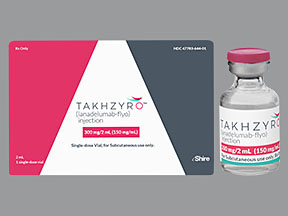 TAKHZYRO 300 MG/2 ML VIAL
The following indications for TAKHZYRO (lanadelumab-flyo) have been approved by the FDA:
Indications:
Prevention of angioedema attacks in patient with hereditary angioedema
Professional Synonyms:
Prevention of angioedema attack in hereditary angioneurotic edema
Prevention of angioedema attacks in patient with HAE
Prophylaxis against angioedema attacks in patient with HAE
Indications:
Prevention of angioedema attacks in patient with hereditary angioedema
Professional Synonyms:
Prevention of angioedema attack in hereditary angioneurotic edema
Prevention of angioedema attacks in patient with HAE
Prophylaxis against angioedema attacks in patient with HAE
The following dosing information is available for TAKHZYRO (lanadelumab-flyo):
Remove the vial from refrigeration 15 minutes before administration to allow the solution to equilibrate to room temperature. Prepare the injection using aseptic technique by withdrawing the prescribed dose from the vial using a syringe and 18-gauge needle. Prior to subcutaneous injection, change the needle to a 27-gauge, one-half inch needle or other needle suitable for subcutaneous injection.
Administer the drug within 2 hours of preparing the dosing syringe. Alternatively, the syringe may be stored at 2-8degreesC and administered within 8 hours of preparation. If the prepared dosing syringe is refrigerated, remove it from the refrigerator 15 minutes before use to allow the drug to reach room temperature.
The injection solution contains no preservatives; discard any unused portion of the drug solution remaining in the vial or syringe.
Administer the entire prescribed dose of lanadelumab by subcutaneous injection into the abdomen, thigh, or upper arm. In clinical studies, the majority of patients self-administered the drug over 10-60 seconds.
Administer the drug within 2 hours of preparing the dosing syringe. Alternatively, the syringe may be stored at 2-8degreesC and administered within 8 hours of preparation. If the prepared dosing syringe is refrigerated, remove it from the refrigerator 15 minutes before use to allow the drug to reach room temperature.
The injection solution contains no preservatives; discard any unused portion of the drug solution remaining in the vial or syringe.
Administer the entire prescribed dose of lanadelumab by subcutaneous injection into the abdomen, thigh, or upper arm. In clinical studies, the majority of patients self-administered the drug over 10-60 seconds.
Lanadelumab-flyo is administered by subcutaneous injection. The drug is intended for self-administration or administration by a healthcare provider orcaregiver after appropriate training. Adult and pediatric patients>=12 years of age may self-administer lanadelumab-flyo.
A healthcare provider or caregiver should administer lanadelumab-flyo to pediatric patients 2 to <12 years of age. Lanadelumab-flyo is commercially available as a ready-to-use solution in a single-dose vial or prefilled syringe. Additional reconstitution or dilution prior to administration is not required.
The vials and prefilled syringes should be stored at 2-8degreesC in the original carton to protect the drug from light; do not freeze or shake the vials or syringes. Prior to administration, inspect the solution for particulate matter or discoloration. The solution should be clear to slightly opalescent and colorless to slightly yellow; discard the drug if the solution is discolored or contains particulates. Avoid vigorous agitation of the vials and syringes.
A healthcare provider or caregiver should administer lanadelumab-flyo to pediatric patients 2 to <12 years of age. Lanadelumab-flyo is commercially available as a ready-to-use solution in a single-dose vial or prefilled syringe. Additional reconstitution or dilution prior to administration is not required.
The vials and prefilled syringes should be stored at 2-8degreesC in the original carton to protect the drug from light; do not freeze or shake the vials or syringes. Prior to administration, inspect the solution for particulate matter or discoloration. The solution should be clear to slightly opalescent and colorless to slightly yellow; discard the drug if the solution is discolored or contains particulates. Avoid vigorous agitation of the vials and syringes.
| DRUG LABEL | DOSING TYPE | DOSING INSTRUCTIONS |
|---|---|---|
| TAKHZYRO 300 MG/2 ML SYRINGE | Maintenance | Adults inject 300 mg by subcutaneous route every 4 weeks in the abdomen, thigh, or outer area of upper arm (rotate sites) |
No generic dosing information available.
The following drug interaction information is available for TAKHZYRO (lanadelumab-flyo):
There are 0 contraindications.
There are 2 severe interactions.
These drug interactions can produce serious consequences in most patients. Actions required for severe interactions include, but are not limited to, discontinuing one or both agents, adjusting dosage, altering administration scheduling, and providing additional patient monitoring. Review the full interaction monograph for more information.
| Drug Interaction | Drug Names |
|---|---|
| IgG Antibodies and Derivatives/Efgartigimod-alfa SEVERITY LEVEL: 2-Severe Interaction: Action is required to reduce the risk of severe adverse interaction. MECHANISM OF ACTION: The neonatal Fc receptor (FcRn) prevents catabolism and mediates recycling of IgG and albumin, which leads to their long persistence in the body.(1,2) Efgartigimod-alfa binds to FcRn and may decrease systemic exposure of other ligands of FcRn, like immunoglobulins and IgG-based antibodies.(3) CLINICAL EFFECTS: The effectiveness of medicines that bind to FcRn may be decreased.(3) PREDISPOSING FACTORS: None determined. PATIENT MANAGEMENT: The manufacturer of efgartigimod-alfa states that efgartigimod-alfa should not be combined with long-term use of FcRn-binding medications. If the medication is essential for the patient, efgartigimod-alfa should be discontinued.(3) DISCUSSION: Clinical drug interaction studies with efgartigimod-alfa have not been performed. Efgartigimod-alfa may decrease concentrations of compounds that bind to the human FcRn.(3) |
VYVGART, VYVGART HYTRULO |
| IgG Antibodies and Derivatives/Nipocalimab-aahu SEVERITY LEVEL: 2-Severe Interaction: Action is required to reduce the risk of severe adverse interaction. MECHANISM OF ACTION: The neonatal Fc receptor (FcRn) prevents catabolism and mediates recycling of IgG and albumin, which leads to their long persistence in the body.(1,2) Nipocalimab-aahu binds to FcRn and may decrease systemic exposure of other ligands of FcRn, like immunoglobulins and IgG-based antibodies.(3) CLINICAL EFFECTS: The effectiveness of medicines that bind to FcRn may be decreased.(3) PREDISPOSING FACTORS: None determined. PATIENT MANAGEMENT: The manufacturer of nipocalimab-aahu states that nipocalimab-aahu should not be combined with long-term use of FcRn-binding medications. If the medication is essential for the patient, nipocalimab-aahu should be discontinued.(3) DISCUSSION: Clinical drug interaction studies with nipocalimab-aahu have not been performed. Nipocalimab-aahu may decrease concentrations of compounds that bind to the human FcRn.(3) |
IMAAVY |
There are 1 moderate interactions.
The clinician should assess the patient’s characteristics and take action as needed. Actions required for moderate interactions include, but are not limited to, discontinuing one or both agents, adjusting dosage, altering administration.
| Drug Interaction | Drug Names |
|---|---|
| IgG Antibodies and Derivatives/Rozanolixizumab-noli SEVERITY LEVEL: 3-Moderate Interaction: Assess the risk to the patient and take action as needed. MECHANISM OF ACTION: The neonatal Fc receptor (FcRn) prevents catabolism and mediates recycling of IgG and albumin, which leads to their long persistence in the body.(1,2) Rozanolixizumab-noli binds to FcRn and may decrease systemic exposure of other ligands of FcRn, like immunoglobulins and IgG-based antibodies.(3) CLINICAL EFFECTS: The effectiveness of medications that bind to FcRn may be decreased.(3) PREDISPOSING FACTORS: None determined. PATIENT MANAGEMENT: The manufacturer of rozanolixizumab-noli states that concurrent use with medications that bind to the human neonatal Fc receptor (FcRn) should be closely monitored for reduced effectiveness of these medications. If long-term use of such medications is essential for the patient, consider discontinuing rozanolixizumab-noli and use alternative therapies.(3) DISCUSSION: Clinical drug interaction studies with rozanolixizumab-noli have not been performed. Rozanolixizumab-noli may decrease concentrations of compounds that bind to the human FcRn.(3) |
RYSTIGGO |
The following contraindication information is available for TAKHZYRO (lanadelumab-flyo):
Drug contraindication overview.
*None.
*None.
There are 0 contraindications.
There are 0 severe contraindications.
There are 1 moderate contraindications.
Clinically significant contraindication, where the condition can be managed or treated before the drug may be given safely.
| Moderate List |
|---|
| No disease contraindications |
The following adverse reaction information is available for TAKHZYRO (lanadelumab-flyo):
Adverse reaction overview.
The most common adverse effects reported in >=10% of patients receiving lanadelumab-flyo in clinical studies include injection site reactions (e.g., pain, erythema, bruising), upper respiratory tract infection, headache, rash, myalgia, dizziness, and diarrhea.
The most common adverse effects reported in >=10% of patients receiving lanadelumab-flyo in clinical studies include injection site reactions (e.g., pain, erythema, bruising), upper respiratory tract infection, headache, rash, myalgia, dizziness, and diarrhea.
There are 2 severe adverse reactions.
| More Frequent | Less Frequent |
|---|---|
| None. |
Abnormal hepatic function tests Hypersensitivity drug reaction |
| Rare/Very Rare |
|---|
| None. |
There are 6 less severe adverse reactions.
| More Frequent | Less Frequent |
|---|---|
|
Diarrhea Dizziness Headache disorder Myalgia Skin rash Upper respiratory infection |
None. |
| Rare/Very Rare |
|---|
| None. |
The following precautions are available for TAKHZYRO (lanadelumab-flyo):
Safety and efficacy of lanadelumab-flyo have not been established in pediatric patients <2 years of age. Among the 125 patients included in the initialpivotal clinical trial of lanadelumab, 10 patients were 12 to <18 years of age; subgroup analysis in such patients indicated that safety and efficacy were consistent with overall study results. An additional 13 pediatric patients aged 12 to <18 years were enrolled in the open-label extension study.
Use of landelumab-flyo in patients 2 to <12 years of age was supported by extrapolation of efficacy datafrom the initial pivotal clinical trial, withadditional pharmacokinetic analyses showing similar drug exposures between adults (>18 years of age) and pediatric patients (2to <12 years of age), and safety and pharmacodynamic data from an open-label, multicenter study in pediatric patientswith HAE aged 2 to <12 years that enrolled 21 patients. The pharmacodynamic responseobserved in this trial for pediatric patients 2 to <12 years of age was similar to that seen in adult and pediatric patients >=12years of age. An increase in lanadelumab AUC of about 37% has been reported in pediatric patients 12 to <18 years of age compared with adults; this difference is thought to be due to lower body weight and is not considered clinically important. Lanadelumab treatment is not expected to impact growth.
Contraindicated
Severe Precaution
Management or Monitoring Precaution
Use of landelumab-flyo in patients 2 to <12 years of age was supported by extrapolation of efficacy datafrom the initial pivotal clinical trial, withadditional pharmacokinetic analyses showing similar drug exposures between adults (>18 years of age) and pediatric patients (2to <12 years of age), and safety and pharmacodynamic data from an open-label, multicenter study in pediatric patientswith HAE aged 2 to <12 years that enrolled 21 patients. The pharmacodynamic responseobserved in this trial for pediatric patients 2 to <12 years of age was similar to that seen in adult and pediatric patients >=12years of age. An increase in lanadelumab AUC of about 37% has been reported in pediatric patients 12 to <18 years of age compared with adults; this difference is thought to be due to lower body weight and is not considered clinically important. Lanadelumab treatment is not expected to impact growth.
Contraindicated
| None |
Severe Precaution
| None |
Management or Monitoring Precaution
| None |
Data are not available regarding the use of lanadelumab in pregnant women. Monoclonal antibodies are transported across the placenta during the third trimester of pregnancy; therefore, the potential for effects of lanadelumab on the fetus is expected to be greater during the third trimester. In animal studies, no effects on maintenance of pregnancy, parturition, or on embryofetal development, survival, growth, or postnatal development were observed in cynomolgus monkeys administered lanadelumab subcutaneously once weekly from the period of organogenesis through parturition at dose exposures up to 33 times those achieved with the maximum recommended human dose. Lanadelumab has been shown to cross the placenta in monkeys.
It is not known whether lanadelumab is distributed into human milk, affects milk production, or affects breast-fed infants. The drug has been detected in milk in monkeys. Because lanadelumab is a large protein molecule, the amount distributed into breast milk is expected to be very low; in addition, any amount present in breast milk is likely to be destroyed in the infant's GI tract, resulting in minimal absorption. Consider the developmental and health benefits of breast-feeding along with the mother's clinical need for lanadelumab and any potential adverse effects on the breast-fed infant from the drug or from the underlying maternal condition.
Of the 125 patients with HAE who were studied in the pivotal clinical trial of lanadelumab, 4% were >=65 years of age. Although no overall differences in safety or efficacy were observed between these patients and younger adults, the possibility that some older patients may exhibit increased sensitivity to the drug cannot be ruled out.
The following prioritized warning is available for TAKHZYRO (lanadelumab-flyo):
No warning message for this drug.
No warning message for this drug.
The following icd codes are available for TAKHZYRO (lanadelumab-flyo)'s list of indications:
| Prevention of angioedema attack in hereditary angioedema | |
| D84.1 | Defects in the complement system |
Formulary Reference Tool