
Please wait while the formulary information is being retrieved.
DRUG IMAGES
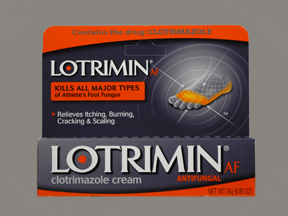 LOTRIMIN AF 1% CREAM
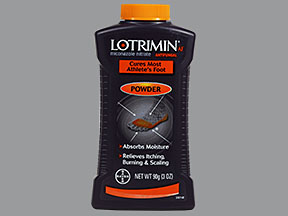 LOTRIMIN AF 2% POWDER
The following indications for LOTRIMIN AF (clotrimazole) have been approved by the FDA:
Indications:
Cutaneous candidiasis
Diaper rash
Tinea corporis
Tinea cruris
Tinea pedis
Tinea versicolor
Professional Synonyms:
Corporeal ringworm
Cutaneous candidosis
Cutaneous moniliasis
Dermatomycosis pedis
Dhobie itch
Diaper dermatitis
Eczema marginatum
Jock itch
Pityriasis versicolor
Tinea circinata
Tinea furfuracea
Tinea glabrosa
Tinea inguinalis
Tinea of the foot
Indications:
Cutaneous candidiasis
Diaper rash
Tinea corporis
Tinea cruris
Tinea pedis
Tinea versicolor
Professional Synonyms:
Corporeal ringworm
Cutaneous candidosis
Cutaneous moniliasis
Dermatomycosis pedis
Dhobie itch
Diaper dermatitis
Eczema marginatum
Jock itch
Pityriasis versicolor
Tinea circinata
Tinea furfuracea
Tinea glabrosa
Tinea inguinalis
Tinea of the foot
The following dosing information is available for LOTRIMIN AF (clotrimazole):
No enhanced Dosing information available for this drug.
Miconazole nitrate is administered topically as a cream, powder, or aerosol powder or tincture, or intravaginally as a vaginal cream or suppository. Miconazole powder or aerosol powder are not recommended for use on the scalp or nails. Clotrimazole is administered topically to the oropharyngeal area as an oral lozenge, to the skin as a cream or solution, or intravaginally as a vaginal cream.
The topical cream and solution are not intended for ophthalmic use. Clotrimazole also is available in fixed combination with betamethasone dipropionate as a cream or lotion; see prescribing information for the combination product for additional details. Store clotrimazole oral lozenges, topical cream, and topical solution at 20--25degreesC. Avoid freezing oral lozenges.
The topical cream and solution are not intended for ophthalmic use. Clotrimazole also is available in fixed combination with betamethasone dipropionate as a cream or lotion; see prescribing information for the combination product for additional details. Store clotrimazole oral lozenges, topical cream, and topical solution at 20--25degreesC. Avoid freezing oral lozenges.
| DRUG LABEL | DOSING TYPE | DOSING INSTRUCTIONS |
|---|---|---|
| LOTRIMIN AF 1% CREAM | Maintenance | Adults apply to the affected and surrounding areas of skin by topical route 2 times per day in the morning and evening |
| LOTRIMIN AF 2% POWDER | Maintenance | Adults apply to the affected area(s) by topical route 2 times per day in the morning and evening |
| DRUG LABEL | DOSING TYPE | DOSING INSTRUCTIONS |
|---|---|---|
| CLOTRIMAZOLE 1% TOPICAL CREAM | Maintenance | Adults apply to the affected and surrounding areas of skin by topical route 2 times per day in the morning and evening |
| MICONAZOLE NITRATE 2% POWDER | Maintenance | Adults apply to the affected area(s) by topical route 2 times per day in themorning and evening |
| CVS CLOTRIMAZOLE 1% TOP CREAM | Maintenance | Adults apply to the affected and surrounding areas of skin by topical route 2 times per day in the morning and evening |
| TM-CLOTRIMAZOLE 1% TOP CREAM | Maintenance | Adults apply to the affected and surrounding areas of skin by topical route 2 times per day in the morning and evening |
| QC CLOTRIMAZOLE 1% TOP CREAM | Maintenance | Adults apply to the affected and surrounding areas of skin by topical route 2 times per day in the morning and evening |
| GNP MICONAZOLE 2% SPRAY POWDER | Maintenance | Adults apply spray to the affected area(s) by topical route 2 times per day in the morning and evening |
The following drug interaction information is available for LOTRIMIN AF (clotrimazole):
There are 0 contraindications.
There are 0 severe interactions.
There are 0 moderate interactions.
The following contraindication information is available for LOTRIMIN AF (clotrimazole):
Drug contraindication overview.
*Known hypersensitivity to clotrimazole or other imidazoles or any ingredient in the formulation.
*Known hypersensitivity to clotrimazole or other imidazoles or any ingredient in the formulation.
There are 0 contraindications.
There are 0 severe contraindications.
There are 1 moderate contraindications.
Clinically significant contraindication, where the condition can be managed or treated before the drug may be given safely.
| Moderate List |
|---|
| No disease contraindications |
The following adverse reaction information is available for LOTRIMIN AF (clotrimazole):
Adverse reaction overview.
Lozenge: nausea, vomiting, unpleasant mouth sensations, and pruritus. Topical cream or solution: blistering, erythema, edema, pruritus, burning, stinging, peeling, urticaria, and general irritation of skin.
Lozenge: nausea, vomiting, unpleasant mouth sensations, and pruritus. Topical cream or solution: blistering, erythema, edema, pruritus, burning, stinging, peeling, urticaria, and general irritation of skin.
There are 16 severe adverse reactions.
| More Frequent | Less Frequent |
|---|---|
| None. | None. |
| Rare/Very Rare |
|---|
|
Abnormal desquamation Anaphylaxis Angioedema Blistering skin Dermatitis due to topical drug Dyspnea Edema Erythema Hypersensitivity drug reaction Hypotension Pruritus of skin Skin irritation Skin rash Stinging of skin Syncope Urticaria |
There are 4 less severe adverse reactions.
| More Frequent | Less Frequent |
|---|---|
| None. | None. |
| Rare/Very Rare |
|---|
|
Dermatitis due to topical drug Erythema Paresthesia Skin irritation |
The following precautions are available for LOTRIMIN AF (clotrimazole):
Safety and efficacy of clotrimazole lozenges have not been established in children <3 years of age. Safety and efficacy of prophylactic therapy with clotrimazole lozenges have not been established in children. Clotrimazole topical cream or solution is not recommended for self-medication in children <3 years of age.
Clotrimazole vaginal cream is not recommended for self-medication in children <12 years of age. Preparations containing clotrimazole in fixed combination with betamethasone dipropionate are not recommended for use in children <17 years of age or for diaper dermatitis.
Contraindicated
Severe Precaution
Management or Monitoring Precaution
Clotrimazole vaginal cream is not recommended for self-medication in children <12 years of age. Preparations containing clotrimazole in fixed combination with betamethasone dipropionate are not recommended for use in children <17 years of age or for diaper dermatitis.
Contraindicated
| None |
Severe Precaution
| None |
Management or Monitoring Precaution
| None |
Because small amounts of miconazole nitrate are absorbed from the vagina, the manufacturer states that the vaginal preparations should not be used in the first trimester of pregnancy unless the drug is considered essential to the welfare of the patient. For self-medication, miconazole nitrate vaginal suppositories or vaginal cream should not be used in pregnant women unless otherwise instructed by a physician. Follow-up reports from clinical studies during which miconazole vaginal preparations were used for up to 14 days in pregnant women have revealed no adverse effects or complications attributable to therapy with the drug in infants born to these women.
Prolonged gestation has occurred in rats, but not in rabbits, receiving oral miconazole nitrate. In addition, fetotoxicity and embryotoxicity have occurred in rats and rabbits and dystocia in rats in reproduction studies using oral miconazole nitrate dosages of 80 mg/kg and higher; these effects were not observed in rats following intravaginal administration of the drug. There are no adequate and controlled studies of clotrimazole lozenges in pregnant women; the drug should be used during pregnancy only if the potential benefits justify the potential risks to the fetus.
In clinical trials, use of intravaginal clotrimazole in pregnant women in the second and third trimester was not associated with adverse effects; there are no adequate and well-controlled studies in pregnant women in the first trimester. . In animal reproductive studies, clotrimazole demonstrated embryotoxic effects, but was not teratogenic when given in doses significantly higher than the recommended human dose.
Prolonged gestation has occurred in rats, but not in rabbits, receiving oral miconazole nitrate. In addition, fetotoxicity and embryotoxicity have occurred in rats and rabbits and dystocia in rats in reproduction studies using oral miconazole nitrate dosages of 80 mg/kg and higher; these effects were not observed in rats following intravaginal administration of the drug. There are no adequate and controlled studies of clotrimazole lozenges in pregnant women; the drug should be used during pregnancy only if the potential benefits justify the potential risks to the fetus.
In clinical trials, use of intravaginal clotrimazole in pregnant women in the second and third trimester was not associated with adverse effects; there are no adequate and well-controlled studies in pregnant women in the first trimester. . In animal reproductive studies, clotrimazole demonstrated embryotoxic effects, but was not teratogenic when given in doses significantly higher than the recommended human dose.
It is not known whether miconazole nitrate is distributed into milk. Miconazole nitrate should be used with caution in nursing women. It is not known whether clotrimazole is excreted in human milk, caution should be exercised when the drug is used in nursing woman.
There were an insufficient number of patients >=65 years of age in clinical studies of clotrimazole lozenges to determine whether geriatric patients respond differently from younger patients; other reported experience did not find any differences in response between these patients.
The following prioritized warning is available for LOTRIMIN AF (clotrimazole):
No warning message for this drug.
No warning message for this drug.
The following icd codes are available for LOTRIMIN AF (clotrimazole)'s list of indications:
| Cutaneous candidiasis | |
| B37.2 | Candidiasis of skin and nail |
| Diaper rash | |
| L22 | Diaper dermatitis |
| Tinea corporis | |
| B35.4 | Tinea corporis |
| Tinea cruris | |
| B35.6 | Tinea cruris |
| Tinea pedis | |
| B35.3 | Tinea pedis |
| Tinea versicolor | |
| B36.0 | Pityriasis versicolor |
Formulary Reference Tool