Please wait while the formulary information is being retrieved.
DRUG IMAGES
 RELISTOR 12 MG/0.6 ML VIAL
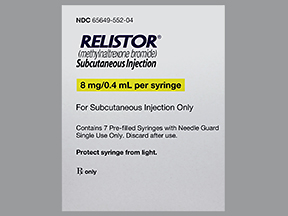 RELISTOR 8 MG/0.4 ML SYRINGE
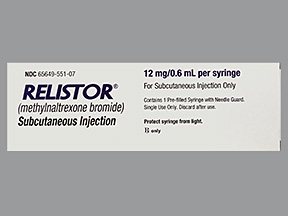 RELISTOR 12 MG/0.6 ML SYRINGE
 RELISTOR 150 MG TABLET
The following indications for RELISTOR (methylnaltrexone bromide) have been approved by the FDA:
Indications:
Opioid-induced constipation
Professional Synonyms:
None.
Indications:
Opioid-induced constipation
Professional Synonyms:
None.
The following dosing information is available for RELISTOR (methylnaltrexone bromide):
No enhanced Dosing information available for this drug.
For the management of opiate-induced constipation, methylnaltrexone bromide is administered orally or by subcutaneous injection in patients with chronic non-cancer-related pain and by subcutaneous injection in those with advanced illness. Patients should be in close proximity to toilet facilities following administration of the drug.
| DRUG LABEL | DOSING TYPE | DOSING INSTRUCTIONS |
|---|---|---|
| RELISTOR 150 MG TABLET | Maintenance | Adults take 3 tablets (450 mg) by oral route once daily in the morning |
| RELISTOR 12 MG/0.6 ML VIAL | Maintenance | Adults inject 0.15 mg/kg by subcutaneous route every other day (for patients weighing <38kg and >114kg) |
| RELISTOR 12 MG/0.6 ML SYRINGE | Maintenance | Adults inject 0.6 milliliter (12 mg) by subcutaneous route every other day as needed (for patients weighing 62kg to 114kg) |
| RELISTOR 8 MG/0.4 ML SYRINGE | Maintenance | Adults inject 0.4 milliliter (8 mg) by subcutaneous route every other day as needed (for patients weighing 38kg to <62kg) |
No generic dosing information available.
The following drug interaction information is available for RELISTOR (methylnaltrexone bromide):
There are 0 contraindications.
There are 0 severe interactions.
There are 0 moderate interactions.
The following contraindication information is available for RELISTOR (methylnaltrexone bromide):
Drug contraindication overview.
Because of the potential for GI perforation, methylnaltrexone is contraindicated in patients with known or suspected GI obstruction and in patients at increased risk for recurrent GI obstruction (see GI Perforation under Cautions: Warnings/Precautions).
Because of the potential for GI perforation, methylnaltrexone is contraindicated in patients with known or suspected GI obstruction and in patients at increased risk for recurrent GI obstruction (see GI Perforation under Cautions: Warnings/Precautions).
There are 2 contraindications.
Absolute contraindication.
| Contraindication List |
|---|
| Chronic kidney disease stage 5 (failure) GFr<15 ml/min |
| Gastrointestinal obstruction |
There are 11 severe contraindications.
Adequate patient monitoring is recommended for safer drug use.
| Severe List |
|---|
| Child-pugh class B hepatic impairment |
| Child-pugh class C hepatic impairment |
| Chronic diarrhea |
| Chronic kidney disease stage 3A (moderate) GFR 45-59 ml/min |
| Chronic kidney disease stage 3B (moderate) GFR 30-44 ml/min |
| Chronic kidney disease stage 4 (severe) GFR 15-29 ml/min |
| Disease of liver |
| Gastrointestinal ulcer |
| Megacolon |
| Primary malignant neoplasm of gastrointestinal tract |
| Severe diarrhea |
There are 0 moderate contraindications.
The following adverse reaction information is available for RELISTOR (methylnaltrexone bromide):
Adverse reaction overview.
Adverse effects reported in 5% or more of patients with opiate-induced constipation and advanced illness receiving methylnaltrexone bromide injection, and at an incidence at least twice that reported with placebo, include transient abdominal pain, flatulence, nausea, dizziness, and diarrhea. Adverse effects reported in 2% or more of patients with opiate-induced constipation and chronic non-cancer-related pain receiving oral methylnaltrexone, and at an incidence greater than that reported with placebo, include abdominal pain, diarrhea, headache, abdominal distention, vomiting, hyperhidrosis, anxiety, muscle spasms, rhinorrhea, and chills. Adverse effects reported in 1% or more of patients with opiate-induced constipation and chronic non-cancer-related pain receiving methylnaltrexone injection, and at an incidence greater than that reported with placebo, include abdominal pain, nausea, diarrhea, hyperhidrosis, hot flush, tremor, and chills.
Adverse effects reported in 5% or more of patients with opiate-induced constipation and advanced illness receiving methylnaltrexone bromide injection, and at an incidence at least twice that reported with placebo, include transient abdominal pain, flatulence, nausea, dizziness, and diarrhea. Adverse effects reported in 2% or more of patients with opiate-induced constipation and chronic non-cancer-related pain receiving oral methylnaltrexone, and at an incidence greater than that reported with placebo, include abdominal pain, diarrhea, headache, abdominal distention, vomiting, hyperhidrosis, anxiety, muscle spasms, rhinorrhea, and chills. Adverse effects reported in 1% or more of patients with opiate-induced constipation and chronic non-cancer-related pain receiving methylnaltrexone injection, and at an incidence greater than that reported with placebo, include abdominal pain, nausea, diarrhea, hyperhidrosis, hot flush, tremor, and chills.
There are 3 severe adverse reactions.
| More Frequent | Less Frequent |
|---|---|
| None. | None. |
| Rare/Very Rare |
|---|
|
Gastrointestinal perforation Opioid withdrawal symptoms Severe diarrhea |
There are 11 less severe adverse reactions.
| More Frequent | Less Frequent |
|---|---|
|
Abdominal pain with cramps Diarrhea Dizziness Flatulence Nausea |
Chills Flushing Malaise Piloerection |
| Rare/Very Rare |
|---|
|
Hyperhidrosis Vomiting |
The following precautions are available for RELISTOR (methylnaltrexone bromide):
Safety and efficacy of methylnaltrexone have not been established in children younger than 18 years of age. Seizures, tremors, and labored breathing were observed in juvenile rats receiving IV methylnaltrexone for 13 weeks, and the juvenile animals exhibited greater sensitivity to adverse effects of the drug compared with adult animals. The toxicity profile in juvenile dogs was similar to that in adult dogs.
Contraindicated
Severe Precaution
Management or Monitoring Precaution
Contraindicated
| None |
Severe Precaution
| None |
Management or Monitoring Precaution
| None |
Because of the immature fetal blood-brain barrier, use of methylnaltrexone during pregnancy may precipitate opiate withdrawal in the fetus. Limited available data regarding use of the drug in pregnant women are insufficient to inform a drug-associated risk of major birth defects and spontaneous abortion. No adverse effects of the drug on embryofetal development have been observed in animal reproduction studies. Pregnant women should be advised of potential fetal risk.
It is unknown whether methylnaltrexone is distributed into human milk, affects milk production, or affects nursing infants. Methylnaltrexone is distributed into milk in rats; the drug is detected in milk within 30 minutes after a single subcutaneous injection and is concentrated in milk (up to 24 times plasma concentrations) at 8 hours after administration. Because of the potential for serious adverse effects, including opiate withdrawal, in nursing infants, women should not breast-feed while receiving the drug.
In clinical studies evaluating oral methylnaltrexone, 10% of patients were 65 years of age and older, while 2% were 75 years of age and older. In clinical studies evaluating methylnaltrexone injection, 28% of patients were 65 years of age and older, while 13% were 75 years of age and older. No overall differences in efficacy were observed in these studies between geriatric patients and younger adults.
Although adverse effects were similar in geriatric patients and younger adults, a higher incidence of diarrhea was reported in geriatric patients receiving oral methylnaltrexone. Following IV administration of a single 24-mg dose of methylnaltrexone bromide in healthy individuals, clearance of the drug was decreased by approximately 20% and systemic exposure (area under the plasma concentration-time curve (AUC)) was increased by 26% in geriatric adults compared with younger adults. Based on these clinical and pharmacokinetic findings, geriatric patients should be monitored for adverse effects while receiving methylnaltrexone therapy, but dosage adjustments based on age are not necessary.
Although adverse effects were similar in geriatric patients and younger adults, a higher incidence of diarrhea was reported in geriatric patients receiving oral methylnaltrexone. Following IV administration of a single 24-mg dose of methylnaltrexone bromide in healthy individuals, clearance of the drug was decreased by approximately 20% and systemic exposure (area under the plasma concentration-time curve (AUC)) was increased by 26% in geriatric adults compared with younger adults. Based on these clinical and pharmacokinetic findings, geriatric patients should be monitored for adverse effects while receiving methylnaltrexone therapy, but dosage adjustments based on age are not necessary.
The following prioritized warning is available for RELISTOR (methylnaltrexone bromide):
No warning message for this drug.
No warning message for this drug.
The following icd codes are available for RELISTOR (methylnaltrexone bromide)'s list of indications:
| Opioid-induced constipation | |
| K59.09 | Other constipation |
Formulary Reference Tool