
Please wait while the formulary information is being retrieved.
Drug overview for ZURNAI (nalmefene hcl):
Generic name: NALMEFENE HCL (NAL-me-feen)
Drug class: Opioid Antagonists
Therapeutic class: Antidotes and other Reversal Agents
Nalmefene hydrochloride is a synthetic opioid antagonist.
No enhanced Uses information available for this drug.
Generic name: NALMEFENE HCL (NAL-me-feen)
Drug class: Opioid Antagonists
Therapeutic class: Antidotes and other Reversal Agents
Nalmefene hydrochloride is a synthetic opioid antagonist.
No enhanced Uses information available for this drug.
DRUG IMAGES
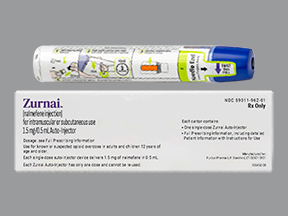 ZURNAI 1.5 MG/0.5 ML AUTOINJCT
The following indications for ZURNAI (nalmefene hcl) have been approved by the FDA:
Indications:
Opioid overdose
Opioid-induced respiratory depression
Professional Synonyms:
Opiate-induced respiratory depression
Opioid agonist overdose
Opioid-induced inadequate ventilation
Indications:
Opioid overdose
Opioid-induced respiratory depression
Professional Synonyms:
Opiate-induced respiratory depression
Opioid agonist overdose
Opioid-induced inadequate ventilation
The following dosing information is available for ZURNAI (nalmefene hcl):
Nalmefene hydrochloride is used for the complete or partial reversal of opioid-induced depression, including respiratory and CNS depression, caused by natural and synthetic opioids and for the management of known or suspected opioid overdose. Reversal of respiratory depression caused by partial agonists or mixed agonist/antagonists (e.g., buprenorphine, pentazocine) may be incomplete and may require higher or repeat doses of nalmefene.
Nalmefene hydrochloride injection is commercially available for use in adults by intravenous, intramuscular (IM), or subcutaneous (SUBQ) injection. Administration of nalmefene should be preceded by other resuscitative measures, such as establishment of a patent airway, ventilatory assistance, administration of oxygen, and circulatory access.
Nalmefene hydrochloride injection is also available as a prefilled auto-injector for IM or SUBQ injection and as a nasal spray for administration by family members or caregivers in adults and pediatric patients 12 years of age and older; such treatment is not a substitute for emergency medical care. When nalmefene is administered outside of a supervised medical setting, emergency medical assistance should always follow immediately after the first dose.
Dosage of nalmefene hydrochloride is expressed in terms of nalmefene.
Titrate dosage to reverse undesired opioid-induced effects. When adequate opioid reversal has been established, additional doses of nalmefene are not required and may cause unwanted reversal of analgesia or precipitate withdrawal.
In pediatric patients >=12 years of age, the dose of nalmefene delivered by prefilled auto-injector for IM or subcutaneous (SUBQ) use is 1.5 mg. If the desired response is not obtained within 2-5 minutes of administration or if the patient initially responds and then relapses into respiratory depression, an additional dose may be administered every 2-5 minutes until emergency medical assistance arrives.
The requirement for repeat doses depends upon the amount, type, and route of administration of the opioid being antagonized. Additional supportive and resuscitative measures may be helpful while awaiting emergency medical assistance.
In pediatric patients >=12 years of age, the dose of nalmefene delivered by prefilled nasal spray is 2.7 mg, delivered as one spray into one nostril. If the desired response is not obtained after 2-5 minutes of administration or if the patient initially responds and then relapses into respiratory depression, an additional dose may be administered every 2-5 minutes until emergency medical assistance arrives.
The requirement for repeat doses depends upon the amount, type, and route of administration of the opioid being antagonized. Additional supportive and resuscitative measures may be helpful while awaiting emergency medical assistance.
Nalmefene injection should only be used when the likelihood of opioid overdosage is high based on a history of opioid overdosage or based on the clinical presentation of respiratory depression with pupillary constriction.
For the treatment of known or suspected opioid overdosage in adult patients not dependent on opioids, the usual initial dose of nalmefene is 0.5 mg/70 kg IV; if IV access is lost or not readily obtainable the drug may be given IM or SUBQ. If needed, a second dose of 1 mg/70 kg may be administered 2-5 minutes later.
If a total dose of 1.5 mg/70 kg has been administered without clinical response, additional nalmefene is unlikely to have an effect. If recurrence of respiratory depression occurs after nalmefene administration, the dose should be titrated to clinical effect using incremental doses to avoid over-reversal.
Nalmefene injection may cause withdrawal symptoms when used for the treatment of known or suspected opioid overdosage in adult patients who are tolerant to or physically dependent on opioids. In such patients, an initial challenge dose of nalmefene 0.1 mg/70 kg IV should administered.
If there is no evidence of withdrawal within 2 minutes, a dose of 0.5 mg/70 kg IV can be given, followed by a second dose of 1 mg/70 mg given after at least 2-5 minutes, as needed. An interval of at least 2-5 minutes should be allowed between doses to allow the full effect of each incremental dose to be reached.
If a total dose of 1.5 mg/70 kg has been administered without clinical response, additional nalmefene is unlikely to have an effect. If recurrence of respiratory depression occurs after nalmefene administration, the dose should be titrated to clinical effect using incremental doses to avoid over-reversal.
In adult patients, the dose of nalmefene delivered by prefilled auto-injector for IM or SUBQ use is 1.5 mg. If the desired response is not obtained after 2-5 minutes of administration or if the patient initially responds and then relapses into respiratory depression, an additional dose may be administered every 2-5 minutes until emergency medical assistance arrives.
The requirement for repeat doses depends upon the amount, type, and route of administration of the opioid being antagonized. Additional supportive and resuscitative measures may be helpful while awaiting emergency medical assistance.
In adult patients, the dose of nalmefene delivered by prefilled nasal spray is 2.7 mg, delivered as one spray into one nostril. If the desired response is not obtained after 2-5 minutes of administration or if the patient initially responds and then relapses into respiratory depression, an additional dose may be administered every 2-5 minutes until emergency medical assistance arrives.
The requirement for repeat doses depends upon the amount, type, and route of administration of the opioid being antagonized. Additional supportive and resuscitative measures may be helpful while awaiting emergency medical assistance.
Nalmefene use in patients that are opioid dependent may precipitate opioid withdrawal; use is unlikely to produce acute withdrawal symptoms in patients who are not opioid dependent. Attempting to overcome opioid withdrawal symptoms caused by opioid antagonists with high or repeated doses of exogenous opioids could lead to opioid intoxication and death.
Inform patients of the potential consequences of attempting to overcome the opioid blockade and to seek emergency medical assistance as soon as possible after use of nalmefene regardless of withdrawal symptoms.
Nalmefene hydrochloride injection is commercially available for use in adults by intravenous, intramuscular (IM), or subcutaneous (SUBQ) injection. Administration of nalmefene should be preceded by other resuscitative measures, such as establishment of a patent airway, ventilatory assistance, administration of oxygen, and circulatory access.
Nalmefene hydrochloride injection is also available as a prefilled auto-injector for IM or SUBQ injection and as a nasal spray for administration by family members or caregivers in adults and pediatric patients 12 years of age and older; such treatment is not a substitute for emergency medical care. When nalmefene is administered outside of a supervised medical setting, emergency medical assistance should always follow immediately after the first dose.
Dosage of nalmefene hydrochloride is expressed in terms of nalmefene.
Titrate dosage to reverse undesired opioid-induced effects. When adequate opioid reversal has been established, additional doses of nalmefene are not required and may cause unwanted reversal of analgesia or precipitate withdrawal.
In pediatric patients >=12 years of age, the dose of nalmefene delivered by prefilled auto-injector for IM or subcutaneous (SUBQ) use is 1.5 mg. If the desired response is not obtained within 2-5 minutes of administration or if the patient initially responds and then relapses into respiratory depression, an additional dose may be administered every 2-5 minutes until emergency medical assistance arrives.
The requirement for repeat doses depends upon the amount, type, and route of administration of the opioid being antagonized. Additional supportive and resuscitative measures may be helpful while awaiting emergency medical assistance.
In pediatric patients >=12 years of age, the dose of nalmefene delivered by prefilled nasal spray is 2.7 mg, delivered as one spray into one nostril. If the desired response is not obtained after 2-5 minutes of administration or if the patient initially responds and then relapses into respiratory depression, an additional dose may be administered every 2-5 minutes until emergency medical assistance arrives.
The requirement for repeat doses depends upon the amount, type, and route of administration of the opioid being antagonized. Additional supportive and resuscitative measures may be helpful while awaiting emergency medical assistance.
Nalmefene injection should only be used when the likelihood of opioid overdosage is high based on a history of opioid overdosage or based on the clinical presentation of respiratory depression with pupillary constriction.
For the treatment of known or suspected opioid overdosage in adult patients not dependent on opioids, the usual initial dose of nalmefene is 0.5 mg/70 kg IV; if IV access is lost or not readily obtainable the drug may be given IM or SUBQ. If needed, a second dose of 1 mg/70 kg may be administered 2-5 minutes later.
If a total dose of 1.5 mg/70 kg has been administered without clinical response, additional nalmefene is unlikely to have an effect. If recurrence of respiratory depression occurs after nalmefene administration, the dose should be titrated to clinical effect using incremental doses to avoid over-reversal.
Nalmefene injection may cause withdrawal symptoms when used for the treatment of known or suspected opioid overdosage in adult patients who are tolerant to or physically dependent on opioids. In such patients, an initial challenge dose of nalmefene 0.1 mg/70 kg IV should administered.
If there is no evidence of withdrawal within 2 minutes, a dose of 0.5 mg/70 kg IV can be given, followed by a second dose of 1 mg/70 mg given after at least 2-5 minutes, as needed. An interval of at least 2-5 minutes should be allowed between doses to allow the full effect of each incremental dose to be reached.
If a total dose of 1.5 mg/70 kg has been administered without clinical response, additional nalmefene is unlikely to have an effect. If recurrence of respiratory depression occurs after nalmefene administration, the dose should be titrated to clinical effect using incremental doses to avoid over-reversal.
In adult patients, the dose of nalmefene delivered by prefilled auto-injector for IM or SUBQ use is 1.5 mg. If the desired response is not obtained after 2-5 minutes of administration or if the patient initially responds and then relapses into respiratory depression, an additional dose may be administered every 2-5 minutes until emergency medical assistance arrives.
The requirement for repeat doses depends upon the amount, type, and route of administration of the opioid being antagonized. Additional supportive and resuscitative measures may be helpful while awaiting emergency medical assistance.
In adult patients, the dose of nalmefene delivered by prefilled nasal spray is 2.7 mg, delivered as one spray into one nostril. If the desired response is not obtained after 2-5 minutes of administration or if the patient initially responds and then relapses into respiratory depression, an additional dose may be administered every 2-5 minutes until emergency medical assistance arrives.
The requirement for repeat doses depends upon the amount, type, and route of administration of the opioid being antagonized. Additional supportive and resuscitative measures may be helpful while awaiting emergency medical assistance.
Nalmefene use in patients that are opioid dependent may precipitate opioid withdrawal; use is unlikely to produce acute withdrawal symptoms in patients who are not opioid dependent. Attempting to overcome opioid withdrawal symptoms caused by opioid antagonists with high or repeated doses of exogenous opioids could lead to opioid intoxication and death.
Inform patients of the potential consequences of attempting to overcome the opioid blockade and to seek emergency medical assistance as soon as possible after use of nalmefene regardless of withdrawal symptoms.
Nalmefene hydrochloride may be administered by IV, IM, or subcutaneous (SUBQ) injection or intranasally.
| DRUG LABEL | DOSING TYPE | DOSING INSTRUCTIONS |
|---|---|---|
| ZURNAI 1.5 MG/0.5 ML AUTOINJCT | Maintenance | Adults inject 1.5 mg by intramuscular route may repeat dose in 2-5 minutes if desired effect is not achieved |
No generic dosing information available.
The following drug interaction information is available for ZURNAI (nalmefene hcl):
There are 0 contraindications.
There are 0 severe interactions.
There are 0 moderate interactions.
The following contraindication information is available for ZURNAI (nalmefene hcl):
Drug contraindication overview.
*Known hypersensitivity to nalmefene hydrochloride or any ingredient in the formulation.
*Known hypersensitivity to nalmefene hydrochloride or any ingredient in the formulation.
There are 0 contraindications.
There are 0 severe contraindications.
There are 1 moderate contraindications.
Clinically significant contraindication, where the condition can be managed or treated before the drug may be given safely.
| Moderate List |
|---|
| No disease contraindications |
The following adverse reaction information is available for ZURNAI (nalmefene hcl):
Adverse reaction overview.
The most common adverse effects of nalmefene hydrochloride injection (>=5% of patients) include nausea, vomiting, tachycardia, hypertension, feeling hot, headache, dizziness, chills, allodynia, palpitations, tinnitus, ear discomfort, feeling abnormal, burning sensation, hot flush, and irritability. The most common adverse effects of nalmefene hydrochloride nasal spray (>=2% of patients) include nasal discomfort, headache, nausea, dizziness, hot flush, vomiting, anxiety, fatigue, nasal congestion, throat irritation, rhinalgia, decreased appetite, dysgeusia, erythema, and hyperhidrosis.
The most common adverse effects of nalmefene hydrochloride injection (>=5% of patients) include nausea, vomiting, tachycardia, hypertension, feeling hot, headache, dizziness, chills, allodynia, palpitations, tinnitus, ear discomfort, feeling abnormal, burning sensation, hot flush, and irritability. The most common adverse effects of nalmefene hydrochloride nasal spray (>=2% of patients) include nasal discomfort, headache, nausea, dizziness, hot flush, vomiting, anxiety, fatigue, nasal congestion, throat irritation, rhinalgia, decreased appetite, dysgeusia, erythema, and hyperhidrosis.
There are 14 severe adverse reactions.
| More Frequent | Less Frequent |
|---|---|
|
Hypertension Tachycardia |
Fever Hypotension Vasodilation of blood vessels |
| Rare/Very Rare |
|---|
|
Acute cognitive impairment Agitation Bradycardia Cardiac arrhythmia Hallucinations Myoclonus Pruritus of skin Pulmonary edema Urinary retention |
There are 15 less severe adverse reactions.
| More Frequent | Less Frequent |
|---|---|
|
Nausea Vertigo Vomiting |
Chills Dizziness Earache Headache disorder Irritability Pain Palpitations Tinnitus |
| Rare/Very Rare |
|---|
|
Depression Diarrhea Drowsy Pharyngitis |
The following precautions are available for ZURNAI (nalmefene hcl):
Safety and efficacy of nalmefene injection in single-dose vials have not been established in pediatric patients. Safety and efficacy of nalmefene injection in auto-injectors (Zurnai(R)) and nalmefene nasal spray (Opvee(R)) have been established in pediatric patients >=12 years of age for the emergency treatment of known or suspected overdose manifested by respiratory and/or CNS depression. Use of these nalmefene dosage forms for this indication in this age group is based on studies performed in adult patients and a pharmacokinetic simulation.
There have not been clinical studies to evaluate their use in pediatric patients. Safety and efficacy have not been established in pediatric patients <12 years of age. Safety and efficacy of nalmefene injection in single-dose vials have not been established in neonates. Nalmefene should only be used in the resuscitation of neonates when, in the opinion of the treating clinician, the expected benefits outweigh the risk.
Contraindicated
Severe Precaution
Management or Monitoring Precaution
There have not been clinical studies to evaluate their use in pediatric patients. Safety and efficacy have not been established in pediatric patients <12 years of age. Safety and efficacy of nalmefene injection in single-dose vials have not been established in neonates. Nalmefene should only be used in the resuscitation of neonates when, in the opinion of the treating clinician, the expected benefits outweigh the risk.
Contraindicated
| None |
Severe Precaution
| None |
Management or Monitoring Precaution
| None |
There is insufficient evidence with nalmefene in pregnant women to evaluate a drug-associated risk of major birth defects or miscarriage. Reproductive studies in rats and rabbits revealed no evidence of impaired fertility or embryotoxic effects, and no adverse effects on embryo-fetal development. Opioid overdose is considered a medical emergency and can be fatal for the pregnant woman and fetus if left untreated. Treatment with nalmefene should not be withheld because of the potential concerns regarding the effects of nalmefene on the fetus.
There is no information regarding the presence of nalmefene and its metabolites in human milk, the effects on the breast-fed child, or the effects on milk production. Nalmefene is distributed into the milk of rats. Use with caution in breastfeeding patients.
Clinical studies of nalmefene injection did not include sufficient numbers of patients >=65 years of age to determine whether they respond differently from younger patients. Clinical studies of nalmefene nasal spray did not include patients >=65 years of age. Other clinical experience with nalmefene has not identified differences in responses between geriatric and younger patients.
Geriatric patients have a greater frequency of decreased hepatic, renal, or cardiac function as well as concomitant diseases and drug therapy; therefore, systemic exposure to nalmefene may be higher in geriatric patients. Dosage of nalmefene hydrochloride injection should be selected with caution in geriatric patients.
Geriatric patients have a greater frequency of decreased hepatic, renal, or cardiac function as well as concomitant diseases and drug therapy; therefore, systemic exposure to nalmefene may be higher in geriatric patients. Dosage of nalmefene hydrochloride injection should be selected with caution in geriatric patients.
The following prioritized warning is available for ZURNAI (nalmefene hcl):
No warning message for this drug.
No warning message for this drug.
The following icd codes are available for ZURNAI (nalmefene hcl)'s list of indications:
| Opioid overdose | |
| T40.0x1A | Poisoning by opium, accidental (unintentional), initial encounter |
| T40.0x2A | Poisoning by opium, intentional self-harm, initial encounter |
| T40.0x3A | Poisoning by opium, assault, initial encounter |
| T40.0x4A | Poisoning by opium, undetermined, initial encounter |
| T40.1x1A | Poisoning by heroin, accidental (unintentional), initial encounter |
| T40.1x2A | Poisoning by heroin, intentional self-harm, initial encounter |
| T40.1x3A | Poisoning by heroin, assault, initial encounter |
| T40.1x4A | Poisoning by heroin, undetermined, initial encounter |
| T40.2x1A | Poisoning by other opioids, accidental (unintentional), initial encounter |
| T40.2x2A | Poisoning by other opioids, intentional self-harm, initial encounter |
| T40.2x3A | Poisoning by other opioids, assault, initial encounter |
| T40.2x4A | Poisoning by other opioids, undetermined, initial encounter |
| T40.3x1A | Poisoning by methadone, accidental (unintentional), initial encounter |
| T40.3x2A | Poisoning by methadone, intentional self-harm, initial encounter |
| T40.3x3A | Poisoning by methadone, assault, initial encounter |
| T40.3x4A | Poisoning by methadone, undetermined, initial encounter |
| T40.411A | Poisoning by fentanyl or fentanyl analogs, accidental (unintentional), initial encounter |
| T40.412A | Poisoning by fentanyl or fentanyl analogs, intentional self-harm, initial encounter |
| T40.413A | Poisoning by fentanyl or fentanyl analogs, assault, initial encounter |
| T40.414A | Poisoning by fentanyl or fentanyl analogs, undetermined, initial encounter |
| T40.421A | Poisoning by tramadol, accidental (unintentional), initial encounter |
| T40.422A | Poisoning by tramadol, intentional self-harm, initial encounter |
| T40.423A | Poisoning by tramadol, assault, initial encounter |
| T40.424A | Poisoning by tramadol, undetermined, initial encounter |
| T40.491A | Poisoning by other synthetic narcotics, accidental (unintentional), initial encounter |
| T40.492A | Poisoning by other synthetic narcotics, intentional self-harm, initial encounter |
| T40.493A | Poisoning by other synthetic narcotics, assault, initial encounter |
| T40.494A | Poisoning by other synthetic narcotics, undetermined, initial encounter |
| T40.601A | Poisoning by unspecified narcotics, accidental (unintentional), initial encounter |
| T40.602A | Poisoning by unspecified narcotics, intentional self-harm, initial encounter |
| T40.603A | Poisoning by unspecified narcotics, assault, initial encounter |
| T40.604A | Poisoning by unspecified narcotics, undetermined, initial encounter |
| T40.691A | Poisoning by other narcotics, accidental (unintentional), initial encounter |
| T40.692A | Poisoning by other narcotics, intentional self-harm, initial encounter |
| T40.693A | Poisoning by other narcotics, assault, initial encounter |
| T40.694A | Poisoning by other narcotics, undetermined, initial encounter |
| T50.7x1A | Poisoning by analeptics and opioid receptor antagonists, accidental (unintentional), initial encounter |
| T50.7x2A | Poisoning by analeptics and opioid receptor antagonists, intentional self-harm, initial encounter |
| T50.7x3A | Poisoning by analeptics and opioid receptor antagonists, assault, initial encounter |
| T50.7x4A | Poisoning by analeptics and opioid receptor antagonists, undetermined, initial encounter |
| Opioid-induced respiratory depression | |
| T40.0x1A | Poisoning by opium, accidental (unintentional), initial encounter |
| T40.0x2A | Poisoning by opium, intentional self-harm, initial encounter |
| T40.0x3A | Poisoning by opium, assault, initial encounter |
| T40.0x4A | Poisoning by opium, undetermined, initial encounter |
| T40.1x1A | Poisoning by heroin, accidental (unintentional), initial encounter |
| T40.1x2A | Poisoning by heroin, intentional self-harm, initial encounter |
| T40.1x3A | Poisoning by heroin, assault, initial encounter |
| T40.1x4A | Poisoning by heroin, undetermined, initial encounter |
| T40.2x1A | Poisoning by other opioids, accidental (unintentional), initial encounter |
| T40.2x2A | Poisoning by other opioids, intentional self-harm, initial encounter |
| T40.2x3A | Poisoning by other opioids, assault, initial encounter |
| T40.2x4A | Poisoning by other opioids, undetermined, initial encounter |
| T40.3x1A | Poisoning by methadone, accidental (unintentional), initial encounter |
| T40.3x2A | Poisoning by methadone, intentional self-harm, initial encounter |
| T40.3x3A | Poisoning by methadone, assault, initial encounter |
| T40.3x4A | Poisoning by methadone, undetermined, initial encounter |
| T40.411A | Poisoning by fentanyl or fentanyl analogs, accidental (unintentional), initial encounter |
| T40.412A | Poisoning by fentanyl or fentanyl analogs, intentional self-harm, initial encounter |
| T40.413A | Poisoning by fentanyl or fentanyl analogs, assault, initial encounter |
| T40.414A | Poisoning by fentanyl or fentanyl analogs, undetermined, initial encounter |
| T40.421A | Poisoning by tramadol, accidental (unintentional), initial encounter |
| T40.422A | Poisoning by tramadol, intentional self-harm, initial encounter |
| T40.423A | Poisoning by tramadol, assault, initial encounter |
| T40.424A | Poisoning by tramadol, undetermined, initial encounter |
| T40.491A | Poisoning by other synthetic narcotics, accidental (unintentional), initial encounter |
| T40.492A | Poisoning by other synthetic narcotics, intentional self-harm, initial encounter |
| T40.493A | Poisoning by other synthetic narcotics, assault, initial encounter |
| T40.494A | Poisoning by other synthetic narcotics, undetermined, initial encounter |
| T40.5x1A | Poisoning by cocaine, accidental (unintentional), initial encounter |
| T40.5x2A | Poisoning by cocaine, intentional self-harm, initial encounter |
| T40.5x3A | Poisoning by cocaine, assault, initial encounter |
| T40.5x4A | Poisoning by cocaine, undetermined, initial encounter |
| T40.601A | Poisoning by unspecified narcotics, accidental (unintentional), initial encounter |
| T40.602A | Poisoning by unspecified narcotics, intentional self-harm, initial encounter |
| T40.603A | Poisoning by unspecified narcotics, assault, initial encounter |
| T40.604A | Poisoning by unspecified narcotics, undetermined, initial encounter |
| T40.691A | Poisoning by other narcotics, accidental (unintentional), initial encounter |
| T40.692A | Poisoning by other narcotics, intentional self-harm, initial encounter |
| T40.693A | Poisoning by other narcotics, assault, initial encounter |
| T40.694A | Poisoning by other narcotics, undetermined, initial encounter |
Formulary Reference Tool