Please wait while the formulary information is being retrieved.
Drug overview for FLUTICASONE PROPIONATE HFA (fluticasone propionate):
Generic name: FLUTICASONE PROPIONATE (floo-TIK-a-sone)
Drug class: Orally Inhaled Steroids
Therapeutic class:
Fluticasone propionate is a synthetic trifluorinated glucocorticoid.
No enhanced Uses information available for this drug.
Generic name: FLUTICASONE PROPIONATE (floo-TIK-a-sone)
Drug class: Orally Inhaled Steroids
Therapeutic class:
Fluticasone propionate is a synthetic trifluorinated glucocorticoid.
No enhanced Uses information available for this drug.
DRUG IMAGES
 FLUTICASONE PROP HFA 44 MCG
 FLUTICASONE PROP HFA 110 MCG
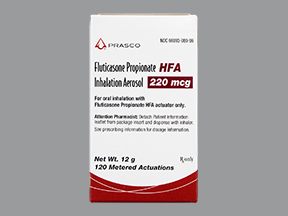 FLUTICASONE PROP HFA 220 MCG
The following indications for FLUTICASONE PROPIONATE HFA (fluticasone propionate) have been approved by the FDA:
Indications:
None.
Professional Synonyms:
None.
Indications:
None.
Professional Synonyms:
None.
The following dosing information is available for FLUTICASONE PROPIONATE HFA (fluticasone propionate):
Unless otherwise stated, the dose of fluticasone propionate administered as an aerosol via metered-dose inhaler with a hydrofluoroalkane (HFA) propellant is expressed as the amount of drug delivered from the actuator of the inhaler per metered spray; the dose of fluticasone propionate (and of salmeterol in the combination preparation Advair(R)) administered as an oral inhalation powder is expressed as the nominal (labeled) dose contained in each foil-wrapped blister. The manufacturer states that spacer devices should not be used with Advair(R) or Flovent(R) Diskus(R).
Each actuation of the commercially available fluticasone propionate HFA oral inhalation aerosol labeled as containing 44, 110, or 220 mcg of fluticasone propionate per metered spray delivers 50, 125, or 250 mcg from the valve, respectively, and 44, 110, or 220 mcg from the actuator, respectively. The 10.6-g (labeled as containing 44 mcg of fluticasone propionate) or 12-g canister (labeled as containing 110 or 220 mcg of fluticasone propionate) delivers 120 metered sprays of fluticasone propionate.
Each actuation of the oral aerosol inhaler containing the fixed combination of fluticasone propionate and salmeterol xinafoate delivers 50, 125, or 250 mcg of fluticasone propionate and 25 mcg of salmeterol from the valve. Dosages of fluticasone propionate and salmeterol in the fixed-combination inhalation aerosol are expressed in terms of drug delivered from the mouthpiece; each actuation of the inhaler delivers 45, 115, or 230 mcg of fluticasone propionate and 21 mcg of salmeterol from the mouthpiece. The commercially available inhalation aerosol of fluticasone propionate in fixed combination with salmeterol delivers 60 or 120 metered sprays per 8- or 12-g canister, respectively.
With commercially available fluticasone propionate inhalation powder (Flovent(R) Diskus(R), Advair(R) Diskus(R)) delivered via the Diskus(R) device, the amount of drug delivered to the lungs depends on factors such as the patient's inspiratory flow. Using standardized in vitro testing at a flow rate of 60 L per minute for 2 seconds, the Flovent(R) Diskus(R) labeled as containing 50, 100, or 250 mcg of fluticasone propionate delivers 46, 94, or 235 mcg of fluticasone propionate, respectively. In adults with obstructive lung disease and severely compromised lung function (FEV1 20-30% of predicted), mean peak inspiratory flow through the Diskus(R) device was 82.4
L/minute. In children 4 and 8 years of age with asthma, mean peak inspiratory flow through the Diskus(R) device was 70 and 104 L/minute, respectively. Using standardized in vitro testing at a flow rate of 60 L per minute for 2 seconds, the Advair(R) Diskus(R) device delivered 93, 233, and 465 mcg of fluticasone propionate and 45 mcg of salmeterol per activation from a Diskus(R) labeled as containing 100, 250, or 500 mcg of fluticasone propionate and 50 mcg of salmeterol, respectively.
In adults with obstructive lung disease and severely compromised lung function (FEV1 20-30% of predicted), mean peak inspiratory flow through the Diskus(R) device was 82.4 L/minute for Advair(R). In adults and adolescents with asthma, mean peak inspiratory flow through the Diskus(R) device was 122.2
L/minute. In a group of children 4 years of age, mean peak inspiratory flow through the Advair(R) Diskus(R) device averaged 75.5 L/minute; in children 8 years of age, mean peak inspiratory flow averaged 107.3 L/minute.
Each actuation of the commercially available fluticasone propionate HFA oral inhalation aerosol labeled as containing 44, 110, or 220 mcg of fluticasone propionate per metered spray delivers 50, 125, or 250 mcg from the valve, respectively, and 44, 110, or 220 mcg from the actuator, respectively. The 10.6-g (labeled as containing 44 mcg of fluticasone propionate) or 12-g canister (labeled as containing 110 or 220 mcg of fluticasone propionate) delivers 120 metered sprays of fluticasone propionate.
Each actuation of the oral aerosol inhaler containing the fixed combination of fluticasone propionate and salmeterol xinafoate delivers 50, 125, or 250 mcg of fluticasone propionate and 25 mcg of salmeterol from the valve. Dosages of fluticasone propionate and salmeterol in the fixed-combination inhalation aerosol are expressed in terms of drug delivered from the mouthpiece; each actuation of the inhaler delivers 45, 115, or 230 mcg of fluticasone propionate and 21 mcg of salmeterol from the mouthpiece. The commercially available inhalation aerosol of fluticasone propionate in fixed combination with salmeterol delivers 60 or 120 metered sprays per 8- or 12-g canister, respectively.
With commercially available fluticasone propionate inhalation powder (Flovent(R) Diskus(R), Advair(R) Diskus(R)) delivered via the Diskus(R) device, the amount of drug delivered to the lungs depends on factors such as the patient's inspiratory flow. Using standardized in vitro testing at a flow rate of 60 L per minute for 2 seconds, the Flovent(R) Diskus(R) labeled as containing 50, 100, or 250 mcg of fluticasone propionate delivers 46, 94, or 235 mcg of fluticasone propionate, respectively. In adults with obstructive lung disease and severely compromised lung function (FEV1 20-30% of predicted), mean peak inspiratory flow through the Diskus(R) device was 82.4
L/minute. In children 4 and 8 years of age with asthma, mean peak inspiratory flow through the Diskus(R) device was 70 and 104 L/minute, respectively. Using standardized in vitro testing at a flow rate of 60 L per minute for 2 seconds, the Advair(R) Diskus(R) device delivered 93, 233, and 465 mcg of fluticasone propionate and 45 mcg of salmeterol per activation from a Diskus(R) labeled as containing 100, 250, or 500 mcg of fluticasone propionate and 50 mcg of salmeterol, respectively.
In adults with obstructive lung disease and severely compromised lung function (FEV1 20-30% of predicted), mean peak inspiratory flow through the Diskus(R) device was 82.4 L/minute for Advair(R). In adults and adolescents with asthma, mean peak inspiratory flow through the Diskus(R) device was 122.2
L/minute. In a group of children 4 years of age, mean peak inspiratory flow through the Advair(R) Diskus(R) device averaged 75.5 L/minute; in children 8 years of age, mean peak inspiratory flow averaged 107.3 L/minute.
Fluticasone propionate alone and in fixed combination with salmeterol is administered as a microcrystalline suspension by oral inhalation using an oral aerosol inhaler with hydrofluoroalkane (HFA; non-chlorofluorocarbon) propellant or as the inhalation powder using the Diskus(R) device that delivers the drug from foil-wrapped blisters. Fluticasone propionate in fixed combination with salmeterol xinafoate is also administered as an inhalation powder using the Diskus(R) device that delivers the drugs from foil-wrapped blisters.
No dosing information available.
No generic dosing information available.
The following drug interaction information is available for FLUTICASONE PROPIONATE HFA (fluticasone propionate):
There are 0 contraindications.
There are 0 severe interactions.
There are 0 moderate interactions.
The following contraindication information is available for FLUTICASONE PROPIONATE HFA (fluticasone propionate):
Drug contraindication overview.
Primary treatment of severe acute asthmatic attacks or status asthmaticus when intensive measures (e.g., oxygen, parenteral bronchodilators, IV corticosteroids) are required. Fluticasone propionate in fixed combination with salmeterol is contraindicated as primary treatment of status asthmaticus or other acute episodes of asthma or chronic obstructive pulmonary disease (COPD) when intensive measures are required. Known hypersensitivity to fluticasone propionate or any ingredient (e.g., milk protein) in the formulation. When fluticasone propionate is used in fixed combination with salmeterol, contraindications associated with salmeterol should be considered.
Primary treatment of severe acute asthmatic attacks or status asthmaticus when intensive measures (e.g., oxygen, parenteral bronchodilators, IV corticosteroids) are required. Fluticasone propionate in fixed combination with salmeterol is contraindicated as primary treatment of status asthmaticus or other acute episodes of asthma or chronic obstructive pulmonary disease (COPD) when intensive measures are required. Known hypersensitivity to fluticasone propionate or any ingredient (e.g., milk protein) in the formulation. When fluticasone propionate is used in fixed combination with salmeterol, contraindications associated with salmeterol should be considered.
There are 0 contraindications.
There are 0 severe contraindications.
There are 0 moderate contraindications.
The following adverse reaction information is available for FLUTICASONE PROPIONATE HFA (fluticasone propionate):
Adverse reaction overview.
Adverse effects occurring in more than 3% of patients older than 12 years of age receiving fluticasone propionate HFA oral inhalation aerosol in controlled clinical trials include upper respiratory tract infection, headache, throat irritation, upper respiratory inflammation, sinusitis/sinus infection, candidiasis (including oral candidiasis), cough, hoarseness/dysphonia, and bronchitis. Adverse effects reported in clinical trials with fluticasone propionate HFA inhalation aerosol in pediatric patients (4-11 years of age) generally were similar to those observed in adolescents and adults. Adverse effects occurring in more than 3% of patients receiving fluticasone propionate oral inhalation powder in controlled clinical trials include upper respiratory tract infection, throat irritation, sinusitis/sinus infection, upper respiratory inflammation, rhinitis, viral respiratory infection, cough, bronchitis, oral candidiasis, nausea and vomiting, GI discomfort and pain, viral GI infection, musculoskeletal pain, muscle injury, headache, fever, and viral infection.
Adverse effects occurring in more than 3% of patients older than 12 years of age receiving fluticasone propionate HFA oral inhalation aerosol in controlled clinical trials include upper respiratory tract infection, headache, throat irritation, upper respiratory inflammation, sinusitis/sinus infection, candidiasis (including oral candidiasis), cough, hoarseness/dysphonia, and bronchitis. Adverse effects reported in clinical trials with fluticasone propionate HFA inhalation aerosol in pediatric patients (4-11 years of age) generally were similar to those observed in adolescents and adults. Adverse effects occurring in more than 3% of patients receiving fluticasone propionate oral inhalation powder in controlled clinical trials include upper respiratory tract infection, throat irritation, sinusitis/sinus infection, upper respiratory inflammation, rhinitis, viral respiratory infection, cough, bronchitis, oral candidiasis, nausea and vomiting, GI discomfort and pain, viral GI infection, musculoskeletal pain, muscle injury, headache, fever, and viral infection.
There are 0 severe adverse reactions.
There are 0 less severe adverse reactions.
The following precautions are available for FLUTICASONE PROPIONATE HFA (fluticasone propionate):
Safety and efficacy of fluticasone propionate inhalation aerosol or powder alone in children younger than 4 years of age have not been established. Safety and efficacy of the inhalation powder containing fluticasone propionate in fixed combination with salmeterol (Advair(R) Diskus(R)) in children younger than 4 years of age have not been established. Safety and efficacy of the inhalation aerosol containing fluticasone propionate in fixed combination with salmeterol (Advair(R) HFA) in children younger than 12 years of age have not been established.
Use of the inhalation powder containing fluticasone propionate in children 4-11 years of age is supported by data from several clinical trials. Use of fluticasone propionate inhalation aerosol or the inhalation powder containing fluticasone propionate in fixed combination with salmeterol (Advair(R) Diskus(R)) in children 4-11 years of age is supported by data from several clinical trials and by extrapolation of efficacy data from older patients. The adverse effect profile of Flovent(R) HFA in pediatric patients (4-11 years of age) generally is similar to that observed in adolescents and adults.
Use of corticosteroids or inadequate control of chronic diseases (e.g., asthma) may lead to suppression of growth in children and adolescents. Therefore, children receiving prolonged therapy with orally inhaled fluticasone propionate should be monitored periodically (e.g., via stadiometry) for possible adverse effects on growth and development. The benefits of corticosteroid therapy should be weighed against the possibility of growth suppression and the risks associated with alternative therapies. Children should be maintained on the lowest possible dosage of fluticasone propionate that controls asthma symptoms.
Contraindicated
Severe Precaution
Management or Monitoring Precaution
Use of the inhalation powder containing fluticasone propionate in children 4-11 years of age is supported by data from several clinical trials. Use of fluticasone propionate inhalation aerosol or the inhalation powder containing fluticasone propionate in fixed combination with salmeterol (Advair(R) Diskus(R)) in children 4-11 years of age is supported by data from several clinical trials and by extrapolation of efficacy data from older patients. The adverse effect profile of Flovent(R) HFA in pediatric patients (4-11 years of age) generally is similar to that observed in adolescents and adults.
Use of corticosteroids or inadequate control of chronic diseases (e.g., asthma) may lead to suppression of growth in children and adolescents. Therefore, children receiving prolonged therapy with orally inhaled fluticasone propionate should be monitored periodically (e.g., via stadiometry) for possible adverse effects on growth and development. The benefits of corticosteroid therapy should be weighed against the possibility of growth suppression and the risks associated with alternative therapies. Children should be maintained on the lowest possible dosage of fluticasone propionate that controls asthma symptoms.
Contraindicated
| None |
Severe Precaution
| None |
Management or Monitoring Precaution
| None |
Category C.
While it is not known whether fluticasone propionate is distributed into milk in humans, the drug is distributed into milk in rats. In addition, other corticosteroids are distributed into milk. Data also are not available on the effects of the drug on the breast-fed child or on milk production.
Since data are not available on the use of fluticasone propionate oral inhalation aerosol in nursing women, caution is advised if the drug is administered in nursing women. The benefits of breast-feeding should be considered along with the woman's clinical need for fluticasone propionate oral inhalation and any potential adverse effects on the breast-fed child from the drug or underlying maternal condition.
Precaution Exists
Precaution exists. (No data or inconclusive human data.) Use of this drug by breast feeding mothers should be evaluated carefully.
Since data are not available on the use of fluticasone propionate oral inhalation aerosol in nursing women, caution is advised if the drug is administered in nursing women. The benefits of breast-feeding should be considered along with the woman's clinical need for fluticasone propionate oral inhalation and any potential adverse effects on the breast-fed child from the drug or underlying maternal condition.
Precaution Exists
Precaution exists. (No data or inconclusive human data.) Use of this drug by breast feeding mothers should be evaluated carefully.
| Drug Name | Excretion Potential | Effect on Infant | Notes |
|---|---|---|---|
| Fluticasone (inhal, Nasal) | Unknown. It is unknown whether the drug is excreted in human breast milk. | It is not known whether this drug has an adverse effect on the nursing infant. (No data or inconclusive human data) | Insuff human data avail; significant exposure to a nursing infant is unlikely |
Although no overall differences in safety and efficacy of orally inhaled fluticasone propionate alone or fluticasone propionate in fixed combination with salmeterol as the inhalation aerosol (Advair(R) HFA) were observed relative to younger adults, the possibility that some older patients may exhibit increased sensitivity to the drug cannot be ruled out. Experience with the inhalation powder containing fluticasone propionate in fixed combination with salmeterol (Advair(R) Diskus(R)) in those 65 years of age or older with asthma is insufficient to determine whether geriatric patients respond differently than younger patients. In clinical studies evaluating the inhalation powder containing fluticasone propionate in fixed combination with salmeterol for COPD, patients 65 years of age or older experienced a higher incidence of serious adverse effects compared with those younger than 65 years of age, although the distribution of adverse effects was similar in the two groups.
Dosage of fluticasone propionate HFA inhalation aerosol in geriatric patients should be selected with caution, reflecting the greater frequency of decreased hepatic function, presence of coexisting conditions, or other drug therapies in such patients. Dosage adjustments based solely on age are not recommended in geriatric patients receiving fluticasone propionate inhalation powder alone or fluticasone propionate inhalation powder or aerosol in fixed combination with salmeterol.
Precaution Exists
Geriatric management or monitoring precaution exists.
Dosage of fluticasone propionate HFA inhalation aerosol in geriatric patients should be selected with caution, reflecting the greater frequency of decreased hepatic function, presence of coexisting conditions, or other drug therapies in such patients. Dosage adjustments based solely on age are not recommended in geriatric patients receiving fluticasone propionate inhalation powder alone or fluticasone propionate inhalation powder or aerosol in fixed combination with salmeterol.
Precaution Exists
Geriatric management or monitoring precaution exists.
| Drug Name | Narrative | REN | HEP | CARDIO | NEURO | PULM | ENDO |
|---|---|---|---|---|---|---|---|
| Fluticasone (inh) | Musculoskeletal-Use with caution in patients with osteoporosis. Decreases in bone mineral density (BMD) has been observed with long-term administration of products containing inhaled corticosteroids. | N | N | N | N | N | Y |
The following prioritized warning is available for FLUTICASONE PROPIONATE HFA (fluticasone propionate):
No warning message for this drug.
No warning message for this drug.
The following icd codes are available for FLUTICASONE PROPIONATE HFA (fluticasone propionate)'s list of indications:
No ICD codes found for this drug.
No ICD codes found for this drug.
Formulary Reference Tool