Please wait while the formulary information is being retrieved.
Drug overview for NYSTATIN-TRIAMCINOLONE (nystatin/triamcinolone acetonide):
Generic name: NYSTATIN/TRIAMCINOLONE ACETONIDE (NYE-stat-in/TRYE-am-SIN-oh-lone)
Drug class: Topical Corticosteroids
Therapeutic class: Dermatological
Nystatin, a polyene antibiotic, is an antifungal agent. Triamcinolone acetonide is a synthetic fluorinated corticosteroid.
Triamcinolone shares the actions of the other topical corticosteroids and is used for the relief of the inflammatory manifestations of corticosteroid-responsive dermatoses. The drug is also used as a paste for adjunctive treatment to provide temporary relief of symptoms associated with oral inflammatory or ulcerative lesions resulting from trauma.
Generic name: NYSTATIN/TRIAMCINOLONE ACETONIDE (NYE-stat-in/TRYE-am-SIN-oh-lone)
Drug class: Topical Corticosteroids
Therapeutic class: Dermatological
Nystatin, a polyene antibiotic, is an antifungal agent. Triamcinolone acetonide is a synthetic fluorinated corticosteroid.
Triamcinolone shares the actions of the other topical corticosteroids and is used for the relief of the inflammatory manifestations of corticosteroid-responsive dermatoses. The drug is also used as a paste for adjunctive treatment to provide temporary relief of symptoms associated with oral inflammatory or ulcerative lesions resulting from trauma.
DRUG IMAGES
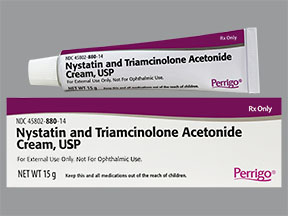 NYSTATIN-TRIAMCINOLONE CREAM
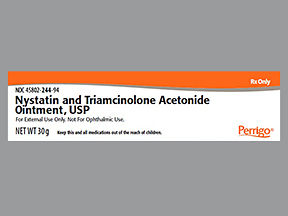 NYSTATIN-TRIAMCINOLONE OINTM
The following indications for NYSTATIN-TRIAMCINOLONE (nystatin/triamcinolone acetonide) have been approved by the FDA:
Indications:
Cutaneous candidiasis
Professional Synonyms:
Cutaneous candidosis
Cutaneous moniliasis
Indications:
Cutaneous candidiasis
Professional Synonyms:
Cutaneous candidosis
Cutaneous moniliasis
The following dosing information is available for NYSTATIN-TRIAMCINOLONE (nystatin/triamcinolone acetonide):
Dermatologic preparations of triamcinolone acetonide are applied sparingly in thin films and are rubbed gently into the affected area 2-4 times daily. The 0.5% cream and 0.5%
ointment should be used only in the treatment of dermatoses which are refractory to treatment with lower concentrations. The 0.1 and 0.5%
creams are applied 2-3 times daily according to severity of the condition. When the aerosol is applied, an area about the size of the patient's hand is sprayed for about 2 seconds from a distance of about 7.5-15 cm 3 or 4 times daily.
Occlusive dressings may be used for severe or resistant dermatoses.
For use in the mouth, a small amount (about 0.6 cm) of the 0.1% paste is pressed to the lesion without rubbing until a thin film develops; a larger amount may be required to cover some lesions. The paste is applied at bedtime and, if necessary, 2 or 3 times daily, preferably after meals.
If substantial regeneration or repair of the oral tissues does not occur after 7 days of treatment, further investigation of the etiology of the oral lesions should be undertaken.
Dosage of nystatin is expressed in terms of USP nystatin units.
ointment should be used only in the treatment of dermatoses which are refractory to treatment with lower concentrations. The 0.1 and 0.5%
creams are applied 2-3 times daily according to severity of the condition. When the aerosol is applied, an area about the size of the patient's hand is sprayed for about 2 seconds from a distance of about 7.5-15 cm 3 or 4 times daily.
Occlusive dressings may be used for severe or resistant dermatoses.
For use in the mouth, a small amount (about 0.6 cm) of the 0.1% paste is pressed to the lesion without rubbing until a thin film develops; a larger amount may be required to cover some lesions. The paste is applied at bedtime and, if necessary, 2 or 3 times daily, preferably after meals.
If substantial regeneration or repair of the oral tissues does not occur after 7 days of treatment, further investigation of the etiology of the oral lesions should be undertaken.
Dosage of nystatin is expressed in terms of USP nystatin units.
Nystatin is applied topically to the skin as a cream, ointment, or powder. Nystatin also is commercially available in fixed combination with a corticosteroid (i.e., triamcinolone acetonide) for topical application to the skin as a cream or ointment. Nystatin is applied topically to the oral cavity as an oral suspension and is administered orally as film-coated tablets. Although nystatin has been administered intravaginally, intravaginal preparations of the drug are no longer commercially available in the US.
| DRUG LABEL | DOSING TYPE | DOSING INSTRUCTIONS |
|---|---|---|
| NYSTATIN-TRIAMCINOLONE OINTM | Maintenance | Adults apply to the affected area(s) by topical route 2 times per day |
| NYSTATIN-TRIAMCINOLONE CREAM | Maintenance | Adults apply to the affected area(s) by topical route 2 times per day in the morning and evening |
| DRUG LABEL | DOSING TYPE | DOSING INSTRUCTIONS |
|---|---|---|
| NYSTATIN-TRIAMCINOLONE OINTM | Maintenance | Adults apply to the affected area(s) by topical route 2 times per day |
| NYSTATIN-TRIAMCINOLONE CREAM | Maintenance | Adults apply to the affected area(s) by topical route 2 times per day in themorning and evening |
The following drug interaction information is available for NYSTATIN-TRIAMCINOLONE (nystatin/triamcinolone acetonide):
There are 0 contraindications.
There are 0 severe interactions.
There are 0 moderate interactions.
The following contraindication information is available for NYSTATIN-TRIAMCINOLONE (nystatin/triamcinolone acetonide):
Drug contraindication overview.
No enhanced Contraindications information available for this drug.
No enhanced Contraindications information available for this drug.
There are 0 contraindications.
There are 0 severe contraindications.
There are 3 moderate contraindications.
Clinically significant contraindication, where the condition can be managed or treated before the drug may be given safely.
| Moderate List |
|---|
| Adrenocortical insufficiency |
| No disease contraindications |
| Telangiectasia |
The following adverse reaction information is available for NYSTATIN-TRIAMCINOLONE (nystatin/triamcinolone acetonide):
Adverse reaction overview.
No enhanced Common Adverse Effects information available for this drug.
No enhanced Common Adverse Effects information available for this drug.
There are 15 severe adverse reactions.
| More Frequent | Less Frequent |
|---|---|
| None. |
Folliculitis Purpura Skin and skin structure infection Skin atrophy |
| Rare/Very Rare |
|---|
|
Adrenocortical insufficiency Bullous dermatitis Cataracts Central serous chorioretinopathy Glaucoma Hypothalamic-pituitary insufficiency Ocular hypertension Skin hypopigmentation Skin striae Skin ulcer Urticaria |
There are 28 less severe adverse reactions.
| More Frequent | Less Frequent |
|---|---|
|
Erythema Stinging of skin |
Acute pain at drug application site Blurred vision Headache disorder Paresthesia Pruritus of skin Skin rash Telangiectasia Treatment site sequelae |
| Rare/Very Rare |
|---|
|
Acneiform eruption Alopecia Blistering skin Contact dermatitis Dry skin Dyschromia Eczema Glycosuria Hirsutism Hypercortisolism Hyperesthesia Hyperglycemia Miliaria Perioral dermatitis Pruritus of skin Skin irritation Skin rash Treatment site sequelae |
The following precautions are available for NYSTATIN-TRIAMCINOLONE (nystatin/triamcinolone acetonide):
No enhanced Pediatric Use information available for this drug.
Contraindicated
Severe Precaution
Management or Monitoring Precaution
Contraindicated
| None |
Severe Precaution
| None |
Management or Monitoring Precaution
| None |
Animal reproduction studies have not been performed using topical or oral nystatin. It is not known whether nystatin can cause fetal harm when administered to a pregnant woman or can affect reproduction capacity. Topical nystatin should be used during pregnancy only if potential benefits outweigh potential risks to the fetus.
Oral nystatin (oral suspension, tablets) should be used during pregnancy only if clearly needed. Fixed-combination topical preparations containing nystatin and triamcinolone acetonide should be used during pregnancy only if potential benefits outweigh potential risks to the fetus. Topical preparations containing corticosteroids should not be used extensively, in large amounts, or for prolonged periods during pregnancy.
Oral nystatin (oral suspension, tablets) should be used during pregnancy only if clearly needed. Fixed-combination topical preparations containing nystatin and triamcinolone acetonide should be used during pregnancy only if potential benefits outweigh potential risks to the fetus. Topical preparations containing corticosteroids should not be used extensively, in large amounts, or for prolonged periods during pregnancy.
It is not known whether nystatin is distributed into human milk. Nystatin and fixed combinations containing nystatin and triamcinolone acetonide should be used with caution in nursing women.
No enhanced Geriatric Use information available for this drug.
The following prioritized warning is available for NYSTATIN-TRIAMCINOLONE (nystatin/triamcinolone acetonide):
No warning message for this drug.
No warning message for this drug.
The following icd codes are available for NYSTATIN-TRIAMCINOLONE (nystatin/triamcinolone acetonide)'s list of indications:
| Cutaneous candidiasis | |
| B37.2 | Candidiasis of skin and nail |
Formulary Reference Tool