Please wait while the formulary information is being retrieved.
Drug overview for BRIDION (sugammadex sodium):
Generic name: SUGAMMADEX SODIUM
Drug class: Reversal of NM Blocking-Selective Relaxant Binding Type
Therapeutic class: Locomotor System
Sugammadex sodium, a modified gamma-cyclodextrin, is a selective relaxant binding agent.
No enhanced Uses information available for this drug.
Generic name: SUGAMMADEX SODIUM
Drug class: Reversal of NM Blocking-Selective Relaxant Binding Type
Therapeutic class: Locomotor System
Sugammadex sodium, a modified gamma-cyclodextrin, is a selective relaxant binding agent.
No enhanced Uses information available for this drug.
DRUG IMAGES
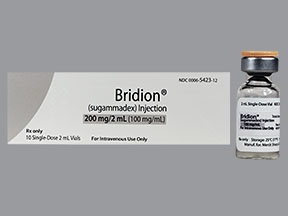 BRIDION 200 MG/2 ML VIAL
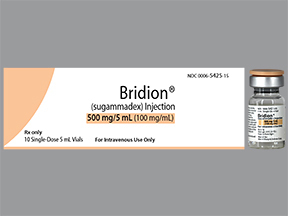 BRIDION 500 MG/5 ML VIAL
The following indications for BRIDION (sugammadex sodium) have been approved by the FDA:
Indications:
Reversal of neuromuscular blockade induced by rocuronium
Reversal of neuromuscular blockade induced by vecuronium
Professional Synonyms:
Reversal of rocuronium neuromuscular blockade
Reversal of vecuronium neuromuscular blockade
Indications:
Reversal of neuromuscular blockade induced by rocuronium
Reversal of neuromuscular blockade induced by vecuronium
Professional Synonyms:
Reversal of rocuronium neuromuscular blockade
Reversal of vecuronium neuromuscular blockade
The following dosing information is available for BRIDION (sugammadex sodium):
Dosage of sugammadex sodium is expressed in terms of sugammadex.
The appropriate dose and timing of sugammadex should be based on twitch response monitoring and the extent of spontaneous recovery that has occurred. Recommended doses are based on actual body weight (ABW) and not on the anesthetic regimen used. Use of lower than recommended doses of sugammadex may lead to an increased risk of recurrence of neuromuscular blockade and is therefore not recommended.
No clinically relevant differences in pharmacokinetic parameters have been observed between obese patients and the general population when the drug is dosed according to ABW. The current evidence therefore supports the use of ABW-based dosing for sugammadex in patients who are morbidly obese (body mass index (BMI) >=40 kg/m2) irrespective of the depth of neuromuscular blockade.
If readministration of a steroidal neuromuscular blocking agent is required (e.g., for intubation) after reversal with sugammadex, a minimum wait time should be observed. (See Readministration of Neuromuscular Blocking Agents under Cautions.)
Sugammadex is administered by direct IV (''bolus'') injection over 10 seconds into an existing IV line. The manufacturer states that the drug has only been administered as a single direct IV injection in clinical trials. Sugammadex injection should be inspected visually for particulate matter and discoloration prior to administration.
The drug may be administered through an existing IV line containing the following solutions: 5% dextrose, 0.9% sodium chloride, 5% dextrose and 0.9% sodium chloride, 2.5%
dextrose and 0.45% sodium chloride, Isolyte(R) P in 5% dextrose, Ringer's injection, or lactated Ringer's injection. The IV administration line should be adequately flushed (e.g., with 0.9% sodium chloride injection) between administration of sugammadex and other drugs.
Sugammadex should not be mixed with other drugs. Prior to use, sugammadex injection should be stored at room temperature (25degreesC) but may be exposed to temperatures of 15-30degreesC. The drug should be protected from light; if not protected from light, the vial should be used within 5 days.
No dosing information available.
No generic dosing information available.
The following drug interaction information is available for BRIDION (sugammadex sodium):
There are 0 contraindications.
There are 2 severe interactions.
These drug interactions can produce serious consequences in most patients. Actions required for severe interactions include, but are not limited to, discontinuing one or both agents, adjusting dosage, altering administration scheduling, and providing additional patient monitoring. Review the full interaction monograph for more information.
| Drug Interaction | Drug Names |
|---|---|
| Sugammadex/Toremifene SEVERITY LEVEL: 2-Severe Interaction: Action is required to reduce the risk of severe adverse interaction. MECHANISM OF ACTION: Toremifene may displace rocuronium or vecuronium from sugammadex.(1) CLINICAL EFFECTS: Use of toremifene on the same day as sugammadex may result in a delay in the recovery of the T4/T1 ratio to 0.9.(1) PREDISPOSING FACTORS: None determined. PATIENT MANAGEMENT: Patients who have received toremifene on the same day as sugammadex should be closely observed for delayed recovery from rocuronium or vecuronium.(1) DISCUSSION: Use of toremifene on the same day as sugammadex may result in a delay in the recovery of the T4/T1 ratio to 0.9.(1) |
FARESTON, TOREMIFENE CITRATE |
| Sugammadex/Hormonal Contraceptives SEVERITY LEVEL: 2-Severe Interaction: Action is required to reduce the risk of severe adverse interaction. MECHANISM OF ACTION: Sugammadex may bind to hormonal contraceptives.(1,2) CLINICAL EFFECTS: Use of sugammadex may result in decreased levels of hormonal contraceptive similar to those seen with a missed dose of an oral contraceptive, which may result in decreased hormonal contraceptive effectiveness.(1,2) PREDISPOSING FACTORS: None determined. PATIENT MANAGEMENT: The US manufacturer of sugammadex recommends that all patients using hormonal contraceptives use an additional non-hormonal contraceptive method for 7 days following the administration of sugammadex.(1) The UK manufacturer of sugammadex recommends that patients taking oral hormonal contraceptives should be instructed to follow the missed dose instructions for their oral hormonal contraceptive on the day they receive sugammadex. Patients taking non-oral hormonal contraceptives should use an additional non-hormonal contraceptive method for 7 days following the administration of sugammadex and should refer to the advice in the package leaflet of their non-oral hormonal contraceptive.(2) DISCUSSION: Use of sugammadex may result in decreased levels of hormonal contraceptive similar to those seen with a missed dose of an oral contraceptive, which may result in decreased hormonal contraceptive effectiveness.(1,2) |
2-METHOXYESTRADIOL, AFIRMELLE, ALTAVERA, ALYACEN, AMETHIA, AMETHYST, ANNOVERA, APRI, ARANELLE, ASHLYNA, AUBRA, AUBRA EQ, AUROVELA, AUROVELA 24 FE, AUROVELA FE, AVERI, AVIANE, AYUNA, AZURETTE, BALCOLTRA, BALZIVA, BEYAZ, BLISOVI 24 FE, BLISOVI FE, BRIELLYN, CAMILA, CAMRESE, CAMRESE LO, CAZIANT, CHARLOTTE 24 FE, CHATEAL EQ, CRYSELLE, CYRED, CYRED EQ, DASETTA, DAYSEE, DEBLITANE, DEPO-PROVERA, DEPO-SUBQ PROVERA 104, DESOGESTR-ETH ESTRAD ETH ESTRA, DESOGESTREL-ETHINYL ESTRADIOL, DIETHYLSTILBESTROL, DOLISHALE, DROSPIRENONE-ETH ESTRA-LEVOMEF, DROSPIRENONE-ETHINYL ESTRADIOL, ELINEST, ELLA, ELURYNG, EMZAHH, ENILLORING, ENPRESSE, ENSKYCE, ERRIN, ESTARYLLA, ESTRADIOL, ESTRADIOL BENZOATE, ESTRADIOL CYPIONATE, ESTRADIOL HEMIHYDRATE, ESTRADIOL HEMIHYDRATE MICRO, ESTRADIOL MICRONIZED, ESTRADIOL VALERATE, ESTRIOL, ESTRIOL MICRONIZED, ESTRONE, ETHINYL ESTRADIOL, ETONOGESTREL-ETHINYL ESTRADIOL, FALMINA, FEIRZA, FEMLYV, FINZALA, GALBRIELA, GEMMILY, GWYN LO, HAILEY, HAILEY 24 FE, HAILEY FE, HALOETTE, HEATHER, ICLEVIA, INCASSIA, INTROVALE, ISIBLOOM, JAIMIESS, JASMIEL, JENCYCLA, JOLESSA, JOYEAUX, JULEBER, JUNEL, JUNEL FE, JUNEL FE 24, KAITLIB FE, KALLIGA, KARIVA, KELNOR 1-35, KURVELO, LARIN, LARIN 24 FE, LARIN FE, LESSINA, LEVONEST, LEVONORG-ETH ESTRAD-FE BISGLYC, LEVONORGESTREL-ETH ESTRADIOL, LO LOESTRIN FE, LO-ZUMANDIMINE, LOESTRIN, LOESTRIN FE, LOJAIMIESS, LORYNA, LOW-OGESTREL, LUIZZA, LUTERA, LYLEQ, LYZA, MARLISSA, MEDROXYPROGESTERONE ACETATE, MELEYA, MIBELAS 24 FE, MICROGESTIN, MICROGESTIN FE, MILI, MINZOYA, MONO-LINYAH, NATAZIA, NECON, NEXPLANON, NEXTSTELLIS, NIKKI, NORA-BE, NORELGESTROMIN-ETH ESTRADIOL, NORETHINDRON-ETHINYL ESTRADIOL, NORETHINDRONE, NORETHINDRONE-E.ESTRADIOL-IRON, NORGESTIMATE-ETHINYL ESTRADIOL, NORTREL, NUVARING, NYLIA, OCELLA, ORQUIDEA, ORTHO TRI-CYCLEN, ORTHO-NOVUM, PHILITH, PIMTREA, PORTIA, RECLIPSEN, RIVELSA, ROSYRAH, SAFYRAL, SETLAKIN, SHAROBEL, SIMLIYA, SIMPESSE, SLYND, SPRINTEC, SYEDA, TARINA 24 FE, TARINA FE, TARINA FE 1-20 EQ, TAYTULLA, TILIA FE, TRI-ESTARYLLA, TRI-LEGEST FE, TRI-LINYAH, TRI-LO-ESTARYLLA, TRI-LO-MARZIA, TRI-LO-MILI, TRI-LO-SPRINTEC, TRI-MILI, TRI-SPRINTEC, TRI-VYLIBRA, TRI-VYLIBRA LO, TULANA, TURQOZ, TWIRLA, TYBLUME, TYDEMY, VALTYA, VELIVET, VESTURA, VIENVA, VIORELE, VOLNEA, VYFEMLA, VYLIBRA, WERA, WYMZYA FE, XARAH FE, XELRIA FE, XULANE, YASMIN 28, YAZ, ZAFEMY, ZARAH, ZOVIA 1-35, ZUMANDIMINE |
There are 0 moderate interactions.
The following contraindication information is available for BRIDION (sugammadex sodium):
Drug contraindication overview.
*Known hypersensitivity to the drug or any ingredient in the formulation. (See Anaphylaxis and Hypersensitivity under Cautions.)
*Known hypersensitivity to the drug or any ingredient in the formulation. (See Anaphylaxis and Hypersensitivity under Cautions.)
There are 2 contraindications.
Absolute contraindication.
| Contraindication List |
|---|
| Chronic kidney disease stage 4 (severe) GFR 15-29 ml/min |
| Chronic kidney disease stage 5 (failure) GFr<15 ml/min |
There are 4 severe contraindications.
Adequate patient monitoring is recommended for safer drug use.
| Severe List |
|---|
| Chronic kidney disease stage 2 (mild) GFR 60-89 ml/min |
| Chronic kidney disease stage 3A (moderate) GFR 45-59 ml/min |
| Chronic kidney disease stage 3B (moderate) GFR 30-44 ml/min |
| Increased risk of bleeding due to coagulation disorder |
There are 1 moderate contraindications.
Clinically significant contraindication, where the condition can be managed or treated before the drug may be given safely.
| Moderate List |
|---|
| Kidney disease with likely reduction in glomerular filtration rate (GFr) |
The following adverse reaction information is available for BRIDION (sugammadex sodium):
Adverse reaction overview.
Adverse effects reported in 10% or more of patients receiving sugammadex in clinical studies and with an incidence greater than that observed with placebo include vomiting, pain, nausea, hypotension, and headache.
Adverse effects reported in 10% or more of patients receiving sugammadex in clinical studies and with an incidence greater than that observed with placebo include vomiting, pain, nausea, hypotension, and headache.
There are 20 severe adverse reactions.
| More Frequent | Less Frequent |
|---|---|
| None. |
Anaphylaxis Anemia Bradycardia Hypertension Hypocalcemia Hypotension Pain in oropharynx Pulmonary edema |
| Rare/Very Rare |
|---|
|
Acute respiratory failure Atrial fibrillation Atrioventricular block Cardiac arrest Dyspnea Hypersensitivity drug reaction Laryngismus ST segment changes Supraventricular premature beats Supraventricular tachycardia Tachycardia Ventricular fibrillation |
There are 28 less severe adverse reactions.
| More Frequent | Less Frequent |
|---|---|
|
Headache disorder |
Acute abdominal pain Chills Cough Depression Dizziness Erythema Fever Flatulence Hypoesthesia Increased creatine kinase level Infection Injection site sequelae Insomnia Musculoskeletal pain Myalgia Nausea Nervousness Pain Pain in extremities Proteinuria Pruritus of skin Symptoms of anxiety Vertigo Vomiting Xerostomia |
| Rare/Very Rare |
|---|
|
Ventricular tachycardia Wheezing |
The following precautions are available for BRIDION (sugammadex sodium):
The manufacturer states that safety and efficacy of sugammadex have not been established in pediatric patients; however, the drug has been used for reversal of moderate rocuronium-induced neuromuscular blockade in pediatric patients. In a study evaluating sugammadex for reversal of rocuronium-induced neuromuscular blockade in pediatric and adult patients undergoing surgery, similar recovery times were observed in pediatric patients 2-17 years of age and adults. Sugammadex plasma concentrations were similar in the different age groups, and no overall difference in safety was observed.
Animal studies have demonstrated increased sugammadex bone deposition in juvenile rats compared with adult rats. Decreased bone length and tooth abnormalities (i.e., discoloration and disturbance of enamel formation) were observed in juvenile rats receiving IV sugammadex daily for 28 days at doses approximately 0.1-3 times the maximum recommended human dose; these effects were not observed with once-weekly sugammadex doses up to 1.2 times the maximum recommended human dose.
Contraindicated
Severe Precaution
Management or Monitoring Precaution
Animal studies have demonstrated increased sugammadex bone deposition in juvenile rats compared with adult rats. Decreased bone length and tooth abnormalities (i.e., discoloration and disturbance of enamel formation) were observed in juvenile rats receiving IV sugammadex daily for 28 days at doses approximately 0.1-3 times the maximum recommended human dose; these effects were not observed with once-weekly sugammadex doses up to 1.2 times the maximum recommended human dose.
Contraindicated
| None |
Severe Precaution
| None |
Management or Monitoring Precaution
| None |
There are no clinical trial data regarding use of sugammadex in pregnant women. Data from a pharmacovigilance safety database and published literature in pregnant women are insufficient to inform a drug-associated risk. Animal studies revealed no evidence of malformations when sugammadex was administered during the period of organogenesis in rats and rabbits at maternal exposures up to 6 and 8 times, respectively, the maximum recommended human dose. However, incomplete ossification and reduced fetal body weight were observed in rabbits at sugammadex doses 8 times the maximum recommended human dose, which corresponds to a dose level that also produced maternal toxicity.
It is not known whether sugammadex is distributed into human milk or if the drug has any effect on milk production or the nursing infant. The drug is distributed into milk in rats. The benefits of breast-feeding and the importance of sugammadex to the woman should be considered along with the potential adverse effects on the breast-fed infant from the drug or underlying maternal condition.
In a study evaluating use of sugammadex in geriatric patients, median time to recovery of the train-of-four (TOF) ratio to 0.9 following administration of sugammadex 2 mg/kg at the reappearance of T2 was 2.5 and 3.6
minutes in patients 65-74 years of age and those 75 years of age or older, respectively, compared with 2.2 minutes in younger adults (18-64 years of age). Across all clinical trials, geriatric patients 65 years of age or older who received sugammadex 4 mg/kg at 1-2 posttetanic counts had a median time to recovery of 2.5 minutes compared with 2 minutes in younger adults.
minutes in patients 65-74 years of age and those 75 years of age or older, respectively, compared with 2.2 minutes in younger adults (18-64 years of age). Across all clinical trials, geriatric patients 65 years of age or older who received sugammadex 4 mg/kg at 1-2 posttetanic counts had a median time to recovery of 2.5 minutes compared with 2 minutes in younger adults.
The following prioritized warning is available for BRIDION (sugammadex sodium):
No warning message for this drug.
No warning message for this drug.
The following icd codes are available for BRIDION (sugammadex sodium)'s list of indications:
| Reversal of neuromuscular blockade induced by rocuronium | |
| T48.1x1A | Poisoning by skeletal muscle relaxants [neuromuscular blocking agents], accidental (unintentional), initial encounter |
| T48.1x2A | Poisoning by skeletal muscle relaxants [neuromuscular blocking agents], intentional self-harm, initial encounter |
| T48.1x3A | Poisoning by skeletal muscle relaxants [neuromuscular blocking agents], assault, initial encounter |
| T48.1x4A | Poisoning by skeletal muscle relaxants [neuromuscular blocking agents], undetermined, initial encounter |
| T48.1x5A | Adverse effect of skeletal muscle relaxants [neuromuscular blocking agents], initial encounter |
| Reversal of neuromuscular blockade induced by vecuronium | |
| T48.1x1A | Poisoning by skeletal muscle relaxants [neuromuscular blocking agents], accidental (unintentional), initial encounter |
| T48.1x2A | Poisoning by skeletal muscle relaxants [neuromuscular blocking agents], intentional self-harm, initial encounter |
| T48.1x3A | Poisoning by skeletal muscle relaxants [neuromuscular blocking agents], assault, initial encounter |
| T48.1x4A | Poisoning by skeletal muscle relaxants [neuromuscular blocking agents], undetermined, initial encounter |
| T48.1x5A | Adverse effect of skeletal muscle relaxants [neuromuscular blocking agents], initial encounter |
Formulary Reference Tool