Please wait while the formulary information is being retrieved.
Drug overview for NEO-SYNALAR (neomycin sulfate/fluocinolone acetonide):
Generic name: NEOMYCIN SULFATE/FLUOCINOLONE ACETONIDE (NEE-oh-MYE-sin/FLOO-oh-SIN-oh-lone)
Drug class: Topical Corticosteroids
Therapeutic class: Dermatological
Fluocinolone acetonide and fluocinonide are synthetic fluorinated Neomycin is an aminoglycoside antibiotic. corticosteroids.
Fluocinolone acetonide and fluocinonide share the actions of the other topical corticosteroids and are used for the relief of the inflammatory manifestations of corticosteroid-responsive dermatoses.
DRUG IMAGES
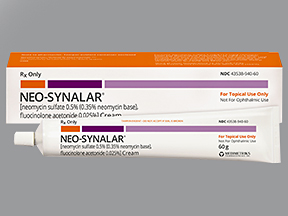 NEO-SYNALAR 0.5%-0.025% CREAM
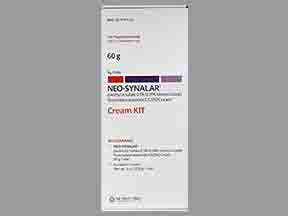 NEO-SYNALAR 0.5-0.025% CRM KIT
The following indications for NEO-SYNALAR (neomycin sulfate/fluocinolone acetonide) have been approved by the FDA:
Indications:
Minor bacterial skin infections
Skin inflammation
Professional Synonyms:
Dermatitis
Minor bacterial skin infection
Indications:
Minor bacterial skin infections
Skin inflammation
Professional Synonyms:
Dermatitis
Minor bacterial skin infection
The following dosing information is available for NEO-SYNALAR (neomycin sulfate/fluocinolone acetonide):
Fluocinolone acetonide shampoo should be prepared by a pharmacist at the time of dispensing the shampoo; contents of the 12-mg capsule should be mixed with the shampoo base supplied by the manufacturer. The extemporaneously prepared shampoo is stable for 3 months from the time of compounding. The extemporaneously prepared shampoo must be shaken well prior to administration.
Topical fluocinolone acetonide or fluocinonide cream, gel, ointment, and solution are applied sparingly in thin films and rubbed gently into the skin 2-4 times daily depending on the severity of the condition. Occlusive dressings may be used for severe or resistant dermatoses.
For the treatment of atopic dermatitis in adults, fluocinolone acetonide 0.01% topical oil is applied as a thin film 3 times daily.
For the treatment of moderate to severe atopic dermatitis in children 2 years of age or older, a thin film of fluocinolone acetonide 0.01% topical oil may be applied twice daily to affected areas for no longer than 4 weeks. The topical oil should not be applied to the face or diaper area.
Application to intertriginous areas also should be avoided because of an increased risk of developing potentially irreversible adverse local effects (e.g., striae, atrophy, telangiectasia).
For the treatment of seborrheic dermatitis of the scalp in adults, no more than 30 mL of fluocinolone acetonide 0.01% shampoo is applied to the scalp once daily, lathered, and allowed to remain on the scalp for about 5 minutes. The hair and scalp are then rinsed thoroughly with water.
Fluocinolone acetonide shampoo should not be used with occlusive dressings and patients should be warned that treated areas of the scalp should not be bandaged or otherwise covered or wrapped as to be occlusive, unless directed by a clinician.
For the treatment of psoriasis of the scalp in adults, a thin film of fluocinolone acetonide 0.01% topical oil should be applied to wet or dampened hair and scalp, massaged well, and covered with the manufacturer-supplied shower cap. The oil should be allowed to remain on the scalp overnight or for a minimum of 4 hours following application before being washed off with regular shampoo and rinsed thoroughly with water.
No enhanced Administration information available for this drug.
| DRUG LABEL | DOSING TYPE | DOSING INSTRUCTIONS |
|---|---|---|
| NEO-SYNALAR 0.5%-0.025% CREAM | Maintenance | Adults apply a thin layer to the affected area(s) by topical route 2-4 times daily |
No generic dosing information available.
The following drug interaction information is available for NEO-SYNALAR (neomycin sulfate/fluocinolone acetonide):
There are 0 contraindications.
There are 0 severe interactions.
There are 0 moderate interactions.
The following contraindication information is available for NEO-SYNALAR (neomycin sulfate/fluocinolone acetonide):
Drug contraindication overview.
No enhanced Contraindications information available for this drug.
No enhanced Contraindications information available for this drug.
There are 0 contraindications.
There are 2 severe contraindications.
Adequate patient monitoring is recommended for safer drug use.
| Severe List |
|---|
| Bacterial skin and skin structure infection |
| Severe burns |
There are 2 moderate contraindications.
Clinically significant contraindication, where the condition can be managed or treated before the drug may be given safely.
| Moderate List |
|---|
| Hypothalamic-pituitary insufficiency |
| Large open wound |
The following adverse reaction information is available for NEO-SYNALAR (neomycin sulfate/fluocinolone acetonide):
Adverse reaction overview.
No enhanced Common Adverse Effects information available for this drug.
No enhanced Common Adverse Effects information available for this drug.
There are 20 severe adverse reactions.
| More Frequent | Less Frequent |
|---|---|
|
Dermatitis due to topical drug Skin rash |
Folliculitis Purpura Skin and skin structure infection Skin atrophy |
| Rare/Very Rare |
|---|
|
Adrenocortical insufficiency Bullous dermatitis Cataracts Central serous chorioretinopathy Glaucoma Growth failure Hypothalamic-pituitary insufficiency Intracranial hypertension Ocular hypertension Ototoxicity Skin hypopigmentation Skin striae Skin ulcer Urticaria |
There are 24 less severe adverse reactions.
| More Frequent | Less Frequent |
|---|---|
|
Erythema Stinging of skin |
Acute pain at drug application site Blurred vision Headache disorder Paresthesia Pruritus of skin Skin rash Telangiectasia Treatment site sequelae |
| Rare/Very Rare |
|---|
|
Acneiform eruption Alopecia Blistering skin Contact dermatitis Dry skin Dyschromia Glycosuria Hirsutism Hypercortisolism Hyperesthesia Hyperglycemia Miliaria Perioral dermatitis Skin irritation |
The following precautions are available for NEO-SYNALAR (neomycin sulfate/fluocinolone acetonide):
No enhanced Pediatric Use information available for this drug.
Contraindicated
Severe Precaution
Management or Monitoring Precaution
Contraindicated
| None |
Severe Precaution
| None |
Management or Monitoring Precaution
| None |
Aminoglycosides may cause fetal harm following systemic absorption in pregnant women. The drugs cross the placenta and total, irreversible, bilateral, congenital deafness has been reported in some children whose mothers received parenteral streptomycin during pregnancy. Fixed-combination topical preparations containing neomycin sulfate and a corticosteroid should be used during pregnancy only if potential benefits justify potential risks to the fetus.
Corticosteroids have been teratogenic in animals (mice, rabbits) when applied topically. If the irrigation solution containing neomycin sulfate and polymyxin B sulfate is used for bladder irrigation during pregnancy, the patient should be informed of the potential hazard to the fetus.
Corticosteroids have been teratogenic in animals (mice, rabbits) when applied topically. If the irrigation solution containing neomycin sulfate and polymyxin B sulfate is used for bladder irrigation during pregnancy, the patient should be informed of the potential hazard to the fetus.
Clinically unimportant amounts of neomycin may distribute into breast milk following systemic absorption of the drug. Fixed-combination topical preparations containing neomycin sulfate and a corticosteroid should be used with caution in nursing women. Corticosteroids administered systemically (e.g., orally) are distributed into human milk, and systemic absorption may occur when the drugs are applied topically.
No enhanced Geriatric Use information available for this drug.
The following prioritized warning is available for NEO-SYNALAR (neomycin sulfate/fluocinolone acetonide):
No warning message for this drug.
No warning message for this drug.
The following icd codes are available for NEO-SYNALAR (neomycin sulfate/fluocinolone acetonide)'s list of indications:
| Minor bacterial skin infections | |
| L08.89 | Other specified local infections of the skin and subcutaneous tissue |
| L08.9 | Local infection of the skin and subcutaneous tissue, unspecified |
| Skin inflammation | |
| H01.81 | Other specified inflammation of right upper eyelid |
| H01.82 | Other specified inflammation of right lower eyelid |
| H01.83 | Other specified inflammation of right eye, unspecified eyelid |
| H01.84 | Other specified inflammation of left upper eyelid |
| H01.85 | Other specified inflammation of left lower eyelid |
| H01.86 | Other specified inflammation of left eye, unspecified eyelid |
| H01.89 | Other specified inflammation of unspecified eye, unspecified eyelid |
| H01.8A | Other specified inflammation of right eye, upper and lower eyelids |
| H01.8B | Other specified inflammation of left eye, upper and lower eyelids |
| L20 | Atopic dermatitis |
| L20.8 | Other atopic dermatitis |
| L20.89 | Other atopic dermatitis |
| L20.9 | Atopic dermatitis, unspecified |
| L21 | Seborrheic dermatitis |
| L21.8 | Other seborrheic dermatitis |
| L21.9 | Seborrheic dermatitis, unspecified |
| L25 | Unspecified contact dermatitis |
| L30.8 | Other specified dermatitis |
| L30.9 | Dermatitis, unspecified |
| L40 | Psoriasis |
| L40.1 | Generalized pustular psoriasis |
| L40.8 | Other psoriasis |
| L40.9 | Psoriasis, unspecified |
| R21 | Rash and other nonspecific skin eruption |
Formulary Reference Tool