Please wait while the formulary information is being retrieved.
Drug overview for NITHIODOTE (sodium nitrite/sodium thiosulfate):
Generic name: SODIUM NITRITE/SODIUM THIOSULFATE
Drug class: Nitrates
Therapeutic class: Antidotes and other Reversal Agents
Sodium nitrite, an inorganic salt, is a cyanide antidote. Sodium thiosulfate is a cyanide antidote.
No enhanced Uses information available for this drug.
Generic name: SODIUM NITRITE/SODIUM THIOSULFATE
Drug class: Nitrates
Therapeutic class: Antidotes and other Reversal Agents
Sodium nitrite, an inorganic salt, is a cyanide antidote. Sodium thiosulfate is a cyanide antidote.
No enhanced Uses information available for this drug.
DRUG IMAGES
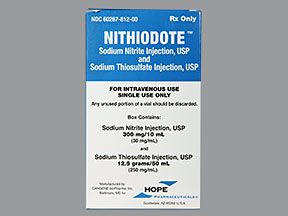 NITHIODOTE 300 MG-12.5 GRAM
The following indications for NITHIODOTE (sodium nitrite/sodium thiosulfate) have been approved by the FDA:
Indications:
Cyanide toxicity
Professional Synonyms:
Cyanide intoxication
Indications:
Cyanide toxicity
Professional Synonyms:
Cyanide intoxication
The following dosing information is available for NITHIODOTE (sodium nitrite/sodium thiosulfate):
It isessential that the manufacturer's labeling be consulted for more detailed information on dosage and administration of this drug. Dosage summary:
Sodium nitrite and sodium thiosulfate should be administered as early as possible after a diagnosis of acute life-threatening cyanide poisoning has been established. Both drugs are administered by slow IV injection. Sodium nitrite should be administered first, followed immediately by sodium thiosulfate.
(See Table 1 for dosage recommendations.) Blood pressure must be monitored during infusion. The rate of infusion should be decreased if significant hypotension is noted.
Table 1: Dosage of Sodium Nitrite and Sodium Thiosulfate for Cyanide Poisoning in Pediatric Patients
Population Dosage Regimen Children Sodium nitrite: 0.2 mL/kg (6 mg/kg or 6-8 mL/m2 BSA) of sodium nitrite at the rate of 2.5 to 5 mL/minute not to exceed 10 mL Sodium thiosulfate (250 mg/mL): 1 mL/kg of body weight (250 mg/kg or approximately 30-40 mL/m2 of BSA) not to exceed 50 mL total d ose immediately following administration of sodium nitrite
If signs of poisoning reappear, repeat treatment using one-half the original dose of both sodium nitrite and sodium thiosulfate.
In patients with known anemia, it is recommended that the dosage of sodium nitrite should be reduced proportionately to the hemoglobin concentration.
Patients should be monitored for at least 24-48 hours after sodium thiosulfate administration for adequacy of oxygenation and perfusion and for recurrent signs and symptoms of cyanide toxicity. When possible, obtain hemoglobin/hematocrit when treatment is initiated. Measurements of oxygen saturation using standard pulse oximetry and calculated oxygen saturation values based on measured PO2 are unreliable in the presence of methemoglobinemia.
The safety of administering other cyanide antidotes simultaneously with sodium nitrite has not been established. If a decision is made to administer another cyanide antidote with sodium nitrite, these drugs should not be administered concurrently in the same IV line.
Sodium nitrite and sodium thiosulfate should be administered as early as possible after a diagnosis of acute life-threatening cyanide poisoning has been established. Both drugs are administered by slow IV injection. Sodium nitrite should be administered first, followed immediately by sodium thiosulfate.
(See Table 2 for dosage recommendations.) Blood pressure must be monitored during infusion. The rate of infusion should be decreased if significant hypotension is noted.
Table 2: Dosage of Sodium Nitrite and Sodium Thiosulfate for Cyanide Poisoning in Adults
Population Adults Sodium nitrite: 10 mL of sodium nitrite at the rate of 2.5 to 5 mL/minute Sodium thiosulfate (250 mg/mL): 50 mL of sodium thiosulfate immediately following administration of sodium nitrite
If signs of poisoning reappear, repeat treatment using one-half the original dose of both sodium nitrite and sodium thiosulfate.
In patients with known anemia, it is recommended that the dosage of sodium nitrite should be reduced proportionately to the hemoglobin concentration.
Patients should be monitored for at least 24-48 hours after sodium thiosulfate administration for adequacy of oxygenation and perfusion and for recurrent signs and symptoms of cyanide toxicity. When possible, obtain hemoglobin/hematocrit when treatment is initiated. Measurements of oxygen saturation using standard pulse oximetry and calculated oxygen saturation values based on measured PO2 are unreliable in the presence of methemoglobinemia.
The safety of administering other cyanide antidotes simultaneously with sodium nitrite has not been established. If a decision is made to administer another cyanide antidote with sodium nitrite, these drugs should not be administered concurrently in the same IV line.
Sodium nitrite and sodium thiosulfate should be administered as early as possible after a diagnosis of acute life-threatening cyanide poisoning has been established. Both drugs are administered by slow IV injection. Sodium nitrite should be administered first, followed immediately by sodium thiosulfate.
(See Table 1 for dosage recommendations.) Blood pressure must be monitored during infusion. The rate of infusion should be decreased if significant hypotension is noted.
Table 1: Dosage of Sodium Nitrite and Sodium Thiosulfate for Cyanide Poisoning in Pediatric Patients
Population Dosage Regimen Children Sodium nitrite: 0.2 mL/kg (6 mg/kg or 6-8 mL/m2 BSA) of sodium nitrite at the rate of 2.5 to 5 mL/minute not to exceed 10 mL Sodium thiosulfate (250 mg/mL): 1 mL/kg of body weight (250 mg/kg or approximately 30-40 mL/m2 of BSA) not to exceed 50 mL total d ose immediately following administration of sodium nitrite
If signs of poisoning reappear, repeat treatment using one-half the original dose of both sodium nitrite and sodium thiosulfate.
In patients with known anemia, it is recommended that the dosage of sodium nitrite should be reduced proportionately to the hemoglobin concentration.
Patients should be monitored for at least 24-48 hours after sodium thiosulfate administration for adequacy of oxygenation and perfusion and for recurrent signs and symptoms of cyanide toxicity. When possible, obtain hemoglobin/hematocrit when treatment is initiated. Measurements of oxygen saturation using standard pulse oximetry and calculated oxygen saturation values based on measured PO2 are unreliable in the presence of methemoglobinemia.
The safety of administering other cyanide antidotes simultaneously with sodium nitrite has not been established. If a decision is made to administer another cyanide antidote with sodium nitrite, these drugs should not be administered concurrently in the same IV line.
Sodium nitrite and sodium thiosulfate should be administered as early as possible after a diagnosis of acute life-threatening cyanide poisoning has been established. Both drugs are administered by slow IV injection. Sodium nitrite should be administered first, followed immediately by sodium thiosulfate.
(See Table 2 for dosage recommendations.) Blood pressure must be monitored during infusion. The rate of infusion should be decreased if significant hypotension is noted.
Table 2: Dosage of Sodium Nitrite and Sodium Thiosulfate for Cyanide Poisoning in Adults
Population Adults Sodium nitrite: 10 mL of sodium nitrite at the rate of 2.5 to 5 mL/minute Sodium thiosulfate (250 mg/mL): 50 mL of sodium thiosulfate immediately following administration of sodium nitrite
If signs of poisoning reappear, repeat treatment using one-half the original dose of both sodium nitrite and sodium thiosulfate.
In patients with known anemia, it is recommended that the dosage of sodium nitrite should be reduced proportionately to the hemoglobin concentration.
Patients should be monitored for at least 24-48 hours after sodium thiosulfate administration for adequacy of oxygenation and perfusion and for recurrent signs and symptoms of cyanide toxicity. When possible, obtain hemoglobin/hematocrit when treatment is initiated. Measurements of oxygen saturation using standard pulse oximetry and calculated oxygen saturation values based on measured PO2 are unreliable in the presence of methemoglobinemia.
The safety of administering other cyanide antidotes simultaneously with sodium nitrite has not been established. If a decision is made to administer another cyanide antidote with sodium nitrite, these drugs should not be administered concurrently in the same IV line.
No enhanced Administration information available for this drug.
No dosing information available.
No generic dosing information available.
The following drug interaction information is available for NITHIODOTE (sodium nitrite/sodium thiosulfate):
There are 2 contraindications.
These drug combinations generally should not be dispensed or administered to the same patient. A manufacturer label warning that indicates the contraindication warrants inclusion of a drug combination in this category, regardless of clinical evidence or lack of clinical evidence to support the contraindication.
| Drug Interaction | Drug Names |
|---|---|
| CGMP Specific PDE Type-5 Inhibitors/Nitrates SEVERITY LEVEL: 1-Contraindicated Drug Combination: This drug combination is contraindicated and generally should not be dispensed or administered to the same patient. MECHANISM OF ACTION: Nitrates activate guanyl cyclase, an enzyme that increases levels of cyclic guanosine monophosphate (cGMP). cGMP produces smooth muscle relaxation. Avanafil,(1) sildenafil,(2) tadalafil,(3,4) and vardenafil (5-7) inhibit phosphodiesterase type 5 (PDE5), which is responsible for the breakdown of cGMP. Concurrent use of nitrates with avanafil,(1) sildenafil,(2) tadalafil,(3,4) or vardenafil(5-7) results in potentiation of the effect of nitrates. CLINICAL EFFECTS: The concurrent use of CGMP specific PDE type-5 inhibitors and nitrates potentiates the hypotensive effects of nitrates(1-7) which may result in dizziness, syncope, heart attack, or stroke.(4) The concurrent use of sildenafil and sodium nitroprusside may potentiate the antiaggregatory effect of sodium nitroprusside in addition to increased hypotensive effects.(2) PREDISPOSING FACTORS: Plasma levels of the PDE type-5 inhibitor may be higher in the following patients: those older than 65, with hepatic impairment, with severe renal impairment, or using concomitant CYP3A4 inhibitors. This may increase the severity of the interaction. PATIENT MANAGEMENT: The administration of avanafil to patients receiving organic nitrates, either regularly and/or intermittently, is contraindicated. In a patient who has taken avanafil, at least 12 hours should elapse after the last dose of avanafil before nitrate administration is considered and it should only be administered under close medical supervision with appropriate hemodynamic monitoring.(1) The administration of sildenafil to patients receiving organic nitrates, either regularly and/or intermittently, in any form is contraindicated.(2) The administration of tadalafil to patients receiving any form of organic nitrate, either regularly and/or intermittently, is contraindicated.(3,4) Patients should be instructed to seek immediate medical attention if they experience anginal chest pain following tadalafil. In such cases where nitrate administration is considered medically necessary, at least 48 hours should elapse after tadalafil administration before nitrate administration is considered. In such cases, nitrates should only be administered under close medical supervision with appropriate hemodynamic monitoring.(4) The administration of vardenafil to patients receiving nitrates or nitric oxide donors is contraindicated.(5-7) In patients prescribed vardenafil in whom nitrate administration is deemed medically necessary in a life-threatening situation, the Canadian manufacturer of vardenafil states that at least 24 hours should have elapsed after the last dose of vardenafil before the nitrate administration is considered. Nitrates should only be administered under close medical supervision with appropriate hemodynamic monitoring.(7) The concomitant use of nicorandil(8) or subinguinal nitroglycerin(9) and PDE type-5 inhibitors is contraindicated. Treat hypotension resulting from concurrent use as a nitrate overdose, with elevation of the extremities and central volume expansion.(10) DISCUSSION: Nitrates activate guanylate cyclase, an enzyme that increases levels of cGMP. cGMP produces smooth muscle relaxation. Avanafil,(1) sildenafil,(2) tadalafil,(3,4) and vardenafil (5-7) inhibit PDE5, which is responsible for the breakdown of cGMP. Concurrent use of nitrates with avanafil,(1) sildenafil,(2) tadalafil,(3,4) or vardenafil(5-7) results in potentiation of the effect of nitrates. It is unknown when nitrates, if necessary, can be safely administered to patients who have taken CGMP specific PDE type-5 inhibitors. Following a single 100 mg oral dose of sildenafil, peak plasma levels are approximately 440 ng/mL and levels 24 hours post dose are approximately 2 ng/ml. Sildenafil plasma levels at 24 hours post dose are three to eight times higher in the following patients: those age greater than 65, those with hepatic impairment, those with severe renal impairment (creatinine clearance less than 30 ml/min), and those with concomitant use of potent CYP P-450-3A4 inhibitors (erythromycin). Although plasma levels of sildenafil are lower at 24 hours post dose, the manufacturer of sildenafil states that it is still unknown whether nitrates can safely be coadministered at that time.(2) In vitro studies with human platelets have shown that sildenafil potentiates the antiaggregatory effect of sodium nitroprusside.(2) In a study of 150 subjects who received tadalafil (20 mg) daily for 7 days, sublingual nitroglycerin was administered at 2, 4, 8, 24, 48, 72, and 96 hours after tadalafil. A significant interaction between tadalafil and nitroglycerin was observed up to and including 24 hours post-tadalafil. At 48 hours, the interaction was not observed by most hemodynamic measures. After 48 hours, the interaction was not detectable.(4) In a population-based cohort study of 61,487 men who received nitrates, 5,710 (9%) concurrently received PDE Type-5 inhibitors (PDE5i). Crude hazard ratios found a significant and inverse association between combination use of nitrates and PDE5i and all cause, cardiovascular, and non-cardiovascular mortality. All-cause mortality incidence rates were 2.69 cases per 100 person-years for the nitrate and PDE5i group vs 3.83 cases per 100 person-years in the nitrate-only group. Concurrent use of nitrates and PDE5i found a multivariate adjusted HR for all-cause mortality of 1.39 (95% CI: 1.28-1.51). Concurrent use of nitrates and PDE5i found an adjusted HR for cardiovascular death, non-cardiovascular death, myocardial infarction, heart failure, revascularization, and major adverse cardiovascular event (MACE) in patients treated with both nitrates and PDE5i was 1.34 (95% CI: 1.11-1.62), 1.40 (95% CI: 1.27-1.54), 1.72 (95% CI: 1.55-1.90), 1.67 (95% CI: 1.48-1.90), 1.95 (95% CI: 1.78-2.13), and 1.70 (95% CI: 1.58-1.83), respectively, compared with patients with nitrates only.(11) |
ALYQ, AVANAFIL, CIALIS, ENTADFI, OPSYNVI, REVATIO, SILDENAFIL CITRATE, STENDRA, TADALAFIL, TADLIQ, VARDENAFIL HCL, VIAGRA, VYBRIQUE |
| Riociguat/Nitrates & Nitric Oxide Donors SEVERITY LEVEL: 1-Contraindicated Drug Combination: This drug combination is contraindicated and generally should not be dispensed or administered to the same patient. MECHANISM OF ACTION: Nitrates activate guanyl cyclase, an enzyme that increases levels of cyclic guanosine monophosphate (cGMP), which produces smooth muscle relaxation. Riociguat stimulates the nitric oxide-soluble guanylate cyclase-cGMP pathway and also increases cGMP. Concurrent use of nitrates with riociguat results in potentiation of the effect of both agents.(1) CLINICAL EFFECTS: The concurrent use riociguat and nitrates potentiates the hypotensive effects of both agents, which may result in dizziness, syncope, heart attack, or stroke.(1) PREDISPOSING FACTORS: None determined. PATIENT MANAGEMENT: The administration of riociguat to patients receiving nitrates, or nitric oxide donors, in any form is contraindicated.(1) DISCUSSION: Riociguat (2.5 mg) potentiated the blood pressure lowering effect of sublingual nitroglycerin (0.4 mg) when taken 4 hour and 8 hours after riociguat. Syncope was reported in some patients.(1) |
ADEMPAS |
There are 0 severe interactions.
There are 0 moderate interactions.
The following contraindication information is available for NITHIODOTE (sodium nitrite/sodium thiosulfate):
Drug contraindication overview.
*None.
*None.
There are 4 contraindications.
Absolute contraindication.
| Contraindication List |
|---|
| Glucose-6-phosphate dehydrogenase (g6Pd) deficiency |
| Hemoglobin H disease |
| Lactation |
| Methemoglobinemia |
There are 0 severe contraindications.
There are 0 moderate contraindications.
The following adverse reaction information is available for NITHIODOTE (sodium nitrite/sodium thiosulfate):
Adverse reaction overview.
Most common adverse reactions are hypotension, headache, and disorientation. Most common adverse reactions are syncope, hypotension, tachycardia, palpitations, dysrhythmia, methemoglobinemia, headache, dizziness, blurred vision, seizures, confusion, and coma.
Most common adverse reactions are hypotension, headache, and disorientation. Most common adverse reactions are syncope, hypotension, tachycardia, palpitations, dysrhythmia, methemoglobinemia, headache, dizziness, blurred vision, seizures, confusion, and coma.
There are 6 severe adverse reactions.
| More Frequent | Less Frequent |
|---|---|
|
Cardiac arrhythmia Coma Hypotension Methemoglobinemia Seizure disorder |
Increased risk of bleeding |
| Rare/Very Rare |
|---|
| None. |
There are 21 less severe adverse reactions.
| More Frequent | Less Frequent |
|---|---|
|
Acute cognitive impairment Blurred vision Dizziness Headache disorder Palpitations Syncope Tachycardia |
Acute abdominal pain Dysgeusia Dyspnea Fatigue General weakness Hyperhidrosis Injection site sequelae Nausea Paresthesia Sensation of warmth Symptoms of anxiety Tachypnea Urticaria Vomiting |
| Rare/Very Rare |
|---|
| None. |
The following precautions are available for NITHIODOTE (sodium nitrite/sodium thiosulfate):
There are case reports in the medical literature of sodium nitrite in conjunction with sodium thiosulfate being administered to pediatric patients with cyanide poisoning; however, there have been no clinical studies to evaluate the safety or efficacy of sodium thiosulfate in the pediatric population. There are case reports in the medical literature of sodium nitrite in conjunction with sodium thiosulfate being administered to pediatric patients with cyanide poisoning; however, there have been no clinical studies to evaluate the safety or efficacy of sodium nitrite in the pediatric population. As for adult patients, dosing recommendations for pediatric patients have been based on theoretical calculations of antidote detoxifying potential, extrapolation from animal experiments, and a small number of human case reports.
Sodium nitrite must be used with caution in patients <6 months of age because they may be at higher risk of developing severe methemoglobinemia compared to older children and adults. The presence of fetal hemoglobin, which is oxidized to methemoglobin more easily than adult hemoglobin, and lower methemoglobin reductase levels compared to older children and adults may contribute to risk. Mortality attributed to sodium nitrite was reported following administration of an adult dose (300 mg IV followed by a second dose of 150 mg) to a 17-month old child.
Contraindicated
Severe Precaution
Management or Monitoring Precaution
Sodium nitrite must be used with caution in patients <6 months of age because they may be at higher risk of developing severe methemoglobinemia compared to older children and adults. The presence of fetal hemoglobin, which is oxidized to methemoglobin more easily than adult hemoglobin, and lower methemoglobin reductase levels compared to older children and adults may contribute to risk. Mortality attributed to sodium nitrite was reported following administration of an adult dose (300 mg IV followed by a second dose of 150 mg) to a 17-month old child.
Contraindicated
| None |
Severe Precaution
| None |
Management or Monitoring Precaution
| None |
There are no available data on sodium thiosulfate use in pregnant women to evaluate for a drug-associated risk. There are risks to the pregnant woman and fetus associated with untreated cyanide poisoning. Therefore, if a pregnant woman has known or suspected cyanide poisoning, sodium thiosulfate injection for sequential use with sodium nitrite is recommended.
In published animal studies, no evidence of embryotoxicity or malformations was reported when sodium thiosulfate was administered during organogenesis to pregnant mice, rats, hamsters, or rats at 0.2 to 0.9 times the human daily dose of 12.5
g for cyanide poisoning. The studies did not test doses that were comparable to the human dose for cyanide poisoning. Cyanide readily crosses the placenta.
Cyanide poisoning is a medical emergency in pregnancy, which can be fatal for the pregnant woman and fetus if left untreated. Treatment for cyanide poisoning should not be withheld because of potential concerns regarding the effects of sodium nitrite on the fetus. Therefore, if a pregnant woman has known or suspected cyanide poisoning, sodium nitrite for sequential use with sodium thiosulfate is recommended.
There are no available data on sodium nitrite use in pregnant women to establish a drug-associated risk for major birth defects, miscarriage, or adverse maternal or fetal outcomes. Cyanide readily crosses the placenta. There are no IV toxicology studies in animals to evaluate the effect of sodium nitrite on embryofetal development.
In published animal studies, fetal mortality was reported when pregnant guinea pigs were subcutaneously administered sodium nitrite at 1.7 times the maximum recommended human dose (MRHD) of 450 mg sodium nitrite when maternal and fetal methemoglobin concentrations were at their peak. In other published studies, no evidence of malformations were reported in guinea pigs, mice, or rats; however, severe anemia, reduced growth, and increased pup mortality was reported when pregnant rats were treated with 4.7
times the MRHD of sodium nitrite via drinking water during gestation and throughout lactation. Sodium nitrite produces methemoglobin. Fetal hemoglobin is oxidized to methemoglobin more easily than adult hemoglobin.
In addition, the fetus has lower levels of methemoglobin reductase than adults. Based on animal studies, prenatal exposure to sodium nitrite resulted in impaired neural development likely the result of prenatal hypoxia. If available, consider alternative therapy not known to be associated with methemoglobinemia.
In published animal studies, no evidence of embryotoxicity or malformations was reported when sodium thiosulfate was administered during organogenesis to pregnant mice, rats, hamsters, or rats at 0.2 to 0.9 times the human daily dose of 12.5
g for cyanide poisoning. The studies did not test doses that were comparable to the human dose for cyanide poisoning. Cyanide readily crosses the placenta.
Cyanide poisoning is a medical emergency in pregnancy, which can be fatal for the pregnant woman and fetus if left untreated. Treatment for cyanide poisoning should not be withheld because of potential concerns regarding the effects of sodium nitrite on the fetus. Therefore, if a pregnant woman has known or suspected cyanide poisoning, sodium nitrite for sequential use with sodium thiosulfate is recommended.
There are no available data on sodium nitrite use in pregnant women to establish a drug-associated risk for major birth defects, miscarriage, or adverse maternal or fetal outcomes. Cyanide readily crosses the placenta. There are no IV toxicology studies in animals to evaluate the effect of sodium nitrite on embryofetal development.
In published animal studies, fetal mortality was reported when pregnant guinea pigs were subcutaneously administered sodium nitrite at 1.7 times the maximum recommended human dose (MRHD) of 450 mg sodium nitrite when maternal and fetal methemoglobin concentrations were at their peak. In other published studies, no evidence of malformations were reported in guinea pigs, mice, or rats; however, severe anemia, reduced growth, and increased pup mortality was reported when pregnant rats were treated with 4.7
times the MRHD of sodium nitrite via drinking water during gestation and throughout lactation. Sodium nitrite produces methemoglobin. Fetal hemoglobin is oxidized to methemoglobin more easily than adult hemoglobin.
In addition, the fetus has lower levels of methemoglobin reductase than adults. Based on animal studies, prenatal exposure to sodium nitrite resulted in impaired neural development likely the result of prenatal hypoxia. If available, consider alternative therapy not known to be associated with methemoglobinemia.
Because of the potential for serious adverse reactions in the breastfed infant, the manufacturer of the sodium thiosulfate preparation indicated for acute cyanide poisoning states that breastfeeding is not recommended during treatment with the drug. There are no data to determine when breastfeeding may be safely restarted following the administration of sodium thiosulfate. There are no data on the presence of sodium nitrite in human or animal milk, the effects on the breastfed infant, or the effects on milk production.
Cyanide is present in human milk. Because of the potential for serious adverse reactions in the breastfed infant, breastfeeding is not recommended during treatment with sodium nitrite. There are no data to determine when breastfeeding may be safely restarted following the administration of sodium nitrite.
Cyanide is present in human milk. Because of the potential for serious adverse reactions in the breastfed infant, breastfeeding is not recommended during treatment with sodium nitrite. There are no data to determine when breastfeeding may be safely restarted following the administration of sodium nitrite.
Sodium nitrite is known to be substantially excreted by the kidney, and the risk of adverse reactions to this drug may be greater in patients with impaired renal function. Because elderly patients are more likely to have decreased renal function, care should be taken in dose selection, and it may be useful to monitor renal function.
The following prioritized warning is available for NITHIODOTE (sodium nitrite/sodium thiosulfate):
No warning message for this drug.
No warning message for this drug.
The following icd codes are available for NITHIODOTE (sodium nitrite/sodium thiosulfate)'s list of indications:
| Cyanide toxicity | |
| T57.3x1A | Toxic effect of hydrogen cyanide, accidental (unintentional), initial encounter |
| T57.3x2A | Toxic effect of hydrogen cyanide, intentional self-harm, initial encounter |
| T57.3x3A | Toxic effect of hydrogen cyanide, assault, initial encounter |
| T57.3x4A | Toxic effect of hydrogen cyanide, undetermined, initial encounter |
| T65.0x1A | Toxic effect of cyanides, accidental (unintentional), initial encounter |
| T65.0x2A | Toxic effect of cyanides, intentional self-harm, initial encounter |
| T65.0x3A | Toxic effect of cyanides, assault, initial encounter |
| T65.0x4A | Toxic effect of cyanides, undetermined, initial encounter |
Formulary Reference Tool