
Please wait while the formulary information is being retrieved.
Drug overview for ATRYN (antithrombin iii, human recombinant):
Generic name: ANTITHROMBIN III, HUMAN RECOMBINANT
Drug class: Plasma Proteins Which Facilitate Anticoagulation
Therapeutic class: Hematological Agents
Antithrombin alfa (antithrombin (recombinant)) is a biosynthetic (recombinant DNA origin) preparation of human antithrombin III, a naturally occurring anticoagulant.
No enhanced Uses information available for this drug.
DRUG IMAGES
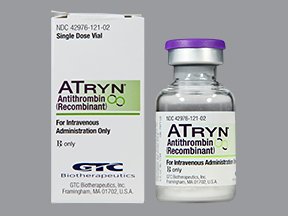 ATRYN 1,750 UNIT VIAL
The following indications for ATRYN (antithrombin iii, human recombinant) have been approved by the FDA:
Indications:
Antithrombin III deficiency
Professional Synonyms:
ATIII deficiency
Indications:
Antithrombin III deficiency
Professional Synonyms:
ATIII deficiency
The following dosing information is available for ATRYN (antithrombin iii, human recombinant):
Potency of antithrombin alfa is expressed in international units (IU, units) as tested against the activity of the World Health Organization reference standard. Each vial is labeled with the number of units of antithrombin alfa (approximately 1750 units per vial).
Dosage of antithrombin alfa is individualized based on the patient's weight, baseline antithrombin III activity, and serial monitoring of serum antithrombin III activity levels (expressed as a percentage of normal). The goal of therapy is to achieve an antithrombin III activity level of 80-120% of normal. Serum antithrombin III levels should be monitored prior to and at regular intervals (i.e., once or twice daily) during therapy to ensure such target antithrombin III activity levels.
Dosage of antithrombin alfa differs in pregnant versus nonpregnant women because clearance and volume of distribution of the drug are increased in pregnant women. (See Description.)
No enhanced Administration information available for this drug.
No dosing information available.
No generic dosing information available.
The following drug interaction information is available for ATRYN (antithrombin iii, human recombinant):
There are 0 contraindications.
There are 0 severe interactions.
There are 0 moderate interactions.
The following contraindication information is available for ATRYN (antithrombin iii, human recombinant):
Drug contraindication overview.
Known hypersensitivity to goat and goat milk proteins.
Known hypersensitivity to goat and goat milk proteins.
There are 0 contraindications.
There are 0 severe contraindications.
There are 2 moderate contraindications.
Clinically significant contraindication, where the condition can be managed or treated before the drug may be given safely.
| Moderate List |
|---|
| Hemorrhage |
| Thromboembolic disorder |
The following adverse reaction information is available for ATRYN (antithrombin iii, human recombinant):
Adverse reaction overview.
The most common adverse effects reported in patients receiving antithrombin alfa in clinical studies were hemorrhage and infusion-site reactions.
The most common adverse effects reported in patients receiving antithrombin alfa in clinical studies were hemorrhage and infusion-site reactions.
There are 2 severe adverse reactions.
| More Frequent | Less Frequent |
|---|---|
|
Hemorrhage |
None. |
| Rare/Very Rare |
|---|
|
Chest pain |
There are 2 less severe adverse reactions.
| More Frequent | Less Frequent |
|---|---|
|
Injection site sequelae |
None. |
| Rare/Very Rare |
|---|
|
Abnormal hepatic function tests |
The following precautions are available for ATRYN (antithrombin iii, human recombinant):
Safety and efficacy not established in pediatric patients younger than 18 years of age.
Contraindicated
Severe Precaution
Management or Monitoring Precaution
Contraindicated
| None |
Severe Precaution
| None |
Management or Monitoring Precaution
| None |
Category C. (See Users Guide.) Adequate and well-controlled studies of antithrombin alfa have not been conducted in pregnant women. In rats receiving antithrombin alfa in dosages of 210 mg/kg daily (5-6 times the usual human dose in pregnant women), a slight (but statistically significant) increase in pup mortality was seen when the drug was administered throughout most of pregnancy and the entire lactation period; however, no adverse effects were observed in another rat study when the same dose of antithrombin alfa was administered around parturition and during lactation.
Antithrombin alfa does not appear to be associated with an increased risk of fetal abnormalities when administered to pregnant women during the third trimester. In premarketing clinical studies, 22 pregnant women with congenital antithrombin III deficiency received antithrombin alfa around parturition; no treatment-related adverse effects were reported in the 22 neonates born to these women. The drug should be used during pregnancy only if clearly indicated.
Antithrombin alfa does not appear to be associated with an increased risk of fetal abnormalities when administered to pregnant women during the third trimester. In premarketing clinical studies, 22 pregnant women with congenital antithrombin III deficiency received antithrombin alfa around parturition; no treatment-related adverse effects were reported in the 22 neonates born to these women. The drug should be used during pregnancy only if clearly indicated.
Antithrombin alfa is distributed into breast milk at concentrations estimated to be 1-2% of those found in maternal blood. Although such milk concentrations are similar to those found in normal lactating women and are not known to be harmful, the manufacturer states that caution should be exercised when antithrombin alfa is used during breast-feeding. The drug should be used in nursing women only if clearly indicated.
Clinical studies of antithrombin alfa did not include sufficient numbers of patients 65 years of age and older to determine whether geriatric patients respond differently than younger patients. In general, geriatric patients should receive initial dosages of antithrombin alfa at the lower end of the usual range because of the greater frequency of decreased hepatic, renal, and/or cardiac function and of concomitant disease and drug therapy in such individuals.
The following prioritized warning is available for ATRYN (antithrombin iii, human recombinant):
No warning message for this drug.
No warning message for this drug.
The following icd codes are available for ATRYN (antithrombin iii, human recombinant)'s list of indications:
| Antithrombin III deficiency | |
| D68.59 | Other primary thrombophilia |
Formulary Reference Tool