Please wait while the formulary information is being retrieved.
DRUG IMAGES
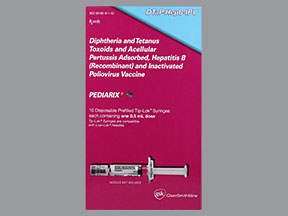 PEDIARIX 0.5 ML SYRINGE
The following indications for PEDIARIX (hep b virus,rcmb/dipth,pertus(acell),tet,polio vaccine/pf) have been approved by the FDA:
Indications:
Diphtheria, pertussis, tetanus, hepatitis B and polio vaccination
Professional Synonyms:
Active immunization against diphtheria, pertussis, tetanus, hepatitis B and polio
Vaccination against diphtheria, pertussis, hepatitis B and polio
Indications:
Diphtheria, pertussis, tetanus, hepatitis B and polio vaccination
Professional Synonyms:
Active immunization against diphtheria, pertussis, tetanus, hepatitis B and polio
Vaccination against diphtheria, pertussis, hepatitis B and polio
The following dosing information is available for PEDIARIX (hep b virus,rcmb/dipth,pertus(acell),tet,polio vaccine/pf):
The dosing schedule (i.e., number of doses) and specific preparation for primary and/or booster immunization (i.e., DTaP, Tdap) varies depending on age. The age-appropriate recommendations for the specific preparation used should be followed.
If licensed and indicated for a patient's age, combination vaccines may be used interchangeably with monovalent formulations and other combination products with similar component antigens produced by the same manufacturer to continue a vaccine series. Combination vaccines are not necessarily interchangeable with other combination vaccines from different manufacturers. ACIP prefers that vaccine doses in a series come from the same manufacturer; however, if this is not possible or if the manufacturer of prior doses is not known, it is recommended to administer the vaccine that is available.
DTaP (Daptacel(R), Infanrix(R)) is used only in infants and children 6 weeks through 6 years of age.
Tdap (Adacel(R), Boostrix(R)) is used in patients >=10 years of age; Adacel(R) is approved for use in patients up to 64 years of age.
The usual dose of DTaP or Tdap is 0.5 mL.
Adults who have received primary immunization against diphtheria and tetanus should receive routine booster doses of Td every 10 years. In addition, an emergency booster dose of Td may be indicated in the event of injury and possible exposure to tetanus infection. Because adults may be at risk for pertussis, ACIP and other experts recommend that a single dose of Tdap be used (instead of Td) when a booster dose is needed in adults 19 through 64 years of age who have not previously received Tdap, unless pertussis antigens are contraindicated or should not be used.
If Tdap is not available or was administered previously, Td should be used for booster doses.
A single dose of Tdap should be used (instead of Td) when a booster dose of vaccine containing tetanus and diphtheria toxoids is needed in adults >=65 years of age who have not previously received Tdap. When feasible, Boostrix(R) should be used in adults >=65 years of age or older; however, ACIP states that either Tdap (Adacel(R)) or Tdap (Boostrix(R)) can be used when a dose of Tdap is indicated in this age group.
Dosage recommendations for hepatitis B vaccine vary depending on the specific preparation used, the recipient's age, the HBsAg status of the mother (for neonates), and the presence of underlying disease.
Because the recommended doses for each vaccine are different, dosage recommendations for the specific preparation used should be followed.
In general, the various brands of age-appropriate hepatitis B vaccines are interchangeable within an immunization series; however, adolescents who start their vaccination series with the adult formulation of Recombivax HB(R) cannot complete the series with the adult formulation of Engerix-B(R), and patients who start their vaccination series with Heplisav-B(R) should complete it with the same product or receive a 3-dose series rather than the 2-dose series that is used with Heplisav-B(R).
The complete hepatitis B vaccine series must be administered to ensure optimal protection. Refer to guidance for specific recommendations if there are interruptions or delays in dosing.
Booster doses of hepatitis B vaccine are not recommended for immunocompetent individuals. Consult expert guidelines for booster dose recommendations (when anti-HBsAg antibody levels decline to <10 mIU/mL) for patients receiving hemodialysis in outpatient centers, pediatric patients with HIV, and other immunocompromised patients with an ongoing risk for HBV exposure.
All individuals who received primary immunization with DTaP, DTP (not commercially available in the US), DT (not commercially available in the US), or Td should receive a booster dose of Tdap (Adacel(R), Boostrix(R)) at 11 through 18 years of age (preferably at 11 through 12 years of age) and a routine booster dose of either Td or Tdap every 10 years to maintain adequate immunity against diphtheria and tetanus.
If licensed and indicated for a patient's age, combination vaccines may be used interchangeably with monovalent formulations and other combination products with similar component antigens produced by the same manufacturer to continue a vaccine series. Combination vaccines are not necessarily interchangeable with other combination vaccines from different manufacturers. ACIP prefers that vaccine doses in a series come from the same manufacturer; however, if this is not possible or if the manufacturer of prior doses is not known, it is recommended to administer the vaccine that is available.
DTaP (Daptacel(R), Infanrix(R)) is used only in infants and children 6 weeks through 6 years of age.
Tdap (Adacel(R), Boostrix(R)) is used in patients >=10 years of age; Adacel(R) is approved for use in patients up to 64 years of age.
The usual dose of DTaP or Tdap is 0.5 mL.
Adults who have received primary immunization against diphtheria and tetanus should receive routine booster doses of Td every 10 years. In addition, an emergency booster dose of Td may be indicated in the event of injury and possible exposure to tetanus infection. Because adults may be at risk for pertussis, ACIP and other experts recommend that a single dose of Tdap be used (instead of Td) when a booster dose is needed in adults 19 through 64 years of age who have not previously received Tdap, unless pertussis antigens are contraindicated or should not be used.
If Tdap is not available or was administered previously, Td should be used for booster doses.
A single dose of Tdap should be used (instead of Td) when a booster dose of vaccine containing tetanus and diphtheria toxoids is needed in adults >=65 years of age who have not previously received Tdap. When feasible, Boostrix(R) should be used in adults >=65 years of age or older; however, ACIP states that either Tdap (Adacel(R)) or Tdap (Boostrix(R)) can be used when a dose of Tdap is indicated in this age group.
Dosage recommendations for hepatitis B vaccine vary depending on the specific preparation used, the recipient's age, the HBsAg status of the mother (for neonates), and the presence of underlying disease.
Because the recommended doses for each vaccine are different, dosage recommendations for the specific preparation used should be followed.
In general, the various brands of age-appropriate hepatitis B vaccines are interchangeable within an immunization series; however, adolescents who start their vaccination series with the adult formulation of Recombivax HB(R) cannot complete the series with the adult formulation of Engerix-B(R), and patients who start their vaccination series with Heplisav-B(R) should complete it with the same product or receive a 3-dose series rather than the 2-dose series that is used with Heplisav-B(R).
The complete hepatitis B vaccine series must be administered to ensure optimal protection. Refer to guidance for specific recommendations if there are interruptions or delays in dosing.
Booster doses of hepatitis B vaccine are not recommended for immunocompetent individuals. Consult expert guidelines for booster dose recommendations (when anti-HBsAg antibody levels decline to <10 mIU/mL) for patients receiving hemodialysis in outpatient centers, pediatric patients with HIV, and other immunocompromised patients with an ongoing risk for HBV exposure.
All individuals who received primary immunization with DTaP, DTP (not commercially available in the US), DT (not commercially available in the US), or Td should receive a booster dose of Tdap (Adacel(R), Boostrix(R)) at 11 through 18 years of age (preferably at 11 through 12 years of age) and a routine booster dose of either Td or Tdap every 10 years to maintain adequate immunity against diphtheria and tetanus.
Diphtheria and tetanus toxoids and acellular pertussis vaccine adsorbed (DTaP) and tetanus toxoid, reduced diphtheria toxoid and acellular pertussis vaccine adsorbed (Tdap) are administered only by IM injection. DTaP and Tdap should not be administered subcutaneously, intradermally, or IV. Diphtheria and tetanus toxoids and acellular pertussis vaccine adsorbed (DTaP) is also available in fixed-combination vaccines containing DTaP and poliovirus antigens (DTaP-IPV; Kinrix(R), Quadracel(R)); DTaP, hepatitis B (HepB), and poliovirus antigens (DTaP-HepB-IPV; Pediarix(R)); DTaP, poliovirus, and Haemophilus influenzae type b (Hib) antigens (DTaP-IPV/Hib; Pentacel(R)); and DTaP, HepB, poliovirus, and Hib antigens (DTaP-HepB-IPV/Hib; Vaxelis(R)).
Consult the prescribing information for these fixed-combination vaccines for additional information. To ensure delivery into muscle, IM injections should be made at a 90degrees angle to the skin using a needle length appropriate for the individual's age and body mass, thickness of adipose tissue and muscle at the injection site, volume to be administered, and injection technique. Depending on patient age, IM injections of DTaP or Tdap should be made into the anterolateral muscles of the thigh or deltoid muscle of the arm.
In adults, adolescents, and children 3 years of age or older, IM injections should preferably be made in the region of the deltoid muscle. In infants and children 6 weeks through 1 year of age, IM injections should preferably be made into the anterolateral thigh; alternatively, the deltoid muscle can be used in those 1 through 2 years of age if muscle mass is adequate. DTaP and Tdap should not be injected into the gluteal area or any area where there may be a major nerve trunk.
If the gluteal muscle is chosen for infants <12 months of age because of special circumstances (e.g., physical obstruction of other sites), it is essential that the clinician identify anatomic landmarks prior to injection. DTaP and Tdap should be inspected visually for particulate matter and discoloration prior to administration. Prior to use, vials or prefilled syringes of DTaP or Tdap should be shaken vigorously until a uniform, turbid, white suspension results.
DTaP and Tdap should not be used if the vaccines cannot be resuspended. DTaP or Tdap should not be mixed with any other vaccine or solution. Although DTaP is commercially available in a kit containing DTaP and inactivated poliovirus vaccine (DTaP-IPV) and Hib vaccine to provide a combination vaccine containing DTaP, poliovirus, and Hib antigens (DTaP-IPV/Hib; Pentacel(R)), extemporaneous vaccine combinations of DTaP or Tdap and other commercially available vaccines should not be prepared by admixing the vaccines.
Use of fixed-combination vaccines can reduce the number of injections a patient receives and alleviate concerns about the number of injections. When multiple vaccines are administered during a single health-care visit, each parenteral vaccine should be given with a different syringe and at different injection sites. Injection sites should be separated by at least 1 inch (if anatomically feasible) to allow appropriate attribution of any local adverse effects that may occur.
For infants and children receiving >2 vaccines in a single limb, the thigh is the preferred site due to greater mass. For older children and adults, more than one IM injection can be administered into the deltoid muscle. DTaP (Daptacel(R) , Infanrix(R) ) and Tdap (Adacel(R) , Boostrix(R) ) should be stored at 2-8degreesC and should not be frozen.
Any DTaP or Tdap vaccine that has been frozen should be discarded. Hepatitis B vaccines are administered by IM injection. Hepatitis B vaccine is commercially available as three monovalent vaccines: hepatitis B vaccine (recombinant; Engerix-B(R) and Recombivax HB(R)) and hepatitis B vaccine (recombinant), adjuvanted (Heplisav-B(R)).
Hepatitis B vaccine also is commercially available in a fixed-combination vaccine with hepatitis A virus vaccine (HepA-HepB; Twinrix(R)), in a fixed-combination vaccine that contains diphtheria, tetanus, pertussis, hepatitis B, and poliovirus antigens (DTaP-HepB-IPV; Pediarix(R)), and in a fixed-combination vaccine that contains diphtheria, tetanus, pertussis, hepatitis B, poliovirus, and Haemophilus influenza type b (Hib) antigens (DTaP-IPV-Hib-HepB; Vaxelis(R)). The manufacturers of the nonadjuvanted recombinant vaccines (Engerix-B(R), Recombivax HB(R)) state that the vaccines may be administered by subcutaneous injection, but only when necessary in individuals at risk of hemorrhage following IM injections (e.g., patients with thrombocytopenia or a bleeding disorder such as hemophilia). Subcutaneous administration is known to result in a lower antibody response.
Additionally, when other aluminum-adsorbed vaccines have been administered subcutaneously, an increased incidence of local reactions (e.g., subcutaneous nodules) has been observed. The vaccines should not be administered IV or intradermally. To ensure delivery of hepatitis B vaccine into the muscle, IM injections should be made at a 90degrees angle to the skin using a needle size that is appropriate for the individual's age and body mass, the thickness of adipose tissue and muscle at the injection site, and the injection technique.
Depending on the age of the patient, the IM injection should be made preferably into the deltoid or anterolateral thigh. Since syncope may occur following vaccination, vaccinees should be observed for approximately 15 minutes after the vaccine dose is administered. If syncope occurs, the patient should be observed until symptoms resolve.
Syncope after vaccination occurs most frequently in adolescents and young adults. Hepatitis B vaccine may be given simultaneously with other age-appropriate vaccines during the same health-care visit (using different injection sites). Monovalent hepatitis B vaccine (Engerix-B(R), Recombivax HB(R)) may be given simultaneously with hepatitis B immune globulin (HBIG) (using different syringes and different injection sites) when passive immunization is considered necessary in addition to active immunization with the vaccine (e.g., in neonates born to hepatitis B surface antigen-positive (HBsAg-positive) women, in persons who experienced percutaneous or permucosal exposure to the virus).
Consult the prescribing information for these fixed-combination vaccines for additional information. To ensure delivery into muscle, IM injections should be made at a 90degrees angle to the skin using a needle length appropriate for the individual's age and body mass, thickness of adipose tissue and muscle at the injection site, volume to be administered, and injection technique. Depending on patient age, IM injections of DTaP or Tdap should be made into the anterolateral muscles of the thigh or deltoid muscle of the arm.
In adults, adolescents, and children 3 years of age or older, IM injections should preferably be made in the region of the deltoid muscle. In infants and children 6 weeks through 1 year of age, IM injections should preferably be made into the anterolateral thigh; alternatively, the deltoid muscle can be used in those 1 through 2 years of age if muscle mass is adequate. DTaP and Tdap should not be injected into the gluteal area or any area where there may be a major nerve trunk.
If the gluteal muscle is chosen for infants <12 months of age because of special circumstances (e.g., physical obstruction of other sites), it is essential that the clinician identify anatomic landmarks prior to injection. DTaP and Tdap should be inspected visually for particulate matter and discoloration prior to administration. Prior to use, vials or prefilled syringes of DTaP or Tdap should be shaken vigorously until a uniform, turbid, white suspension results.
DTaP and Tdap should not be used if the vaccines cannot be resuspended. DTaP or Tdap should not be mixed with any other vaccine or solution. Although DTaP is commercially available in a kit containing DTaP and inactivated poliovirus vaccine (DTaP-IPV) and Hib vaccine to provide a combination vaccine containing DTaP, poliovirus, and Hib antigens (DTaP-IPV/Hib; Pentacel(R)), extemporaneous vaccine combinations of DTaP or Tdap and other commercially available vaccines should not be prepared by admixing the vaccines.
Use of fixed-combination vaccines can reduce the number of injections a patient receives and alleviate concerns about the number of injections. When multiple vaccines are administered during a single health-care visit, each parenteral vaccine should be given with a different syringe and at different injection sites. Injection sites should be separated by at least 1 inch (if anatomically feasible) to allow appropriate attribution of any local adverse effects that may occur.
For infants and children receiving >2 vaccines in a single limb, the thigh is the preferred site due to greater mass. For older children and adults, more than one IM injection can be administered into the deltoid muscle. DTaP (Daptacel(R) , Infanrix(R) ) and Tdap (Adacel(R) , Boostrix(R) ) should be stored at 2-8degreesC and should not be frozen.
Any DTaP or Tdap vaccine that has been frozen should be discarded. Hepatitis B vaccines are administered by IM injection. Hepatitis B vaccine is commercially available as three monovalent vaccines: hepatitis B vaccine (recombinant; Engerix-B(R) and Recombivax HB(R)) and hepatitis B vaccine (recombinant), adjuvanted (Heplisav-B(R)).
Hepatitis B vaccine also is commercially available in a fixed-combination vaccine with hepatitis A virus vaccine (HepA-HepB; Twinrix(R)), in a fixed-combination vaccine that contains diphtheria, tetanus, pertussis, hepatitis B, and poliovirus antigens (DTaP-HepB-IPV; Pediarix(R)), and in a fixed-combination vaccine that contains diphtheria, tetanus, pertussis, hepatitis B, poliovirus, and Haemophilus influenza type b (Hib) antigens (DTaP-IPV-Hib-HepB; Vaxelis(R)). The manufacturers of the nonadjuvanted recombinant vaccines (Engerix-B(R), Recombivax HB(R)) state that the vaccines may be administered by subcutaneous injection, but only when necessary in individuals at risk of hemorrhage following IM injections (e.g., patients with thrombocytopenia or a bleeding disorder such as hemophilia). Subcutaneous administration is known to result in a lower antibody response.
Additionally, when other aluminum-adsorbed vaccines have been administered subcutaneously, an increased incidence of local reactions (e.g., subcutaneous nodules) has been observed. The vaccines should not be administered IV or intradermally. To ensure delivery of hepatitis B vaccine into the muscle, IM injections should be made at a 90degrees angle to the skin using a needle size that is appropriate for the individual's age and body mass, the thickness of adipose tissue and muscle at the injection site, and the injection technique.
Depending on the age of the patient, the IM injection should be made preferably into the deltoid or anterolateral thigh. Since syncope may occur following vaccination, vaccinees should be observed for approximately 15 minutes after the vaccine dose is administered. If syncope occurs, the patient should be observed until symptoms resolve.
Syncope after vaccination occurs most frequently in adolescents and young adults. Hepatitis B vaccine may be given simultaneously with other age-appropriate vaccines during the same health-care visit (using different injection sites). Monovalent hepatitis B vaccine (Engerix-B(R), Recombivax HB(R)) may be given simultaneously with hepatitis B immune globulin (HBIG) (using different syringes and different injection sites) when passive immunization is considered necessary in addition to active immunization with the vaccine (e.g., in neonates born to hepatitis B surface antigen-positive (HBsAg-positive) women, in persons who experienced percutaneous or permucosal exposure to the virus).
No dosing information available.
No generic dosing information available.
The following drug interaction information is available for PEDIARIX (hep b virus,rcmb/dipth,pertus(acell),tet,polio vaccine/pf):
There are 0 contraindications.
There are 1 severe interactions.
These drug interactions can produce serious consequences in most patients. Actions required for severe interactions include, but are not limited to, discontinuing one or both agents, adjusting dosage, altering administration scheduling, and providing additional patient monitoring. Review the full interaction monograph for more information.
| Drug Interaction | Drug Names |
|---|---|
| Non-Live or Non-Replicating Vaccines/Teplizumab SEVERITY LEVEL: 2-Severe Interaction: Action is required to reduce the risk of severe adverse interaction. MECHANISM OF ACTION: Teplizumab may cause lymphopenia and alter the immune system's response to vaccines.(1) CLINICAL EFFECTS: Administration of a non-live vaccine within the 2 weeks prior to, during, or for 6 weeks following teplizumab therapy may result in decreased effectiveness of the vaccine.(1) PREDISPOSING FACTORS: None determined. PATIENT MANAGEMENT: Ideally, administer vaccines prior to initiating teplizumab therapy. The manufacturer of teplizumab states that non-live vaccines (e.g., inactivated or mRNA vaccines) are not recommended within the 2 weeks prior to, during, or for 6 weeks after stopping teplizumab therapy.(1) The immune response to non-live vaccines should be monitored in patients who receive teplizumab within these time frames. The Centers for Disease Control's (CDC) Advisory Committee on Immunization Practices (ACIP) states that non-live vaccines should be used with caution in patients who are severely immunosuppressed. Patients who are vaccinated within the 14 days prior to initiating immunosuppressive therapy should be considered unvaccinated and should be revaccinated at least 3 months after immunosuppressive therapy is discontinued when immune competence is restored.(2) For COVID-19 vaccines, the CDC advises planning for vaccination at least 2 weeks before starting or resuming immunosuppressive therapy. Patients should be offered and given a COVID-19 vaccine even if the use and timing of immunosuppressive agents cannot be adjusted. The CDC states that an age-appropriate mRNA COVID-19 vaccine is preferred over the Janssen COVID-19 vaccine for the primary and booster doses for immunocompromised patients. All immunocompromised patients over 5 years of age should receive at least 1 booster dose if eligible. See the CDC's Interim Clinical Considerations for Use of COVID-19 Vaccines for age- and product-specific recommendations.(3) DISCUSSION: Vaccinations may be less effective if administered within 2 weeks before, during, and for 6 weeks following teplizumab therapy.(1) |
TZIELD |
There are 9 moderate interactions.
The clinician should assess the patient’s characteristics and take action as needed. Actions required for moderate interactions include, but are not limited to, discontinuing one or both agents, adjusting dosage, altering administration.
| Drug Interaction | Drug Names |
|---|---|
| Non-Live or Non-Replicating Vaccines/Fingolimod SEVERITY LEVEL: 3-Moderate Interaction: Assess the risk to the patient and take action as needed. MECHANISM OF ACTION: Fingolimod is an immunosuppressant and may alter the immune system's response to vaccines.(1) CLINICAL EFFECTS: Administration of a vaccine during and for 2 months following fingolimod therapy may result in decreased effectiveness of the vaccine.(1,2) PREDISPOSING FACTORS: None determined. PATIENT MANAGEMENT: Ideally, administer vaccines prior to initiating fingolimod therapy. The immune response to non-live vaccines should be monitored in patients receiving fingolimod or who have received fingolimod in the previous two months. Vaccinations given during and for 2 months after stopping fingolimod therapy may need to be repeated.(1,2) The Centers for Disease Control's (CDC) Advisory Committee on Immunization Practices (ACIP) states that non-live vaccines should be used with caution in patients who are severely immunosuppressed. Patients who are vaccinated within the 14 days prior to initiating immunosuppressive therapy should be considered unvaccinated and should be revaccinated at least 3 months after immunosuppressive therapy is discontinued when immune competence is restored.(3) DISCUSSION: Vaccinations may be less effective during and for 2 months following fingolimod therapy(1) however they are considered safe to administer.(2) |
FINGOLIMOD, GILENYA, TASCENSO ODT |
| Non-Live or Non-Replicating Vaccines/Siponimod SEVERITY LEVEL: 3-Moderate Interaction: Assess the risk to the patient and take action as needed. MECHANISM OF ACTION: Siponimod is an immunosuppressant and may alter the immune system's response to vaccines.(2) CLINICAL EFFECTS: Administration of a vaccine during and for up to 1 month after discontinuation of siponimod therapy may result in decreased effectiveness of the vaccine. Siponimod treatment should be paused 1 week prior and for 4 weeks after vaccination.(2) PREDISPOSING FACTORS: None determined. PATIENT MANAGEMENT: Ideally, administer vaccines prior to initiating siponimod therapy. The immune response to non-live vaccines should be monitored in patients receiving siponimod or who have received siponimod in the previous week. Vaccinations given during and for up to 1 month after discontinuation of siponimod therapy may need to be repeated.(2) The Centers for Disease Control's (CDC) Advisory Committee on Immunization Practices (ACIP) states that non-live vaccines should be used with caution in patients who are severely immunosuppressed. Patients who are vaccinated within the 14 days prior to initiating immunosuppressive therapy should be considered unvaccinated and should be revaccinated at least 3 months after immunosuppressive therapy is discontinued when immune competence is restored.(3) DISCUSSION: Vaccinations may be less effective if administered during and for up to 1 month after siponimod treatment(2) however they are considered safe to administer.(1) |
MAYZENT |
| Non-Live or Non-Replicating Vaccines/Satralizumab SEVERITY LEVEL: 3-Moderate Interaction: Assess the risk to the patient and take action as needed. MECHANISM OF ACTION: Satralizumab is an immunosuppressant and may alter the immune system's response to vaccines.(1) CLINICAL EFFECTS: Administration of a vaccine during satralizumab therapy may result in decreased effectiveness of the vaccine. If possible, non-live vaccines should be administered at least two weeks prior to initiation of satralizumab.(1) PREDISPOSING FACTORS: None determined. PATIENT MANAGEMENT: Ideally, administer vaccines two weeks prior to initiating satralizumab therapy. The immune response to non-live vaccines should be monitored in patients receiving satralizumab. Vaccinations given during satralizumab therapy may need to be repeated.(1) Patients who are vaccinated within the 14 days prior to initiating immunosuppressive therapy should be considered unvaccinated and should be revaccinated at least 3 months after immunosuppressive therapy is discontinued when immune competence is restored.(2) DISCUSSION: Vaccinations may be less effective if administered during satralizumab treatment.(1) |
ENSPRYNG |
| Non-Live or Non-Replicating Vaccines/Ublituximab SEVERITY LEVEL: 3-Moderate Interaction: Assess the risk to the patient and take action as needed. MECHANISM OF ACTION: Ublituximab is an immunosuppressant and may alter the immune system's response to vaccines.(1) CLINICAL EFFECTS: Administration of a non-live vaccine within 2 weeks before or during ublituximab therapy may result in decreased effectiveness of the vaccine. If possible, non-live vaccines should be administered at least two weeks prior to initiating ublituximab therapy.(1) PREDISPOSING FACTORS: None determined. PATIENT MANAGEMENT: Ideally, administer non-live vaccines at least two weeks prior to initiating ublituximab therapy. The immune response to non-live vaccines should be monitored in patients receiving ublituximab. Vaccinations given during ublituximab therapy may need to be repeated.(1) Patients who are vaccinated within the 14 days prior to initiating immunosuppressive therapy should be considered unvaccinated and should be revaccinated at least 3 months after immunosuppressive therapy is discontinued when immune competence is restored.(2) DISCUSSION: Vaccinations may be less effective if administered within 2 weeks before or during ublituximab treatment.(1) |
BRIUMVI |
| Systemic Corticosteroids; Corticotropin/Non-Live or Non-Replicating Vaccines SEVERITY LEVEL: 3-Moderate Interaction: Assess the risk to the patient and take action as needed. MECHANISM OF ACTION: Corticosteroids and corticotropin suppress the immune system and may alter the immune system's response to vaccines.(1) CLINICAL EFFECTS: Vaccines administered during or within 2 weeks prior to therapy with corticosteroids or corticotropin may result in decreased effectiveness of the vaccine.(1) PREDISPOSING FACTORS: Patients receiving immunosuppressive doses of corticosteroids or corticotropin for equal to or greater than 14 consecutive days.(1) PATIENT MANAGEMENT: The Centers for Disease Control's (CDC) Advisory Committee on Immunization Practices (ACIP) states that non-live vaccines should be used with caution in patients who are severely immunosuppressed, including those who are receiving or have received high-dose, systemic steroids for greater than or equal to 14 consecutive days. When initiating immunosuppressives doses of corticosteroids, wait 2 weeks after a non-live vaccines is administered. However, if patients require therapy for chronic inflammatory conditions, do not delay therapy due to past vaccines.(1) The immune response to non-live vaccines should be monitored in patients receiving corticosteroids. Vaccinations given during corticosteroid therapy may need to be repeated.(1) Patients who are vaccinated within the 14 days prior to initiating immunosuppressive therapy should be considered unvaccinated and should be revaccinated at least 3 months after immunosuppressive therapy is discontinued when immune competence is restored.(1) DISCUSSION: Vaccinations given during and within 2 weeks prior to corticosteroid therapy may be less effective. However they are considered safe to administer.(1) Many clinicians consider a dose equivalent to either 2 mg/kg of body weight or a total of 20 mg/day of prednisone as sufficiently immunosuppressive to raise safety concerns about live-virus vaccines.(1) Immunization procedures may be undertaken in patients receiving corticosteroids when the therapy is short term (less than 2 weeks); low to moderate dose; long-term, alternate-day treatment with short-acting preparations; maintenance physiologic doses (replacement therapy); or administered topically (skin or eyes), by aerosol, or by intra-articular, bursal, or tendon injection.(1) |
ACTHAR, ACTHAR SELFJECT, ADRENOCORTICOTROPHIC HORMONE, ALDOSTERONE, ALKINDI SPRINKLE, ANUCORT-HC, ANUSOL-HC, BECLOMETHASONE DIPROPIONATE, BETALOAN SUIK, BETAMETHASONE ACETATE MICRO, BETAMETHASONE ACETATE-SOD PHOS, BETAMETHASONE DIPROPIONATE, BETAMETHASONE SOD PHOS-ACETATE, BETAMETHASONE SOD PHOS-WATER, BETAMETHASONE SODIUM PHOSPHATE, BETAMETHASONE VALERATE, BUDESONIDE, BUDESONIDE DR, BUDESONIDE EC, BUDESONIDE ER, BUDESONIDE MICRONIZED, BUPIVACAINE-DEXAMETH-EPINEPHRN, CELESTONE, CLOBETASOL PROPIONATE MICRO, CORTEF, CORTENEMA, CORTICOTROPHIN, CORTIFOAM, CORTISONE ACETATE, CORTROPHIN, DEFLAZACORT, DEPO-MEDROL, DESONIDE MICRONIZED, DESOXIMETASONE, DESOXYCORTICOSTERONE ACETATE, DEXABLISS, DEXAMETHASONE, DEXAMETHASONE ACETATE, DEXAMETHASONE ACETATE MICRO, DEXAMETHASONE INTENSOL, DEXAMETHASONE ISONICOTINATE, DEXAMETHASONE MICRONIZED, DEXAMETHASONE SOD PHOS-WATER, DEXAMETHASONE SODIUM PHOSPHATE, DEXAMETHASONE-0.9% NACL, DEXLYT, DMT SUIK, DOUBLEDEX, EMFLAZA, EOHILIA, FLUDROCORTISONE ACETATE, FLUNISOLIDE, FLUOCINOLONE ACETONIDE, FLUOCINOLONE ACETONIDE MICRO, FLUOCINONIDE MICRONIZED, FLUTICASONE PROPIONATE, FLUTICASONE PROPIONATE MICRO, HEMADY, HEMMOREX-HC, HEXATRIONE, HYDROCORTISONE, HYDROCORTISONE ACETATE, HYDROCORTISONE SOD SUCCINATE, JAYTHARI, KENALOG-10, KENALOG-40, KENALOG-80, KHINDIVI, KYMBEE, LIDOCIDEX-I, MAS CARE-PAK, MEDROL, MEDROLOAN II SUIK, MEDROLOAN SUIK, METHYLPREDNISOLONE, METHYLPREDNISOLONE AC MICRO, METHYLPREDNISOLONE ACETATE, METHYLPREDNISOLONE SODIUM SUCC, MILLIPRED, MILLIPRED DP, MOMETASONE FUROATE, ORAPRED ODT, P-PACK PREDNISONE, PREDNISOLONE, PREDNISOLONE ACETATE MICRONIZE, PREDNISOLONE MICRONIZED, PREDNISOLONE SODIUM PHOS ODT, PREDNISOLONE SODIUM PHOSPHATE, PREDNISONE, PREDNISONE INTENSOL, PREDNISONE MICRONIZED, PROCTOCORT, PYQUVI, SOLU-CORTEF, SOLU-MEDROL, TAPERDEX, TARPEYO, TRIAMCINOLONE, TRIAMCINOLONE ACETONIDE, TRIAMCINOLONE DIACETATE, TRIAMCINOLONE DIACETATE MICRO, TRILOAN II SUIK, TRILOAN SUIK, UCERIS, VERIPRED 20, ZCORT |
| Non-Live or Non-Replicating Vaccines/Etrasimod SEVERITY LEVEL: 3-Moderate Interaction: Assess the risk to the patient and take action as needed. MECHANISM OF ACTION: Etrasimod is an immunosuppressant and may alter the immune system's response to vaccines.(1) CLINICAL EFFECTS: Administration of a vaccine during and for up to 5 weeks after discontinuation of etrasimod therapy may result in decreased effectiveness of the vaccine. Etrasimod treatment should be paused 5 weeks prior and for 4 weeks after vaccination.(1) PREDISPOSING FACTORS: None determined. PATIENT MANAGEMENT: Ideally, administer vaccines prior to initiating etrasimod therapy. The immune response to non-live vaccines should be monitored in patients receiving etrasimod or who have received etrasimod in the previous 5 weeks. Vaccinations given during and for up to 5 weeks after discontinuation of etrasimod therapy may need to be repeated.(1) The Centers for Disease Control's (CDC) Advisory Committee on Immunization Practices (ACIP) states that non-live vaccines should be used with caution in patients who are severely immunosuppressed. Patients who are vaccinated within the 14 days prior to initiating immunosuppressive therapy should be considered unvaccinated and should be revaccinated at least 3 months after immunosuppressive therapy is discontinued when immune competence is restored.(2) DISCUSSION: Vaccinations may be less effective if administered during and for up to 5 weeks after etrasimod treatment.(1) However they are considered safe to administer. |
VELSIPITY |
| Non-Live or Non-Replicating Vaccines/Ozanimod SEVERITY LEVEL: 3-Moderate Interaction: Assess the risk to the patient and take action as needed. MECHANISM OF ACTION: Ozanimod is an immunosuppressant and may alter the immune system's response to vaccines.(1) CLINICAL EFFECTS: Administration of a vaccine during and for up to 3 months after discontinuation of ozanimod therapy may result in decreased effectiveness of the vaccine. Ozanimod treatment should be paused 3 months prior and for 1 month after vaccination.(1) PREDISPOSING FACTORS: None determined. PATIENT MANAGEMENT: Ideally, administer vaccines prior to initiating ozanimod therapy. The immune response to non-live vaccines should be monitored in patients receiving ozanimod or who have received ozanimod in the previous 3 months. Vaccinations given during and for up to 3 months after discontinuation of ozanimod therapy may need to be repeated.(1) The Centers for Disease Control's (CDC) Advisory Committee on Immunization Practices (ACIP) states that non-live vaccines should be used with caution in patients who are severely immunosuppressed. Patients who are vaccinated within the 14 days prior to initiating immunosuppressive therapy should be considered unvaccinated and should be revaccinated at least 3 months after immunosuppressive therapy is discontinued when immune competence is restored.(2) DISCUSSION: Vaccinations may be less effective if administered during and for up to 3 months after ozanimod treatment.(1) However they are considered safe to administer. |
ZEPOSIA |
| Non-Live or Non-Replicating Vaccines/Ponesimod SEVERITY LEVEL: 3-Moderate Interaction: Assess the risk to the patient and take action as needed. MECHANISM OF ACTION: Ponesimod is an immunosuppressant and may alter the immune system's response to vaccines.(1) CLINICAL EFFECTS: Administration of a vaccine during and for up to 2 weeks after discontinuation of ponesimod therapy may result in decreased effectiveness of the vaccine. Ponesimod treatment should be paused 1-2 weeks prior and for 4 weeks after vaccination.(1) PREDISPOSING FACTORS: None determined. PATIENT MANAGEMENT: Ideally, administer vaccines prior to initiating ponesimod therapy. The immune response to non-live vaccines should be monitored in patients receiving ponesimod or who have received ponesimod in the previous 2 weeks. Vaccinations given during and for up to 2 weeks after discontinuation of ponesimod therapy may need to be repeated.(1) The Centers for Disease Control's (CDC) Advisory Committee on Immunization Practices (ACIP) states that non-live vaccines should be used with caution in patients who are severely immunosuppressed. Patients who are vaccinated within the 14 days prior to initiating immunosuppressive therapy should be considered unvaccinated and should be revaccinated at least 3 months after immunosuppressive therapy is discontinued when immune competence is restored.(2) DISCUSSION: Vaccinations may be less effective if administered during and for up to 2 weeks after ponesimod treatment.(1) However they are considered safe to administer. |
PONVORY |
| Non-Live or Non-Replicating Vaccines/Ocrelizumab SEVERITY LEVEL: 3-Moderate Interaction: Assess the risk to the patient and take action as needed. MECHANISM OF ACTION: Ocrelizumab is an immunosuppressant and may alter the immune system's response to vaccines.(1) CLINICAL EFFECTS: Administration of a non-live vaccine within 2 weeks before or during ocrelizumab therapy may result in decreased effectiveness of the vaccine. If possible, non-live vaccines should be administered at least two weeks prior to initiating ocrelizumab therapy.(1) PREDISPOSING FACTORS: None determined. PATIENT MANAGEMENT: Ideally, administer non-live vaccines at least two weeks prior to initiating ocrelizumab therapy. The immune response to non-live vaccines should be monitored in patients receiving ocrelizumab. Vaccinations given during ocrelizumab therapy may need to be repeated.(1) Patients who are vaccinated within the 14 days prior to initiating immunosuppressive therapy should be considered unvaccinated and should be revaccinated at least 3 months after immunosuppressive therapy is discontinued when immune competence is restored.(2) DISCUSSION: Vaccinations may be less effective if administered within 2 weeks before or during ocrelizumab treatment.(1) |
OCREVUS ZUNOVO |
The following contraindication information is available for PEDIARIX (hep b virus,rcmb/dipth,pertus(acell),tet,polio vaccine/pf):
Drug contraindication overview.
*Severe allergic reactions (e.g., anaphylaxis) after previous dose of DTaP, any vaccine component, or any vaccine containing tetanus, diphtheria, or pertussis antigens. *Encephalopathy (e.g., coma, decreased level of consciousness, prolonged seizures) within 7 days of a previous dose of a vaccine containing pertussis antigens that is not attributable to another identifiable cause. *Progressive neurologic disorder, including infantile spasms, uncontrolled epilepsy, or progressive encephalopathy (DTaP only).
*Hypersensitivity to any ingredient in the vaccine, including yeast (Engerix-B(R), Recombivax HB(R), Heplisav-B(R)). *History of previous hypersensitivity to any hepatitis B vaccine (Engerix-B(R), Recombivax HB(R), Heplisav-B(R)). *History of hypersensitivity to any ingredient in the vaccine (e.g., yeast, neomycin, polymyxin B) (Pediarix(R)).
*History of hypersensitivity to a previous dose of the vaccine or any vaccine component (Vaxelis(R)). *History of serious allergic reaction (e.g., anaphylaxis) after a previous dose of any diphtheria toxoid-, tetanus toxoid-, pertussis antigen-, hepatitis B-, or poliovirus-containing vaccine (Pediarix(R)). *History of serious allergic reaction (e.g., anaphylaxis) after a previous dose of any diphtheria toxoid, tetanus toxoid, pertussis antigen, hepatitis B, inactivated poliovirus, or H.
influenzae type b-containing vaccine (Vaxelis(R)). *Encephalopathy (e.g., coma, decreased consciousness, prolonged seizures) within 7 days of a previous dose of vaccine containing pertussis antigens that could not be attributed to another identifiable cause (Pediarix(R), Vaxelis(R)). *Progressive neurologic disorder, including infantile spasms, uncontrolled epilepsy, or progressive encephalopathy; vaccine should not be administered to patients with these conditions until the neurological status has stabilized (Pediarix(R), Vaxelis(R)).
*Hypersensitivity to any ingredient in the vaccine, including yeast and neomycin (Twinrix(R)). *Previous hypersensitivity reactions to any hepatitis A- or hepatitis B- containing vaccines (Twinrix(R)).
*Severe allergic reactions (e.g., anaphylaxis) after previous dose of DTaP, any vaccine component, or any vaccine containing tetanus, diphtheria, or pertussis antigens. *Encephalopathy (e.g., coma, decreased level of consciousness, prolonged seizures) within 7 days of a previous dose of a vaccine containing pertussis antigens that is not attributable to another identifiable cause. *Progressive neurologic disorder, including infantile spasms, uncontrolled epilepsy, or progressive encephalopathy (DTaP only).
*Hypersensitivity to any ingredient in the vaccine, including yeast (Engerix-B(R), Recombivax HB(R), Heplisav-B(R)). *History of previous hypersensitivity to any hepatitis B vaccine (Engerix-B(R), Recombivax HB(R), Heplisav-B(R)). *History of hypersensitivity to any ingredient in the vaccine (e.g., yeast, neomycin, polymyxin B) (Pediarix(R)).
*History of hypersensitivity to a previous dose of the vaccine or any vaccine component (Vaxelis(R)). *History of serious allergic reaction (e.g., anaphylaxis) after a previous dose of any diphtheria toxoid-, tetanus toxoid-, pertussis antigen-, hepatitis B-, or poliovirus-containing vaccine (Pediarix(R)). *History of serious allergic reaction (e.g., anaphylaxis) after a previous dose of any diphtheria toxoid, tetanus toxoid, pertussis antigen, hepatitis B, inactivated poliovirus, or H.
influenzae type b-containing vaccine (Vaxelis(R)). *Encephalopathy (e.g., coma, decreased consciousness, prolonged seizures) within 7 days of a previous dose of vaccine containing pertussis antigens that could not be attributed to another identifiable cause (Pediarix(R), Vaxelis(R)). *Progressive neurologic disorder, including infantile spasms, uncontrolled epilepsy, or progressive encephalopathy; vaccine should not be administered to patients with these conditions until the neurological status has stabilized (Pediarix(R), Vaxelis(R)).
*Hypersensitivity to any ingredient in the vaccine, including yeast and neomycin (Twinrix(R)). *Previous hypersensitivity reactions to any hepatitis A- or hepatitis B- containing vaccines (Twinrix(R)).
There are 0 contraindications.
There are 5 severe contraindications.
Adequate patient monitoring is recommended for safer drug use.
| Severe List |
|---|
| Febrile convulsions |
| Guillain-barre syndrome |
| High fever >101 degrees fahrenheit |
| Infantile spasms |
| Uncontrolled epilepsy |
There are 2 moderate contraindications.
Clinically significant contraindication, where the condition can be managed or treated before the drug may be given safely.
| Moderate List |
|---|
| Fever |
| Multiple sclerosis |
The following adverse reaction information is available for PEDIARIX (hep b virus,rcmb/dipth,pertus(acell),tet,polio vaccine/pf):
Adverse reaction overview.
Rates of adverse effects following DTaP (Daptacel(R), Infanrix(R)) administration varied by dose number, with injection site reactions (pain, redness, swelling) the most frequent following doses 4 and 5. Common systemic adverse effects with DTaP vaccination include fever, drowsiness, fussiness/irritability, inconsolable crying, loss of appetite, and lethargy. Following the first booster dose of Tdap (Adacel(R)), the most common adverse effects within the first 2 weeks of vaccination for adolescents were injection site pain (77.8%), headache (43.7%), body aches or muscle weakness (30.4%), tiredness (30.2%), injection site swelling (20.9%), and injection site redness (20.8%).
In adults 18-64 years of age, the most common adverse effects within the first 2 weeks were injection site pain (65.7%), headache (33.9%), body aches or muscle weakness (21.9%), tiredness (24.3%), injection site swelling (21%), and injection site redness (24.7%). Within the first week after a second booster dose of Tdap (Adacel(R)), the most common adverse effects in patients 18-64 years of age were injection site pain (87.1%), myalgia (58.1%), headache (41.4%), malaise (33.3%), injection site swelling (6.9%), and injection site erythema (6.4%). Adverse effects reported in >=15% of adolescents and adults 10-64 years of age following administration of Tdap (Boostrix(R)) were injection site reactions (pain, redness, swelling), headache, fatigue, and GI symptoms.
Increased arm circumference was also reported in adolescent patients. In adults >=65 years of age, the most common adverse effect was pain at the injection site. In healthy infants and children (<=10 years of age), the most frequently reported systemic adverse reactions (>1% of the injections) with Recombivax HB(R) were irritability, fever, diarrhea, fatigue/weakness, diminished appetite, and rhinitis.
In healthy adults, injection site reactions were reported following 17% of the injections and systemic adverse reactions were reported following 15% of the injections. The most common solicited adverse reactions with Engerix-B(R) were injection-site soreness (22%) and fatigue (14%). The most common solicited adverse reactions following any dose (>=25%) of Pediarix(R) included local injection site reactions (pain, redness, and swelling), fever (>=38.0degreesC), drowsiness, irritability/fussiness, and loss of appetite.
The most common (>=10%) solicited injection site reactions following any dose of Twinrix(R) included soreness (35-41%) and erythema (8-11%), and the most common solicited systemic adverse reactions were headache (13-22%) and fatigue (11-14%). The most common local reaction with Heplisav-B(R) was injection site pain (9-39%), and the most common systemic reactions were fatigue (10-17%) and headache (5-17%). The most common solicited adverse reactions following any dose of Vaxelis(R) were irritability (>=55%), crying (>=45%), injection site pain (>=44%), somnolence (>=40%), injection site erythema (>=25%), decreased appetite (>=23%), fever >=38.0degreesC (>=19%), injection site swelling (>=18%), and vomiting (>=9%).
Rates of adverse effects following DTaP (Daptacel(R), Infanrix(R)) administration varied by dose number, with injection site reactions (pain, redness, swelling) the most frequent following doses 4 and 5. Common systemic adverse effects with DTaP vaccination include fever, drowsiness, fussiness/irritability, inconsolable crying, loss of appetite, and lethargy. Following the first booster dose of Tdap (Adacel(R)), the most common adverse effects within the first 2 weeks of vaccination for adolescents were injection site pain (77.8%), headache (43.7%), body aches or muscle weakness (30.4%), tiredness (30.2%), injection site swelling (20.9%), and injection site redness (20.8%).
In adults 18-64 years of age, the most common adverse effects within the first 2 weeks were injection site pain (65.7%), headache (33.9%), body aches or muscle weakness (21.9%), tiredness (24.3%), injection site swelling (21%), and injection site redness (24.7%). Within the first week after a second booster dose of Tdap (Adacel(R)), the most common adverse effects in patients 18-64 years of age were injection site pain (87.1%), myalgia (58.1%), headache (41.4%), malaise (33.3%), injection site swelling (6.9%), and injection site erythema (6.4%). Adverse effects reported in >=15% of adolescents and adults 10-64 years of age following administration of Tdap (Boostrix(R)) were injection site reactions (pain, redness, swelling), headache, fatigue, and GI symptoms.
Increased arm circumference was also reported in adolescent patients. In adults >=65 years of age, the most common adverse effect was pain at the injection site. In healthy infants and children (<=10 years of age), the most frequently reported systemic adverse reactions (>1% of the injections) with Recombivax HB(R) were irritability, fever, diarrhea, fatigue/weakness, diminished appetite, and rhinitis.
In healthy adults, injection site reactions were reported following 17% of the injections and systemic adverse reactions were reported following 15% of the injections. The most common solicited adverse reactions with Engerix-B(R) were injection-site soreness (22%) and fatigue (14%). The most common solicited adverse reactions following any dose (>=25%) of Pediarix(R) included local injection site reactions (pain, redness, and swelling), fever (>=38.0degreesC), drowsiness, irritability/fussiness, and loss of appetite.
The most common (>=10%) solicited injection site reactions following any dose of Twinrix(R) included soreness (35-41%) and erythema (8-11%), and the most common solicited systemic adverse reactions were headache (13-22%) and fatigue (11-14%). The most common local reaction with Heplisav-B(R) was injection site pain (9-39%), and the most common systemic reactions were fatigue (10-17%) and headache (5-17%). The most common solicited adverse reactions following any dose of Vaxelis(R) were irritability (>=55%), crying (>=45%), injection site pain (>=44%), somnolence (>=40%), injection site erythema (>=25%), decreased appetite (>=23%), fever >=38.0degreesC (>=19%), injection site swelling (>=18%), and vomiting (>=9%).
There are 14 severe adverse reactions.
| More Frequent | Less Frequent |
|---|---|
| None. |
Irregular sleep-wake rhythm |
| Rare/Very Rare |
|---|
|
Angioedema Cellulitis Cyanosis Encephalopathy Erythema Hypersensitivity drug reaction Hypotonia Idiopathic thrombocytopenic purpura Intussusception of intestine Jaundice Syncope Thrombocytopenic disorder Tonic clonic seizure |
There are 26 less severe adverse reactions.
| More Frequent | Less Frequent |
|---|---|
|
Fever Injection site sequelae Irritability |
Anorexia Nervousness |
| Rare/Very Rare |
|---|
|
Abdominal pain with cramps Alopecia Arthralgia Diarrhea Drowsy Earache Edema Erythema multiforme General weakness Headache disorder Lethargy Lymphadenopathy Malaise Nausea Pallor Petechiae Pruritus of skin Skin rash Upper respiratory infection Urticaria Vomiting |
The following precautions are available for PEDIARIX (hep b virus,rcmb/dipth,pertus(acell),tet,polio vaccine/pf):
Safety and efficacy of DTaP (Daptacel(R), Infanrix(R)) in children younger than 6 weeks of age or in children 7 years of age or older have not been established. Safety and efficacy of Tdap (Adacel(R), Boostrix(R)) in children <10 years of age have not been established. Recombivax HB(R) is approved for use in pediatric patients of any age.
In neonates, passively acquired maternal anti-HBs antibodies do not appear to interfere with the active immune response to hepatitis B vaccine. Safety and efficacy of Recombivax(R) HB Dialysis Formulation have not been established in children. Engerix-B(R) is approved for use in pediatric patients of any age.
In neonates, passively acquired maternal anti-HBs antibodies do not appear to interfere with the active immune response to hepatitis B vaccine. The timing of the first dose in infants weighing <2000 g at birth depends on the HBsAg status of the mother. Safety and efficacy of Heplisav-B(R) have not been established in pediatric patients younger than 18 years of age.
Safety and efficacy of Pediarix(R) have not been established in infants younger than 6 weeks of age or in children 7 years of age or older. Safety and efficacy of Twinrix(R) have not been established in pediatric patients younger than 18 years of age. Safety and efficacy of Vaxelis(R) have not been established in infants younger than 6 weeks of age or in children 5 years of age or older.
Contraindicated
Severe Precaution
Management or Monitoring Precaution
In neonates, passively acquired maternal anti-HBs antibodies do not appear to interfere with the active immune response to hepatitis B vaccine. Safety and efficacy of Recombivax(R) HB Dialysis Formulation have not been established in children. Engerix-B(R) is approved for use in pediatric patients of any age.
In neonates, passively acquired maternal anti-HBs antibodies do not appear to interfere with the active immune response to hepatitis B vaccine. The timing of the first dose in infants weighing <2000 g at birth depends on the HBsAg status of the mother. Safety and efficacy of Heplisav-B(R) have not been established in pediatric patients younger than 18 years of age.
Safety and efficacy of Pediarix(R) have not been established in infants younger than 6 weeks of age or in children 7 years of age or older. Safety and efficacy of Twinrix(R) have not been established in pediatric patients younger than 18 years of age. Safety and efficacy of Vaxelis(R) have not been established in infants younger than 6 weeks of age or in children 5 years of age or older.
Contraindicated
| None |
Severe Precaution
| None |
Management or Monitoring Precaution
| None |
Tdap (Adacel(R), Boostrix(R)) is indicated for immunization during the third trimester of each pregnancy to prevent pertussis in infants <2 months of age. Available data indicate that rates of major birth defects and miscarriage are similar in women who received Adacel(R) or Boostrix(R) 28-30 days prior to pregnancy and during pregnancy compared to background estimated rates. A retrospective passive surveillance study compared outcomes between 225 women who received Adacel(R) during pregnancy and 675 controls matched by age and date of their first positive pregnancy test.
Of the Adacel(R) recipients, 110 were vaccinated in the first trimester, 33 during the second trimester, and 14 in the third trimester. Twenty-nine had an unknown time of vaccination, and 39 had received Adacel(R) within 2 weeks prior to their last menstrual period. Spontaneous abortions were reported in 15% of patients in the control group and 9.3%
of Adacel(R) recipients. The incidence of congenital anomalies was 8.4% in the control group and 6.7%
in the group exposed to Adacel(R). An assessment of 1236 prospective reports from an ongoing registry of exposure to Adacel(R) indicate that rates of assessed outcomes (e.g., congenital anomalies, spontaneous abortions) in the prospective population were consistent with estimated background rates. Among 256 reports with known pregnancy outcomes in women exposed to Boostrix(R) within 28 days prior to conception or during pregnancy, 19 women with first trimester exposure to Boostrix(R) had no reported major birth defects and 3 spontaneous abortions.
Twenty-eight women exposed in the second trimester and 199 in the third trimester also reported no major birth defects; an additional 10 women that were exposed to Boostrix(R) at an unknown timing during pregnancy reported no major birth defects. Other spontaneous reports and postmarketing data have shown that out of 138 reports with known pregnancy outcomes, there were no major birth defects and 2 spontaneous abortions among 17 women exposed to Boostrix(R) in the first trimester. Out of 26 exposures in the second trimester and 92 in the third trimester there were no major birth defects reported; 3 women exposed to Boostrix(R) at an unknown timing during pregnancy also had no major birth defects reported.
Irrespective of vaccine history, ACIP and ACOG recommend administering a single dose of Tdap (Adacel(R) or Boostrix(R)) in all pregnant women during each pregnancy as early as possible between 27 and 36 weeks gestation. Immunization with Tdap during the third trimester of pregnancy provides passive protection against pertussis via transplacental antibody transfer in infants <2 months of age. Clinicians are encouraged to register pregnant women who receive Tdap with the manufacturer's pregnancy registry at 800-822-2463 or https://www.sanofipasteurpregnancyregistry.com
(Adacel(R)) or 888-452-9622 or http://pregnancyregistry.gsk.com/boostrix.html
(Boostrix(R)). Engerix-B(R) or Recombivax HB(R): Animal reproduction studies have not been performed with the vaccine. There are no adequate and well-controlled studies of the vaccine in pregnant women in the U.S.
Available data do not suggest an increased risk of major birth defects or miscarriage in women who received the vaccine during pregnancy. Twinrix(R): An animal development study in female rats found no adverse effects on fetal or pre-weaning development when the vaccine was administered prior to mating and during gestation. There are no adequate and well-controlled studies of the vaccine in pregnant women in the U.S.
Available data do not suggest an increased risk of major birth defects or miscarriage in women who received the vaccine within 28 days prior to conception or during pregnancy. Heplisav-B(R): An animal development toxicity study in female rats found no evidence of fetal harm due to a vaccine formulation containing 2.5 mcg HBsAg and 3000 mcg cytidine phospho-guanosine (CpG) 1018 adjuvant administered prior to mating and during gestation; a full human dose of Heplisav-B(R) contains 20 mcg HBsAg and 3000 mcg CpG 1018 adjuvant.
There are no adequate and well-controlled studies of the vaccine in pregnant women. Available data, primarily in individuals who received one dose of the vaccine in the 28 days prior to or during pregnancy, do not suggest an increased risk of major birth defects and miscarriage. Vaxelis(R) and Pediarix(R) are not indicated for use in women of childbearing age. ACIP states that pregnant women who require hepatitis B vaccination may receive any of the available single-antigen hepatitis B vaccines or Twinrix(R) (if vaccination against both hepatitis A and hepatitis B is desired).
Of the Adacel(R) recipients, 110 were vaccinated in the first trimester, 33 during the second trimester, and 14 in the third trimester. Twenty-nine had an unknown time of vaccination, and 39 had received Adacel(R) within 2 weeks prior to their last menstrual period. Spontaneous abortions were reported in 15% of patients in the control group and 9.3%
of Adacel(R) recipients. The incidence of congenital anomalies was 8.4% in the control group and 6.7%
in the group exposed to Adacel(R). An assessment of 1236 prospective reports from an ongoing registry of exposure to Adacel(R) indicate that rates of assessed outcomes (e.g., congenital anomalies, spontaneous abortions) in the prospective population were consistent with estimated background rates. Among 256 reports with known pregnancy outcomes in women exposed to Boostrix(R) within 28 days prior to conception or during pregnancy, 19 women with first trimester exposure to Boostrix(R) had no reported major birth defects and 3 spontaneous abortions.
Twenty-eight women exposed in the second trimester and 199 in the third trimester also reported no major birth defects; an additional 10 women that were exposed to Boostrix(R) at an unknown timing during pregnancy reported no major birth defects. Other spontaneous reports and postmarketing data have shown that out of 138 reports with known pregnancy outcomes, there were no major birth defects and 2 spontaneous abortions among 17 women exposed to Boostrix(R) in the first trimester. Out of 26 exposures in the second trimester and 92 in the third trimester there were no major birth defects reported; 3 women exposed to Boostrix(R) at an unknown timing during pregnancy also had no major birth defects reported.
Irrespective of vaccine history, ACIP and ACOG recommend administering a single dose of Tdap (Adacel(R) or Boostrix(R)) in all pregnant women during each pregnancy as early as possible between 27 and 36 weeks gestation. Immunization with Tdap during the third trimester of pregnancy provides passive protection against pertussis via transplacental antibody transfer in infants <2 months of age. Clinicians are encouraged to register pregnant women who receive Tdap with the manufacturer's pregnancy registry at 800-822-2463 or https://www.sanofipasteurpregnancyregistry.com
(Adacel(R)) or 888-452-9622 or http://pregnancyregistry.gsk.com/boostrix.html
(Boostrix(R)). Engerix-B(R) or Recombivax HB(R): Animal reproduction studies have not been performed with the vaccine. There are no adequate and well-controlled studies of the vaccine in pregnant women in the U.S.
Available data do not suggest an increased risk of major birth defects or miscarriage in women who received the vaccine during pregnancy. Twinrix(R): An animal development study in female rats found no adverse effects on fetal or pre-weaning development when the vaccine was administered prior to mating and during gestation. There are no adequate and well-controlled studies of the vaccine in pregnant women in the U.S.
Available data do not suggest an increased risk of major birth defects or miscarriage in women who received the vaccine within 28 days prior to conception or during pregnancy. Heplisav-B(R): An animal development toxicity study in female rats found no evidence of fetal harm due to a vaccine formulation containing 2.5 mcg HBsAg and 3000 mcg cytidine phospho-guanosine (CpG) 1018 adjuvant administered prior to mating and during gestation; a full human dose of Heplisav-B(R) contains 20 mcg HBsAg and 3000 mcg CpG 1018 adjuvant.
There are no adequate and well-controlled studies of the vaccine in pregnant women. Available data, primarily in individuals who received one dose of the vaccine in the 28 days prior to or during pregnancy, do not suggest an increased risk of major birth defects and miscarriage. Vaxelis(R) and Pediarix(R) are not indicated for use in women of childbearing age. ACIP states that pregnant women who require hepatitis B vaccination may receive any of the available single-antigen hepatitis B vaccines or Twinrix(R) (if vaccination against both hepatitis A and hepatitis B is desired).
It is not known whether Tdap (Adacel(R), Boostrix(R)) is distributed into human milk and data on the effect on breast-fed infants or on milk production are not available. The manufacturers state that Tdap should be used with caution in breast-feeding women. Engerix-B(R), Recombivax HB(R), Twinrix(R), and Heplisav-B(R): It is not known whether the vaccine is distributed into human milk, or affects the breast-fed child or milk production.
The manufacturers state that the benefits of breast-feeding and the importance of the vaccine to the mother should be considered along with the potential adverse effects on the breast-fed child from the vaccine or from the underlying maternal condition (i.e., susceptibility to meningococcal infection). Although specific data are not available, ACIP states that breast-feeding is not a contraindication to administration of hepatitis B vaccine and lactating women should receive the vaccine as recommended for other adults.
The manufacturers state that the benefits of breast-feeding and the importance of the vaccine to the mother should be considered along with the potential adverse effects on the breast-fed child from the vaccine or from the underlying maternal condition (i.e., susceptibility to meningococcal infection). Although specific data are not available, ACIP states that breast-feeding is not a contraindication to administration of hepatitis B vaccine and lactating women should receive the vaccine as recommended for other adults.
Clinical studies evaluating the safety and efficacy of Tdap (Boostrix(R)) included adults >=65 years of age, and this preparation is labeled by FDA for booster immunization in geriatric adults. Safety and efficacy of Tdap (Adacel(R)) have not been established in adults >=65 years of age. Although Tdap (Adacel(R)) is not labeled by FDA for use in adults >=65 years of age, ACIP states the vaccine can be used in this age group if it is the only Tdap vaccine available.
Clinical studies of Engerix-B(R) and Recombivax HB(R) did not include sufficient numbers of individuals 65 years of age or older to determine whether these individuals respond differently than younger individuals. However, later studies have found that a diminished antibody response may occur in geriatric individuals >60 years of age. In clinical studies of Heplisav-B(R), 90% of adults 65-70 years of age achieved seroprotective antibody levels to HBsAg, compared with 96% of adults 18-64 years of age.
The safety and efficacy of Heplisav-B(R) in adults over 70 years of age were extrapolated from data obtained in participants younger than 70 years of age. Clinical studies of Twinrix(R) did not include sufficient numbers of individuals 65 years of age or older to determine whether geriatric individuals respond differently than younger adults. Vaxelis(R) and Pediarix(R) are not indicated for use in adults, including geriatric adults.
Clinical studies of Engerix-B(R) and Recombivax HB(R) did not include sufficient numbers of individuals 65 years of age or older to determine whether these individuals respond differently than younger individuals. However, later studies have found that a diminished antibody response may occur in geriatric individuals >60 years of age. In clinical studies of Heplisav-B(R), 90% of adults 65-70 years of age achieved seroprotective antibody levels to HBsAg, compared with 96% of adults 18-64 years of age.
The safety and efficacy of Heplisav-B(R) in adults over 70 years of age were extrapolated from data obtained in participants younger than 70 years of age. Clinical studies of Twinrix(R) did not include sufficient numbers of individuals 65 years of age or older to determine whether geriatric individuals respond differently than younger adults. Vaxelis(R) and Pediarix(R) are not indicated for use in adults, including geriatric adults.
The following prioritized warning is available for PEDIARIX (hep b virus,rcmb/dipth,pertus(acell),tet,polio vaccine/pf):
No warning message for this drug.
No warning message for this drug.
The following icd codes are available for PEDIARIX (hep b virus,rcmb/dipth,pertus(acell),tet,polio vaccine/pf)'s list of indications:
| DPt, hepatitis B and polio vaccination | |
| Z23 | Encounter for immunization |
Formulary Reference Tool