
Please wait while the formulary information is being retrieved.
Drug overview for VEKLURY (remdesivir):
Generic name: remdesivir (rem-DE-si-vir)
Drug class: COVID-19 (SARS-CoV-2) Antiviral Agents-Nucleotide Analog
Therapeutic class: Anti-Infective Agents
Remdesivir, a severe acute respiratory syndrome coronavirus 2 (SARS-CoV-2) nucleotide RNA polymerase inhibitor, is an antiviral agent.
No enhanced Uses information available for this drug.
Generic name: remdesivir (rem-DE-si-vir)
Drug class: COVID-19 (SARS-CoV-2) Antiviral Agents-Nucleotide Analog
Therapeutic class: Anti-Infective Agents
Remdesivir, a severe acute respiratory syndrome coronavirus 2 (SARS-CoV-2) nucleotide RNA polymerase inhibitor, is an antiviral agent.
No enhanced Uses information available for this drug.
DRUG IMAGES
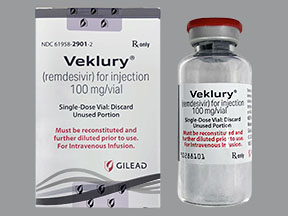 VEKLURY 100 MG VIAL
The following indications for VEKLURY (remdesivir) have been approved by the FDA:
Indications:
COVID-19
Professional Synonyms:
Coronavirus disease
Disease caused by 2019 novel coronavirus
Disease caused by 2019-nCoV
Disease caused by severe acute respiratory syndrome coronavirus 2
SARS-CoV-2 infection
Indications:
COVID-19
Professional Synonyms:
Coronavirus disease
Disease caused by 2019 novel coronavirus
Disease caused by 2019-nCoV
Disease caused by severe acute respiratory syndrome coronavirus 2
SARS-CoV-2 infection
The following dosing information is available for VEKLURY (remdesivir):
No enhanced Dosing information available for this drug.
Remdesivir is administered only by IV infusion. The drug should not be given by any other route. Remdesivir is available in 2 different formulations: a lyophilized powder in single-dose vials containing 100 mg of remdesivir that must be reconstituted with sterile water for injection prior to dilution with 0.9%
sodium chloride injection, and a solution concentrate in single-dose vials containing 100 mg/20 mL (5 mg/mL) that must be further diluted in 0.9% sodium chloride injection prior to infusion. Carefully follow the product-specific preparation instructions for each formulation.
The lyophilized powder formulation is the only approved dosage form of remdesivir for pediatric patients weighing 3 kg to less than 40 kg. Remdesivir should not be administered simultaneously with any other IV drugs. Remdesivir is compatible with 0.9%
sodium chloride injection, but compatibility with other IV solutions or drugs is not known. The manufacturer states that remdesivir solutions should not be shaken. Because studies have not been conducted to assess the effects of vigorous shaking or vibration on the drug, the manufacturer states that pneumatic tube systems should not be used to transport or deliver IV infusion bags containing remdesivir.
After the IV infusion of remdesivir is completed, the infusion line should be flushed with a sufficient volume of 0.9% sodium chloride injection to ensure delivery of the entire dose. Remdesivir solutions should be inspected visually for discoloration and particulates prior to administration whenever solution and container permit; the solutions should be discarded if they are discolored or contain particulates.
Remdesivir formulations contain no preservatives or bacteriostatic agents. Final dilutions of the drug should be prepared on the same day that they are administered and should be administered immediately after preparation whenever possible. Unused lyophilized powder, solution concentrate, or diluted solutions of the drug should be discarded and should not be reused or saved for future use.
sodium chloride injection, and a solution concentrate in single-dose vials containing 100 mg/20 mL (5 mg/mL) that must be further diluted in 0.9% sodium chloride injection prior to infusion. Carefully follow the product-specific preparation instructions for each formulation.
The lyophilized powder formulation is the only approved dosage form of remdesivir for pediatric patients weighing 3 kg to less than 40 kg. Remdesivir should not be administered simultaneously with any other IV drugs. Remdesivir is compatible with 0.9%
sodium chloride injection, but compatibility with other IV solutions or drugs is not known. The manufacturer states that remdesivir solutions should not be shaken. Because studies have not been conducted to assess the effects of vigorous shaking or vibration on the drug, the manufacturer states that pneumatic tube systems should not be used to transport or deliver IV infusion bags containing remdesivir.
After the IV infusion of remdesivir is completed, the infusion line should be flushed with a sufficient volume of 0.9% sodium chloride injection to ensure delivery of the entire dose. Remdesivir solutions should be inspected visually for discoloration and particulates prior to administration whenever solution and container permit; the solutions should be discarded if they are discolored or contain particulates.
Remdesivir formulations contain no preservatives or bacteriostatic agents. Final dilutions of the drug should be prepared on the same day that they are administered and should be administered immediately after preparation whenever possible. Unused lyophilized powder, solution concentrate, or diluted solutions of the drug should be discarded and should not be reused or saved for future use.
| DRUG LABEL | DOSING TYPE | DOSING INSTRUCTIONS |
|---|---|---|
| VEKLURY 100 MG VIAL | Maintenance | Adults infuse 100 mg by intravenous route once daily |
No generic dosing information available.
The following drug interaction information is available for VEKLURY (remdesivir):
There are 2 contraindications.
These drug combinations generally should not be dispensed or administered to the same patient. A manufacturer label warning that indicates the contraindication warrants inclusion of a drug combination in this category, regardless of clinical evidence or lack of clinical evidence to support the contraindication.
| Drug Interaction | Drug Names |
|---|---|
| Lemborexant (Greater Than 5 mg)/Weak CYP3A4 Inhibitors SEVERITY LEVEL: 1-Contraindicated Drug Combination: This drug combination is contraindicated and generally should not be dispensed or administered to the same patient. MECHANISM OF ACTION: Inhibitors of CYP3A4 may inhibit the metabolism of lemborexant.(1) CLINICAL EFFECTS: Concurrent use of an inhibitor of CYP3A4 may result in increased levels of and effects from lemborexant, including somnolence, fatigue, CNS depressant effects, daytime impairment, headache, and nightmare or abnormal dreams.(1) PREDISPOSING FACTORS: None determined. PATIENT MANAGEMENT: The maximum recommended dose of lemborexant with concurrent use of a weak CYP3A4 inhibitors should not exceed 5 mg per dose.(1) DISCUSSION: Lemborexant is a CYP3A4 substrate. In a PKPB model, concurrent use of lemborexant with itraconazole increased area-under-curve (AUC) and concentration maximum (Cmax) by 3.75-fold and 1.5-fold, respectively. Concurrent use of lemborexant with fluconazole increased AUC and Cmax by 4.25-fold and 1.75-fold, respectively.(1) Weak inhibitors of CYP3A4 include: alprazolam, amiodarone, amlodipine, anamorelin, asciminib, azithromycin, Baikal skullcap, belumosudil, berberine, bicalutamide, blueberry, brodalumab, cannabidiol, capivasertib, chlorzoxazone, cilostazol, cimetidine, ciprofloxacin, clotrimazole, cranberry, cyclosporine, daclatasvir, daridorexant, delavirdine, dihydroberberine, diosmin, elinzanetant, everolimus, flibanserin, fosaprepitant, fostamatinib, gepotidacin, ginkgo, givinostat, glecaprevir/pibrentasvir, goldenseal, grazoprevir, isoniazid, istradefylline, ivacaftor, lacidipine, lapatinib, larotrectinib, lazertinib, leflunomide, levamlodipine, linagliptin, lomitapide, lurasidone, mavorixafor, olaparib, osilodrostat, palbociclib, pazopanib, peppermint oil, piperine, propiverine, propofol, ranitidine, ranolazine, remdesivir, resveratrol, roxithromycin, rucaparib, selpercatinib, simeprevir, sitaxsentan, skullcap, suvorexant, teriflunomide, ticagrelor, tolvaptan, trofinetide, viloxazine, vonoprazan, and ziftomenib.(1,2) |
DAYVIGO |
| Ubrogepant (Greater Than 50 mg)/Weak CYP3A4 Inhibitors SEVERITY LEVEL: 1-Contraindicated Drug Combination: This drug combination is contraindicated and generally should not be dispensed or administered to the same patient. MECHANISM OF ACTION: Weak inhibitors of CYP3A4 may inhibit the metabolism of ubrogepant.(1) CLINICAL EFFECTS: Concurrent use of ubrogepant with weak CYP3A4 inhibitors may result in an increase in exposure of ubrogepant.(1) PREDISPOSING FACTORS: None determined. PATIENT MANAGEMENT: The manufacturer recommends a dosage adjustment of ubrogepant when used concomitantly with weak CYP3A4 inhibitors. Initial dose of ubrogepant should not exceed 50 mg when used concomitantly with weak inhibitors of CYP3A4. A second dose may be given within 24 hours but should not exceed 50 mg when used concurrently with weak CYP3A4 inhibitors.(1) DISCUSSION: Coadministration of ubrogepant with verapamil, a moderate CYP3A4 inhibitor, resulted in a 3.5-fold and 2.8-fold increase in area-under-curve (AUC) and concentration maximum (Cmax), respectively. No dedicated drug interaction study was conducted to assess concomitant use with weak CYP3A4 inhibitors. The conservative prediction of the maximal potential increase in ubrogepant exposure with weak CYP3A4 inhibitors is not expected to be more than 2-fold.(1) Weak inhibitors of CYP3A4 include: alprazolam, amiodarone, amlodipine, anamorelin, asciminib, azithromycin, Baikal skullcap, berberine, bicalutamide, blueberry, brodalumab, cannabidiol, capivasertib, chlorzoxazone, cilostazol, cimetidine, ciprofloxacin, clotrimazole, cranberry, cyclosporine, daclatasvir, delavirdine, deutivacaftor, dihydroberberine, diosmin, elinzanetant, everolimus, flibanserin, fosaprepitant, fostamatinib, gepotidacin, givinostat, glecaprevir/pibrentasvir, goldenseal, grazoprevir, isoniazid, istradefylline, ivacaftor, lacidipine, lapatinib, larotrectinib, lazertinib, leflunomide, levamlodipine, linagliptin, lomitapide, lurasidone, maribavir, mavorixafor, olaparib, osilodrostat, palbociclib, pazopanib, peppermint oil, piperine, pirtobrutinib, propiverine, propofol, ranitidine, ranolazine, remdesivir, resveratrol, roxithromycin, rucaparib, simeprevir, sitaxsentan, skullcap, suvorexant, teriflunomide, ticagrelor, tolvaptan, trofinetide, viloxazine, vonoprazan, and ziftomenib.(2,3) |
UBRELVY |
There are 3 severe interactions.
These drug interactions can produce serious consequences in most patients. Actions required for severe interactions include, but are not limited to, discontinuing one or both agents, adjusting dosage, altering administration scheduling, and providing additional patient monitoring. Review the full interaction monograph for more information.
| Drug Interaction | Drug Names |
|---|---|
| Lomitapide (Less Than or Equal To 30 mg)/Weak CYP3A4 Inhibitors SEVERITY LEVEL: 2-Severe Interaction: Action is required to reduce the risk of severe adverse interaction. MECHANISM OF ACTION: Weak inhibitors of CYP3A4 may inhibit the metabolism of lomitapide.(1) Lomitapide is very susceptible to CYP3A4 inhibition. For example, in an interaction study with a strong CYP3A4 inhibitor (ketoconazole) lomitapide exposure was increased 27-fold.(2) Thus even weak CYP3A4 inhibitors may affect lomitapide exposure (AUC, area-under-curve). CLINICAL EFFECTS: Concurrent use of a weak inhibitor of CYP3A4 may result in 2-fold increases in lomitapide levels and toxicity from lomitapide.(1) PREDISPOSING FACTORS: This interaction may be more severe in patients with hepatic impairment or with end-stage renal disease.(1) PATIENT MANAGEMENT: The maximum lomitapide dose should be 30 mg daily for patients taking concomitant weak CYP3A4 inhibitors. Due to lomitapide's long half-life, it may take 1 to 2 weeks to see the full effect of this interaction. When initiating a weak CYP3A4 inhibitor in patients taking lomitapide 10 mg daily or more, decrease the dose of lomitapide by 50%. In patients taking lomitapide 5 mg daily, continue current dose. DISCUSSION: Lomitapide is very susceptible to CYP3A4 inhibition. For example, in an interaction study with a strong CYP3A4 inhibitor (ketoconazole) lomitapide exposure was increased 27-fold.(2) Based upon interactions with stronger inhibitors, weak inhibitors of CYP3A4 are predicted to increase lomitapide area-under-curve(AUC) 2-fold.(1) Weak CYP3A4 inhibitors linked to this interaction include alprazolam, amiodarone, amlodipine, anamorelin, asciminib, atorvastatin, azithromycin, Baikal skullcap, belumosudil, bicalutamide, blueberry juice, brodalumab, cannabidiol, capivasertib, cilostazol, cimetidine, ciprofloxacin, chlorzoxazone, clotrimazole, cranberry juice, cyclosporine, daridorexant, delavirdine, diosmin, elinzanetant, everolimus, flibanserin, fosaprepitant, fostamatinib, gepotidacin, ginkgo, givinostat, glecaprevir/pibrentasvir, goldenseal, grazoprevir, isoniazid, istradefylline, ivacaftor, larotrectinib, lacidipine, lapatinib, lazertinib, leflunomide, levamlodipine, linagliptin, lurasidone, maribavir, mavorixafor, olaparib, osilodrostat, palbociclib, pazopanib, peppermint oil, piperine, propiverine, propofol, ranitidine, ranolazine, remdesivir, resveratrol, roxithromycin, rucaparib, selpercatinib, sitaxsentan, skullcap, teriflunomide, ticagrelor, tolvaptan, trofinetide, viloxazine, vonoprazan, ziftomenib, and zileuton.(1-3) |
JUXTAPID |
| Eliglustat/Weak CYP3A4 Inhibitors SEVERITY LEVEL: 2-Severe Interaction: Action is required to reduce the risk of severe adverse interaction. MECHANISM OF ACTION: Weak inhibitors of CYP3A4 may inhibit the metabolism of eliglustat. If the patient is also taking an inhibitor of CYP2D6, eliglustat metabolism can be further inhibited.(1) CLINICAL EFFECTS: Concurrent use of an agent that is a weak inhibitor of CYP3A4 may result in elevated levels of and clinical effects of eliglustat, including prolongation of the PR, QTc, and/or QRS intervals, which may result in life-threatening cardiac arrhythmias.(1) PREDISPOSING FACTORS: If the patient is also taking an inhibitor of CYP2D6, is a poor metabolizer of CYP2D6, and/or has hepatic impairment, eliglustat metabolism can be further inhibited.(1) The risk of QT prolongation or torsades de pointes may be increased in patients with cardiovascular disease (e.g. heart failure, myocardial infarction, history of torsades de pointes, congenital long QT syndrome), hypokalemia, hypomagnesemia, hypocalcemia, bradycardia, female gender, or advanced age.(2) Concurrent use of more than one drug known to cause QT prolongation or higher systemic concentrations of either QT prolonging drug are additional risk factors for torsades de pointes. Factors which may increase systemic drug concentrations include rapid infusion of an intravenous dose or impaired metabolism or elimination of the drug (e.g. coadministration with an agent which inhibits its metabolism or elimination, genetic impairment in drug metabolism or elimination, and/or renal/hepatic dysfunction).(2) PATIENT MANAGEMENT: The concurrent use of eliglustat with weak inhibitors of CYP3A4 in poor metabolizers of CYP2D6 should be avoided.(1) The dosage of eliglustat with weak inhibitors of CYP3A4 in extensive metabolizers of CYP2D6 with mild (Child-Pugh Class A) hepatic impairment should be limited to 84 mg daily.(1) If concurrent therapy is warranted, consider obtaining serum calcium, magnesium, and potassium levels and monitoring ECG at baseline and at regular intervals. Correct any electrolyte abnormalities. Instruct patients to report any irregular heartbeat, dizziness, or fainting. DISCUSSION: Ketoconazole (400 mg daily), a strong inhibitor of CYP3A4, increased eliglustat (84 mg BID) maximum concentration (Cmax) and area-under-curve (AUC) by 4-fold and 4.4-fold, respectively, in extensive metabolizers. Physiologically-based pharmacokinetic (PKPB) models suggested ketoconazole would increase eliglustat Cmax and AUC by 4.4-fold and 5.4-fold, respectively, in intermediate metabolizers. PKPB models suggested ketoconazole may increase the Cmax and AUC of eliglustat (84 mg daily) by 4.3-fold and 6.2-fold, respectively, in poor metabolizers.(1) PKPB models suggested fluconazole, a moderate inhibitor of CYP3A4, would increase eliglustat Cmax and AUC by 2.8-fold and 3.2-fold, respectively, in extensive metabolizers and by 2.5-fold and 2.9-fold, respectively in intermediate metabolizers. PKPB models suggest that concurrent eliglustat (84 mg BID), paroxetine (a strong inhibitor of CYP2D6), and ketoconazole would increase eliglustat Cmax and AUC by 16.7-fold and 24.2-fold, respectively, in extensive metabolizers. In intermediate metabolizers, eliglustat Cmax and AUC would be expected to increase 7.5-fold and 9.8-fold, respectively.(1) PKPB models suggest that concurrent eliglustat (84 mg BID), terbinafine (a moderate inhibitor of CYP2D6), and ketoconazole would increase eliglustat Cmax and AUC by 10.2-fold and 13.6-fold, respectively, in extensive metabolizers. In intermediate metabolizers, eliglustat Cmax and AUC would be expected to increase 4.2-fold and 5-fold, respectively.(1) Weak inhibitors of CYP3A4 include: alprazolam, amlodipine, anamorelin, asciminib, azithromycin, Baikal skullcap, belumosudil, berberine, bicalutamide, blueberry, brodalumab, cannabidiol, chlorzoxazone, cilostazol, cimetidine, ciprofloxacin, clotrimazole, cranberry, cyclosporine, daclatasvir, daridorexant, delavirdine, dihydroberberine, diosmin, elinzanetant, everolimus, flibanserin, fosaprepitant, fostamatinib, gepotidacin, ginkgo, givinostat, glecaprevir/pibrentasvir, goldenseal, grazoprevir, isoniazid, istradefylline, ivacaftor, lacidipine, lapatinib, larotrectinib, lazertinib, leflunomide, levamlodipine, linagliptin, lomitapide, lurasidone, olaparib, osilodrostat, palbociclib, pazopanib, peppermint oil, piperine, propiverine, propofol, ranolazine, remdesivir, resveratrol, roxithromycin, rucaparib, selpercatinib, simeprevir, sitaxsentan, skullcap, suvorexant, teriflunomide, ticagrelor, tolvaptan, trofinetide, vonoprazan, and ziftomenib.(3,4) |
CERDELGA |
| Remdesivir/Chloroquine; Hydroxychloroquine SEVERITY LEVEL: 2-Severe Interaction: Action is required to reduce the risk of severe adverse interaction. MECHANISM OF ACTION: Chloroquine may inhibit the intracellular metabolic activation and antiviral activity of remdesivir.(1,2) CLINICAL EFFECTS: Concurrent use of chloroquine or hydroxychloroquine may result in decreased effectiveness of remdesivir.(1,2) PREDISPOSING FACTORS: None determined. PATIENT MANAGEMENT: The concurrent use of chloroquine or hydroxychloroquine with remdesivir is not recommended.(1,2) Monitor patients receiving concurrent therapy for decreased remdesivir effects. DISCUSSION: In vitro tests in HEp-2 cells infected with respiratory syncytial virus (RSV) found that the antiviral activity of remdesivir was antagonized by chloroquine phosphate in a dose-dependent manner at clinically relevant concentrations.(1,2) Higher remdesivir EC50 values were seen with increasing concentrations of chloroquine phosphate. Reduced formation of remdesivir triphosphate (the pharmacologically active metabolite) in normal human bronchial epithelial cells was also seen with increasing concentration of chloroquine phosphate.(1,2) |
CHLOROQUINE PHOSPHATE, HYDROXYCHLOROQUINE SULFATE, PLAQUENIL, SOVUNA |
There are 5 moderate interactions.
The clinician should assess the patient’s characteristics and take action as needed. Actions required for moderate interactions include, but are not limited to, discontinuing one or both agents, adjusting dosage, altering administration.
| Drug Interaction | Drug Names |
|---|---|
| Tacrolimus/Moderate and Weak CYP3A4 Inhibitors SEVERITY LEVEL: 3-Moderate Interaction: Assess the risk to the patient and take action as needed. MECHANISM OF ACTION: Moderate and weak inhibitors of CYP3A4 may inhibit the metabolism of tacrolimus.(1) CLINICAL EFFECTS: Concurrent use of a CYP3A4 inhibitor may result in elevated levels of and toxicity from tacrolimus, including nephrotoxicity, neurotoxicity, and prolongation of the QTc interval and life-threatening cardiac arrhythmias, including torsades de pointes.(1) PREDISPOSING FACTORS: The risk of QT prolongation or torsade de pointes may be increased in patients with cardiovascular disease (e.g. heart failure, myocardial infarction, history of torsade de pointes, congenital long QT syndrome), hypokalemia, hypomagnesemia, hypocalcemia, bradycardia, female gender, or advanced age.(2) Concurrent use of more than one drug known to cause QT prolongation or higher systemic concentrations of either QT prolonging drug are additional risk factors for torsade de pointes. Factors which may increase systemic drug concentrations include rapid infusion of an intravenous dose or impaired metabolism or elimination of the drug (e.g. coadministration with an agent which inhibits its metabolism or elimination, and/or renal/hepatic dysfunction).(2) PATIENT MANAGEMENT: The US manufacturer of tacrolimus recommends monitoring tacrolimus whole blood trough concentrations and reducing tacrolimus dose if needed.(1) Consider obtaining serum calcium, magnesium, and potassium levels and monitoring ECG at baseline and at regular intervals. Correct any electrolyte abnormalities. Instruct patients to report any irregular heartbeat, dizziness, or fainting. DISCUSSION: In a study of 26 renal transplant recipients, conjugated estrogens 3.75 mg daily increased the tacrolimus dose-corrected concentration of tacrolimus by 85.6%. Discontinuation of the conjugated estrogens led to a decrease in tacrolimus concentration of 46.6%.(3) A case report describes a 65-year-old kidney transplant recipient who was stable on tacrolimus 9 mg per day with trough levels of 5 to 7.5 ng/mL. Ten days after starting on estradiol gel 0.5 mg per day, her tacrolimus level rose to 18.3 ng/mL and serum creatinine (Scr) rose from 1.1 mg/dL at baseline to 2 mg/dL. Tacrolimus dose was reduced by 60%, and trough levels and Scr normalized after two weeks.(4) A study of 16 healthy volunteers found that elbasvir 50 mg/grazoprevir 200 mg daily increased the area-under-curve (AUC) of tacrolimus by 43%, while the maximum concentration (Cmax) of tacrolimus was decreased by 40%.(5) An analysis of FAERS data from 2004-2017, found a significant association between transplant rejection and concurrent use of tacrolimus and clotrimazole (reporting odds ratio 1.92, 95% CI). A retrospective study of 7 heart transplant patients on concurrent tacrolimus and clotrimazole troche showed a significant correlation between tacrolimus trough concentration and AUC after clotrimazole discontinuation. Tacrolimus clearance and bioavailability after clotrimazole discontinuation was 2.2-fold greater (0.27 vs. 0.59 L/h/kg) and the trough concentration decreased from 6.5 ng/mL at 1 day to 5.3 ng/mL at 2 days after clotrimazole discontinuation.(7) A retrospective study of 26 heart transplant patients found that discontinuation of concurrent clotrimazole with tacrolimus in the CYP3A5 expresser group had a 3.3-fold increase in apparent oral clearance and AUC of tacrolimus (0.27 vs. 0.89 L/h/kg) compared to the CYP3A5 non expresser group with a 2.2-fold mean increase (0.18 vs. 0.39 L/h/kg).(8) A study of 6 adult kidney transplant recipients found that clotrimazole (5-day course) increased the tacrolimus AUC 250% and the blood trough concentrations doubled (27.7 ng/ml versus 27.4 ng/ml). Tacrolimus clearance decreased 60% with coadministration of clotrimazole.(9) A case report describes a 23-year-old kidney transplant recipient who was stable on tacrolimus 5 mg twice daily, mycophenolate mofetil 30 mg daily, prednisone (30 mg daily tapered over time to 5 mg), and clotrimazole troche 10 mg four times daily. Discontinuation of clotrimazole resulted in a decrease in tacrolimus trough levels from 13.7 ng/ml to 5.4 ng/ml over a period of 6 days. Clotrimazole was restarted with tacrolimus 6 mg resulting in an increased tacrolimus level of 19.2 ng/ml.(10) A retrospective study in 95 heart transplant recipients on concurrent clotrimazole and tacrolimus found a median tacrolimus dose increase of 66.7% was required after clotrimazole discontinuation. Tacrolimus trough concentration was found to have decreased 42.5% after clotrimazole discontinuation.(11) A retrospective study in 65 pancreas transplant patients on concurrent tacrolimus, clotrimazole, cyclosporine, and prednisone found that clotrimazole discontinuation at 3 months after transplantation may cause significant tacrolimus trough level reductions.(12) A case report describes a 6-year-old kidney transplant recipient who was on a regimen of tacrolimus and mycophenolate mofetil. The patient was started letermovir 240 mg via G-tube 2 months post kidney transplant. One week after starting letermovir, the routine tacrolimus level showed a supratherapeutic concentration of 22.9 ng/L. A 36% dose reduction of tacrolimus was required. Upon discontinuation of letermovir, the tacrolimus level decreased by 42%.(13) Moderate CYP3A4 inhibitors linked to this monograph include: aprepitant, berotralstat, conivaptan, fluvoxamine, lenacapavir, letermovir, netupitant, nirogacestat, sevabertinib, stiripentol, and tofisopam.(6) Weak CYP3A4 inhibitors linked to this monograph include: alprazolam, avacopan, baikal skullcap, berberine, bicalutamide, blueberry, brodalumab, chlorzoxazone, cimetidine, cranberry juice, daclatasvir, daridorexant, delavirdine, diosmin, elinzanetant, estrogens, flibanserin, fosaprepitant, fostamatinib, ginkgo biloba, givinostat, glecaprevir/pibrentasvir, goldenseal, grazoprevir, isoniazid, istradefylline, ivacaftor, lacidipine, lazertinib, linagliptin, lomitapide, lumateperone, lurasidone, peppermint oil, piperine, propiverine, ranitidine, remdesivir, resveratrol, rimegepant, simeprevir, sitaxsentan, skullcap, suvorexant, ticagrelor, tolvaptan, trofinetide, viloxazine, and vonoprazan-amoxicillin.(6) |
ASTAGRAF XL, ENVARSUS XR, PROGRAF, TACROLIMUS, TACROLIMUS XL |
| Lemborexant (Less Than or Equal To 5 mg)/Weak CYP3A4 Inhibitors SEVERITY LEVEL: 3-Moderate Interaction: Assess the risk to the patient and take action as needed. MECHANISM OF ACTION: Inhibitors of CYP3A4 may inhibit the metabolism of lemborexant.(1) CLINICAL EFFECTS: Concurrent use of an inhibitor of CYP3A4 may result in increased levels of and effects from lemborexant, including somnolence, fatigue, CNS depressant effects, daytime impairment, headache, and nightmare or abnormal dreams.(1) PREDISPOSING FACTORS: None determined. PATIENT MANAGEMENT: The maximum recommended dose of lemborexant with concurrent use of a weak CYP3A4 inhibitors should not exceed 5 mg per dose.(1) DISCUSSION: Lemborexant is a CYP3A4 substrate. In a PKPB model, concurrent use of lemborexant with itraconazole increased area-under-curve (AUC) and concentration maximum (Cmax) by 3.75-fold and 1.5-fold, respectively. Concurrent use of lemborexant with fluconazole increased AUC and Cmax by 4.25-fold and 1.75-fold, respectively.(1) Weak inhibitors of CYP3A4 include: alprazolam, amiodarone, amlodipine, anamorelin, asciminib, azithromycin, Baikal skullcap, belumosudil, berberine, bicalutamide, blueberry, brodalumab, cannabidiol, capivasertib, chlorzoxazone, cilostazol, cimetidine, ciprofloxacin, clotrimazole, cranberry, cyclosporine, daclatasvir, daridorexant, delavirdine, dihydroberberine, diosmin, elinzanetant, everolimus, flibanserin, fosaprepitant, fostamatinib, gepotidacin, ginkgo, givinostat, glecaprevir/pibrentasvir, goldenseal, grazoprevir, isoniazid, istradefylline, ivacaftor, lacidipine, lapatinib, larotrectinib, lazertinib, leflunomide, levamlodipine, linagliptin, lomitapide, lurasidone, mavorixafor, olaparib, osilodrostat, palbociclib, pazopanib, peppermint oil, piperine, propiverine, propofol, ranitidine, ranolazine, remdesivir, resveratrol, roxithromycin, rucaparib, selpercatinib, simeprevir, sitaxsentan, skullcap, suvorexant, teriflunomide, ticagrelor, tolvaptan, trofinetide, viloxazine, vonoprazan, and ziftomenib.(1,2) |
DAYVIGO |
| Ubrogepant (Less Than or Equal To 50 mg)/Weak CYP3A4 Inhibitors SEVERITY LEVEL: 3-Moderate Interaction: Assess the risk to the patient and take action as needed. MECHANISM OF ACTION: Weak inhibitors of CYP3A4 may inhibit the metabolism of ubrogepant.(1) CLINICAL EFFECTS: Concurrent use of ubrogepant with weak CYP3A4 inhibitors may result in an increase in exposure of ubrogepant.(1) PREDISPOSING FACTORS: None determined. PATIENT MANAGEMENT: The manufacturer recommends a dosage adjustment of ubrogepant when used concomitantly with weak CYP3A4 inhibitors. Initial dose of ubrogepant should not exceed 50 mg when used concomitantly with weak inhibitors of CYP3A4. A second dose may be given within 24 hours but should not exceed 50 mg when used concurrently with weak CYP3A4 inhibitors.(1) DISCUSSION: Coadministration of ubrogepant with verapamil, a moderate CYP3A4 inhibitor, resulted in a 3.5-fold and 2.8-fold increase in area-under-curve (AUC) and concentration maximum (Cmax), respectively. No dedicated drug interaction study was conducted to assess concomitant use with weak CYP3A4 inhibitors. The conservative prediction of the maximal potential increase in ubrogepant exposure with weak CYP3A4 inhibitors is not expected to be more than 2-fold.(1) Weak inhibitors of CYP3A4 include: alprazolam, amiodarone, amlodipine, anamorelin, asciminib, azithromycin, Baikal skullcap, berberine, bicalutamide, blueberry, brodalumab, cannabidiol, capivasertib, chlorzoxazone, cilostazol, cimetidine, ciprofloxacin, clotrimazole, cranberry, cyclosporine, daclatasvir, delavirdine, deutivacaftor, dihydroberberine, diosmin, elinzanetant, everolimus, flibanserin, fosaprepitant, fostamatinib, gepotidacin, givinostat, glecaprevir/pibrentasvir, goldenseal, grazoprevir, isoniazid, istradefylline, ivacaftor, lacidipine, lapatinib, larotrectinib, lazertinib, leflunomide, levamlodipine, linagliptin, lomitapide, lurasidone, maribavir, mavorixafor, olaparib, osilodrostat, palbociclib, pazopanib, peppermint oil, piperine, pirtobrutinib, propiverine, propofol, ranitidine, ranolazine, remdesivir, resveratrol, roxithromycin, simeprevir, sitaxsentan, skullcap, suvorexant, teriflunomide, ticagrelor, tolvaptan, trofinetide, viloxazine, vonoprazan, and ziftomenib.(2,3) |
UBRELVY |
| Sirolimus Protein-Bound/Slt Moderate and Weak CYP3A4 Inhibit SEVERITY LEVEL: 3-Moderate Interaction: Assess the risk to the patient and take action as needed. MECHANISM OF ACTION: Moderate and weak CYP3A4 inhibitors may inhibit the metabolism of sirolimus by CYP3A4.(1) CLINICAL EFFECTS: Concurrent use of moderate or weak CYP3A4 inhibitors may result in elevated levels of and side effects from sirolimus.(1) PREDISPOSING FACTORS: None determined. PATIENT MANAGEMENT: The US manufacturer of sirolimus protein-bound injection (Fyarro) states a dose reduction to 56 mg/m2 is recommended when used concurrently with moderate or weak CYP3A4 inhibitors. Concurrent use with strong CYP3A4 inhibitors should be avoided.(1) DISCUSSION: In an open, randomized, cross-over trial in 18 healthy subjects, concurrent single doses of diltiazem (120 mg) and sirolimus (10 mg) increased sirolimus area-under-curve (AUC) and maximum concentration (Cmax) by 60% and by 43%, respectively. Sirolimus apparent oral clearance and volume of distribution decreased by 38% and 45%, respectively. There were no effects on diltiazem pharmacokinetics or pharmacodynamics.(2) In a study in 26 healthy subjects, concurrent sirolimus (2 mg daily) with verapamil (180 mg twice daily) increased sirolimus AUC and Cmax by 2.2-fold and 2.3-fold, respectively. The AUC and Cmax of the active S-enantiomer of verapamil each increased by 1.5-fold. Verapamil time to Cmax (Tmax) was increased by 1.2 hours.(2) Moderate and weak CYP3A4 inhibitors linked to this monograph include: alprazolam, amlodipine, anamorelin, aprepitant, avacopan, azithromycin, berberine, berotralstat, bicalutamide, blueberry, brodalumab, chlorzoxazone, cilostazol, cimetidine, ciprofloxacin, clofazimine, conivaptan, daclatasvir, daridorexant, delavirdine, diosmin, elinzanetant, entrectinib, erythromycin, estrogen, flibanserin, fluvoxamine, fosaprepitant, fosnetupitant, fostamatinib, ginkgo, givinostat, glecaprevir/pibrentasvir, goldenseal, grazoprevir, isoniazid, istradefylline, ivacaftor, lacidipine, lazertinib, lenacapavir, levamlodipine, linagliptin, lomitapide, lumateperone, lurasidone, mavorixafor, netupitant, omeprazole, osilodrostat, peppermint oil, piperine, propiverine, propofol, ranitidine, ranolazine, remdesivir, resveratrol, rimegepant, roxithromycin, scutellarin, sevabertinib, simeprevir, sitaxsentan, stiripentol, suvorexant, ticagrelor, tofisopam, tolvaptan, trofinetide, and vonoprazan.(3,4) |
FYARRO |
| Mavacamten/Weak CYP3A4 Inhibitors SEVERITY LEVEL: 3-Moderate Interaction: Assess the risk to the patient and take action as needed. MECHANISM OF ACTION: Weak CYP3A4 inhibitors may decrease the metabolism of mavacamten.(1) CLINICAL EFFECTS: Concurrent use of weak CYP3A4 inhibitors may increase the plasma levels and the incidence and severity of adverse reactions of mavacamten.(1) PREDISPOSING FACTORS: CYP2C19 poor metabolizers may experience an increased incidence or severity of adverse effects.(1) PATIENT MANAGEMENT: The UK manufacturer of mavacamten states no dose adjustment is necessary when starting mavacamten in patients on weak CYP3A4 inhibitors or in intermediate, normal, rapid, or ultra-rapid CYP2C19 metabolizers already on mavacamten and starting a weak CYP3A4 inhibitor. In poor CYP2C19 metabolizers already on mavacamten and starting a weak CYP3A4 inhibitor, reduce mavacamten 5 mg to 2.5 mg or if on 2.5 mg pause treatment for 4 weeks. If CYP2C19 phenotype is unknown, consider a mavacamten starting dose of 2.5 mg daily.(1) DISCUSSION: In a PBPK model, concomitant use of mavacamten (15 mg daily) with cimetidine 400 mg twice daily, a weak CYP3A4 inhibitor, was predicted to increase mavacamten area-under-curve (AUC) by 6% and maximum concentration (Cmax) by 4% in poor CYP2C19 metabolizers and by 3% and 2%, respectively, in both intermediate and normal CYP2C19 metabolizers.(2) Weak CYP3A4 inhibitors include: alprazolam, amiodarone, amlodipine, anamorelin, asciminib, azithromycin, Baikal skullcap, belumosudil, berberine, bicalutamide, blueberry, brodalumab, chlorzoxazone, cilostazol, ciprofloxacin, clotrimazole, cranberry, cyclosporine, delavirdine, dihydroberberine, diosmin, elinzanetant, everolimus, flibanserin, fosaprepitant, fostamatinib, gepotidacin, ginkgo, givinostat, glecaprevir/pibrentasvir, goldenseal, istradefylline, ivacaftor, lacidipine, lapatinib, leflunomide, levamlodipine, linagliptin, lomitapide, lurasidone, mavorixafor, pazopanib, peppermint oil, propiverine, propofol, ranitidine, remdesivir, resveratrol, roxithromycin, sitaxsentan, skullcap, suvorexant, teriflunomide, ticagrelor, tolvaptan, trofinetide, and viloxazine.(4,5) |
CAMZYOS |
The following contraindication information is available for VEKLURY (remdesivir):
Drug contraindication overview.
Remdesivir is contraindicated in patients with a history of clinically important hypersensitivity reactions to the drug or any ingredient in the formulation.
Remdesivir is contraindicated in patients with a history of clinically important hypersensitivity reactions to the drug or any ingredient in the formulation.
There are 0 contraindications.
There are 0 severe contraindications.
There are 1 moderate contraindications.
Clinically significant contraindication, where the condition can be managed or treated before the drug may be given safely.
| Moderate List |
|---|
| Sinus bradycardia |
The following adverse reaction information is available for VEKLURY (remdesivir):
Adverse reaction overview.
Adverse effects reported in 5% or more of patients receiving remdesivir include nausea and increased ALT and AST concentrations.
Adverse effects reported in 5% or more of patients receiving remdesivir include nausea and increased ALT and AST concentrations.
There are 15 severe adverse reactions.
| More Frequent | Less Frequent |
|---|---|
|
Increased alanine transaminase Increased aspartate transaminase |
Abnormal hepatic function tests Hyperbilirubinemia |
| Rare/Very Rare |
|---|
|
Anaphylaxis Angioedema Bradycardia Dyspnea Extravasation injury Hypersensitivity drug reaction Hypertension Hypotension Hypoxia Seizure disorder Sinus bradycardia |
There are 9 less severe adverse reactions.
| More Frequent | Less Frequent |
|---|---|
|
Nausea |
Fever Hyperglycemia |
| Rare/Very Rare |
|---|
|
Chills Hyperhidrosis Skin rash Tachycardia Vomiting Wheezing |
The following precautions are available for VEKLURY (remdesivir):
Safety and efficacy of remdesivir for the treatment of COVID-19 have been established in pediatric patients 28 days of age and older weighing at least 3 kg. Use of the drug in this pediatric population is supported by an open-label trial in 53 hospitalized pediatric subjects who were treated for up to 10 days with weight-based remdesevir. Safety and pharmacokinetic findings in this age group were similar to those in adults.
Use of remdesivir in pediatric patients weighing at least 40 kg is futher supported by a clinical trial in nonhospitalized patients that included 3 pediatric patients 12 years of age and older and by clinical trials in hospitalized patients that included 30 adults weighing 40 to 50 kg. Use of remdesivir in pediatric patients with renal impairment is supported by safety data in adults. There are limited data in pediatric patients with mild to moderate renal impairment and no data in pediatric patients with severe renal impairment. The formulation contains the excipient betadex sulfobutyl ether sodium (sulfobutylether beta-cyclodextrin sodium; SBECD) which, when administeredIV, is eliminated through glomerular filtration and therefore when administered to pediatricpatients with renal immaturity or renal impairment, may result in higher exposure to SBECD.
Contraindicated
Severe Precaution
Management or Monitoring Precaution
Use of remdesivir in pediatric patients weighing at least 40 kg is futher supported by a clinical trial in nonhospitalized patients that included 3 pediatric patients 12 years of age and older and by clinical trials in hospitalized patients that included 30 adults weighing 40 to 50 kg. Use of remdesivir in pediatric patients with renal impairment is supported by safety data in adults. There are limited data in pediatric patients with mild to moderate renal impairment and no data in pediatric patients with severe renal impairment. The formulation contains the excipient betadex sulfobutyl ether sodium (sulfobutylether beta-cyclodextrin sodium; SBECD) which, when administeredIV, is eliminated through glomerular filtration and therefore when administered to pediatricpatients with renal immaturity or renal impairment, may result in higher exposure to SBECD.
Contraindicated
| None |
Severe Precaution
| None |
Management or Monitoring Precaution
| None |
Data regarding the use of remdesivir during pregnancy are available from a clinical trial, published case reports, an ongoing pregnancy exposure registry, and a compassionate use access program. The available data have not identified a drug-associated risk of major birth defects, miscarriage, or adverse maternal or fetal outcomes following drug exposure in the second and third trimester; however, there are insufficient data regarding risk during the first trimester. There are maternal and fetal risks associated with untreated COVID-19 during pregnancy.
In nonclinical reproductive toxicity studies, remdesivir demonstrated no adverse effect on embryofetal development when administered to pregnant animals at systemic exposures of the predominant circulating metabolite of remdesivir (GS-441524) that were 4 times (rats and rabbits) the exposure in humans at the recommended human dose (RHD). Some data are available regarding use of remdesivir in pregnant women hospitalized for the treatment of moderate COVID-19.
In nonclinical reproductive toxicity studies, remdesivir demonstrated no adverse effect on embryofetal development when administered to pregnant animals at systemic exposures of the predominant circulating metabolite of remdesivir (GS-441524) that were 4 times (rats and rabbits) the exposure in humans at the recommended human dose (RHD). Some data are available regarding use of remdesivir in pregnant women hospitalized for the treatment of moderate COVID-19.
Remdesivir and its active metabolite distribute into human milk; however, available data do not indicate any adverse effects on the breast-fed infant from exposure to the drug. It is not known whether remdesivir has any effects on milk production. The developmental and health benefits of breast-feeding should be considered along with the mother's clinical need for remdesivir and any potential adverse effects on the breast-fed child from the drug or from the underlying maternal condition. Breastfeeding individuals with COVID-19 should follow clinical guidelines to avoid exposing the infant to the virus.
Reported clinical experience has not identified differences in responses to remdesivir between geriatric and younger patients. Although dosage adjustment of remdesivir is not needed in patients older than 65 years of age, appropriate caution and monitoring are recommended because of the greater frequency of decreased hepatic, renal, and/or cardiac function and of concomitant disease or other drug therapy observed in this age group.
The following prioritized warning is available for VEKLURY (remdesivir):
No warning message for this drug.
No warning message for this drug.
The following icd codes are available for VEKLURY (remdesivir)'s list of indications:
| COVId-19 | |
| J12.82 | Pneumonia due to coronavirus disease 2019 |
| U07.1 | COVId-19 |
Formulary Reference Tool