Please wait while the formulary information is being retrieved.
Drug overview for PROTAMINE SULFATE (protamine sulfate):
Generic name: PROTAMINE SULFATE
Drug class: Heparin Antagonists
Therapeutic class: Antidotes and other Reversal Agents
Protamine sulfate, which is prepared from the sperm or mature testes of salmon or related species and is composed of arginine, proline, serine, and valine, acts as a heparin antagonist.
No enhanced Uses information available for this drug.
Generic name: PROTAMINE SULFATE
Drug class: Heparin Antagonists
Therapeutic class: Antidotes and other Reversal Agents
Protamine sulfate, which is prepared from the sperm or mature testes of salmon or related species and is composed of arginine, proline, serine, and valine, acts as a heparin antagonist.
No enhanced Uses information available for this drug.
DRUG IMAGES
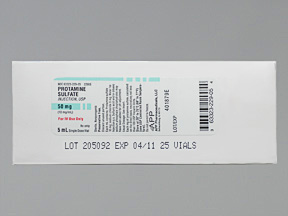 PROTAMINE 50 MG/5 ML VIAL
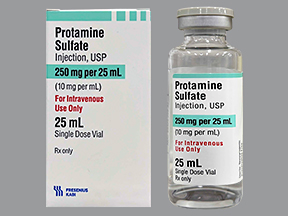 PROTAMINE 250 MG/25 ML VIAL
The following indications for PROTAMINE SULFATE (protamine sulfate) have been approved by the FDA:
Indications:
Heparin toxicity
Professional Synonyms:
Acute heparin overdosage
Indications:
Heparin toxicity
Professional Synonyms:
Acute heparin overdosage
The following dosing information is available for PROTAMINE SULFATE (protamine sulfate):
Protamine sulfate is used in the treatment of severe heparin sodium overdosage. Protamine sulfate should not be used if only minor bleeding occurs during heparin therapy, since withdrawal of heparin will usually correct minor overdosage or bleeding within a few hours. However, if severe overdosage or bleeding occurs during heparin therapy, heparin should be discontinued and protamine sulfate administered immediately.
Blood transfusions may be required in patients with massive blood loss. (See Heparin 20:12.04.16.)
Protamine sulfate has been used in the treatment of low molecular weight heparin (e.g., dalteparin, enoxaparin, tinzaparin (no longer commercially available in the US)) overdosage+ . However, unlike treatment of overdosage of conventional unfractionated heparin, neutralization of the effects of a low molecular weight heparin is not complete even with multiple doses of protamine sulfate. (See Pharmacology.)
Dosage of protamine sulfate should be determined by the dose of heparin received, route of administration, the time elapsed since heparin was given, and by blood coagulation studies. Generally, 1 mg of protamine sulfate will neutralize no less than 100 units of heparin sodium.
Since blood heparin concentrations decrease rapidly after IV administration of heparin, the dose of protamine sulfate required in the treatment of IV heparin overdosage also decreases rapidly as time elapses. If only a few minutes have elapsed since heparin was administered by IV injection, most clinicians recommend that 1 mg of protamine sulfate be given for every 100 units of heparin sodium administered. If 30 minutes have elapsed since IV injection of heparin, 0.5
mg of protamine sulfate should be given for every 100 units of heparin sodium and, if 2 hours or more have elapsed since IV injection of heparin, 0.25-0.375 mg of protamine sulfate should be given for every 100 units of heparin sodium administered.
If heparin was administered by IV infusion, some clinicians recommend that a dose of 25-50 mg of protamine sulfate be given after stopping the infusion.
If heparin was administered by deep subcutaneous injection, some clinicians recommend that 1-1.5 mg of protamine sulfate be given IV for each 100 units of heparin sodium. Some clinicians have suggested that a loading dose of 25-50 mg of protamine sulfate may be administered by slow IV injection and the rest of the calculated dose administered by continuous IV infusion over 8-16 hours or the expected duration of absorption of heparin.
To largely neutralize the effects of low molecular weight heparins following overdosage+ , the dose of protamine sulfate is determined by the administered dose of the low molecular weight heparin, the time elapsed since the drug was given, and blood coagulation studies.
For severe bleeding or low molecular weight heparin overdosage, 1 mg of protamine sulfate should be given for every 100 anti-factor Xa units of low molecular weight heparin (e.g., dalteparin sodium, enoxaparin sodium (1 mg of enoxaparin sodium has an anti-factor Xa activity of approximately 100 units), tinzaparin sodium (no longer commercially available in the US)) if the low molecular weight heparin was administered in the previous 8 hours. If the activated partial thromboplastin time (aPTT) measured 2-4 hours after the first protamine sulfate infusion remains prolonged or if bleeding continues, a second dose of 0.5 mg of protamine sulfate may be given for every 100 anti-factor Xa units of low molecular weight heparin administered.
If more than 8 hours has elapsed since the low molecular weight heparin was administered, an infusion of 0.5 mg of protamine sulfate may be given for every 100 anti-factor Xa units of low molecular weight heparin administered.
However, even after higher dosages of protamine sulfate, the aPTT may remain more prolonged than would be the case following treatment of overdosage of conventional unfractionated heparin since anti-factor Xa activity is never completely neutralized. A maximum of about 60-75% or 60% of anti-factor Xa activity is neutralized with protamine sulfate administration for overdosage of dalteparin or enoxaparin, respectively.
Protamine administration may not be required if more than 12 hours has elapsed since administration of enoxaparin.
Blood transfusions may be required in patients with massive blood loss. (See Heparin 20:12.04.16.)
Protamine sulfate has been used in the treatment of low molecular weight heparin (e.g., dalteparin, enoxaparin, tinzaparin (no longer commercially available in the US)) overdosage+ . However, unlike treatment of overdosage of conventional unfractionated heparin, neutralization of the effects of a low molecular weight heparin is not complete even with multiple doses of protamine sulfate. (See Pharmacology.)
Dosage of protamine sulfate should be determined by the dose of heparin received, route of administration, the time elapsed since heparin was given, and by blood coagulation studies. Generally, 1 mg of protamine sulfate will neutralize no less than 100 units of heparin sodium.
Since blood heparin concentrations decrease rapidly after IV administration of heparin, the dose of protamine sulfate required in the treatment of IV heparin overdosage also decreases rapidly as time elapses. If only a few minutes have elapsed since heparin was administered by IV injection, most clinicians recommend that 1 mg of protamine sulfate be given for every 100 units of heparin sodium administered. If 30 minutes have elapsed since IV injection of heparin, 0.5
mg of protamine sulfate should be given for every 100 units of heparin sodium and, if 2 hours or more have elapsed since IV injection of heparin, 0.25-0.375 mg of protamine sulfate should be given for every 100 units of heparin sodium administered.
If heparin was administered by IV infusion, some clinicians recommend that a dose of 25-50 mg of protamine sulfate be given after stopping the infusion.
If heparin was administered by deep subcutaneous injection, some clinicians recommend that 1-1.5 mg of protamine sulfate be given IV for each 100 units of heparin sodium. Some clinicians have suggested that a loading dose of 25-50 mg of protamine sulfate may be administered by slow IV injection and the rest of the calculated dose administered by continuous IV infusion over 8-16 hours or the expected duration of absorption of heparin.
To largely neutralize the effects of low molecular weight heparins following overdosage+ , the dose of protamine sulfate is determined by the administered dose of the low molecular weight heparin, the time elapsed since the drug was given, and blood coagulation studies.
For severe bleeding or low molecular weight heparin overdosage, 1 mg of protamine sulfate should be given for every 100 anti-factor Xa units of low molecular weight heparin (e.g., dalteparin sodium, enoxaparin sodium (1 mg of enoxaparin sodium has an anti-factor Xa activity of approximately 100 units), tinzaparin sodium (no longer commercially available in the US)) if the low molecular weight heparin was administered in the previous 8 hours. If the activated partial thromboplastin time (aPTT) measured 2-4 hours after the first protamine sulfate infusion remains prolonged or if bleeding continues, a second dose of 0.5 mg of protamine sulfate may be given for every 100 anti-factor Xa units of low molecular weight heparin administered.
If more than 8 hours has elapsed since the low molecular weight heparin was administered, an infusion of 0.5 mg of protamine sulfate may be given for every 100 anti-factor Xa units of low molecular weight heparin administered.
However, even after higher dosages of protamine sulfate, the aPTT may remain more prolonged than would be the case following treatment of overdosage of conventional unfractionated heparin since anti-factor Xa activity is never completely neutralized. A maximum of about 60-75% or 60% of anti-factor Xa activity is neutralized with protamine sulfate administration for overdosage of dalteparin or enoxaparin, respectively.
Protamine administration may not be required if more than 12 hours has elapsed since administration of enoxaparin.
Protamine sulfate is administered by very slow IV injection. The drug has also been administered by continuous IV infusion+. Protamine sulfate injection is intended for administration without further dilution at a concentration of 10 mg of protamine sulfate per mL.
However, if further dilution is desired, 5% dextrose or 0.9% sodium chloride injection may be used. Diluted solutions of protamine sulfate should not be stored since they contain no preservative.
Protamine sulfate usually is administered by very slow IV injection over 10 minutes. No more than 50 mg of the drug should be administered in any 10-minute period. (See Cautions: Precautions and Contraindications.)
However, if further dilution is desired, 5% dextrose or 0.9% sodium chloride injection may be used. Diluted solutions of protamine sulfate should not be stored since they contain no preservative.
Protamine sulfate usually is administered by very slow IV injection over 10 minutes. No more than 50 mg of the drug should be administered in any 10-minute period. (See Cautions: Precautions and Contraindications.)
No dosing information available.
No generic dosing information available.
The following drug interaction information is available for PROTAMINE SULFATE (protamine sulfate):
There are 0 contraindications.
There are 0 severe interactions.
There are 0 moderate interactions.
The following contraindication information is available for PROTAMINE SULFATE (protamine sulfate):
Drug contraindication overview.
No enhanced Contraindications information available for this drug.
No enhanced Contraindications information available for this drug.
There are 0 contraindications.
There are 2 severe contraindications.
Adequate patient monitoring is recommended for safer drug use.
| Severe List |
|---|
| Hyperheparinemia |
| Pulmonary edema |
There are 2 moderate contraindications.
Clinically significant contraindication, where the condition can be managed or treated before the drug may be given safely.
| Moderate List |
|---|
| Left ventricular failure |
| Male infertility |
The following adverse reaction information is available for PROTAMINE SULFATE (protamine sulfate):
Adverse reaction overview.
No enhanced Common Adverse Effects information available for this drug.
No enhanced Common Adverse Effects information available for this drug.
There are 10 severe adverse reactions.
| More Frequent | Less Frequent |
|---|---|
|
Bradycardia Dyspnea Hypotension Severe hypotension Shock |
Anaphylaxis Hypertension Pulmonary edema Pulmonary hypertension |
| Rare/Very Rare |
|---|
|
Heart failure |
There are 6 less severe adverse reactions.
| More Frequent | Less Frequent |
|---|---|
| None. | None. |
| Rare/Very Rare |
|---|
|
Back pain Flushing General weakness Nausea Sensation of warmth Vomiting |
The following precautions are available for PROTAMINE SULFATE (protamine sulfate):
No enhanced Pediatric Use information available for this drug.
Contraindicated
Severe Precaution
Management or Monitoring Precaution
Contraindicated
| None |
Severe Precaution
| None |
Management or Monitoring Precaution
| None |
Animal reproduction studies have not been performed with protamine sulfate. It is not known whether protamine sulfate can cause fetal harm when administered to pregnant women or can affect reproduction capacity. The drug should be used during pregnancy only when clearly needed.
Since it is not known whether protamine sulfate is distributed into human milk, the drug should be used with caution in nursing women.
No enhanced Geriatric Use information available for this drug.
The following prioritized warning is available for PROTAMINE SULFATE (protamine sulfate):
No warning message for this drug.
No warning message for this drug.
The following icd codes are available for PROTAMINE SULFATE (protamine sulfate)'s list of indications:
No ICD codes found for this drug.
No ICD codes found for this drug.
Formulary Reference Tool