
Please wait while the formulary information is being retrieved.
Drug overview for CONEXXENCE (denosumab-bnht):
Generic name: DENOSUMAB-BNHT (den-OH-sue-mab)
Drug class: Hypercalcemia Agents
Therapeutic class: Endocrine
Denosumab, denosumab-bbdz, denosumab-bmwo, denosumab-bnht, denosumab-desu, denosumab-dssb, denosumab-kyqq, denosumab-mobz, denosumab-nxxp, and denosumab-qbde, fully human monoclonal antibodies that are specific for the receptor activator of nuclear factor kappa-B ligand (RANKL) and act as RANKL inhibitors, are bone resorption inhibitors. FDA defines a biosimilar as a biological product that is highly similar to an FDA-licensed reference biological with the exception of minor differences in clinically inactive components and for which there are no clinically meaningful differences in safety, purity, or potency. The claim of biosimilarity is based on a totality-of-evidence approach, which includes consideration of data from analytical, animal, and clinical studies (e.g., human pharmacokinetic and pharmacodynamic studies, clinical immunogenicity assessment, additional comparative clinical studies).
Therefore, biosimilarity may be established even when there are formulation or minor structural differences as long as these differences are not clinically meaningful. Biosimilars are approved through an abbreviated licensure pathway that establishes biosimilarity between the proposed biological and the reference biological but does not independently establish safety and effectiveness of the proposed biological. In order to be considered an interchangeable biosimilar, a biological product must meet additional requirements beyond demonstrating biosimilarity to its reference product; these requirements include demonstrating that the biological product can be expected to produce the same clinical results as the reference product in any given patient and, for a biological product that is administered more than once to an individual, the risk in terms of safety or diminished efficacy of alternating or switching between use of the biological product and the reference product is no greater than the risk of using the reference product without such alteration or switch.
Biosimilar products that are interchangeable can be substituted for the reference product without the intervention of the healthcare provider who prescribed the reference product. All of the approved denosumab biosimilars have brand name products that are designated as interchangeable with denosumab (Prolia(R)) or denosumab (Xgeva(R)). In this monograph, unless otherwise stated, the term ''denosumab products'' refers to denosumab (the reference drug) and its approved biosimilars.
Denosumab (Prolia(R)) is used in the treatment of osteoporosis in postmenopausal women and men at high risk for fracture, in the treatment of glucocorticoid-induced osteoporosis in patients at high risk for fracture, and to increase bone mass in patients at high risk for fracture who are receiving androgen deprivation or aromatase inhibitor therapy. Denosumab (Xgeva(R)) is used to prevent skeletal-related events (SREs) in patients with multiple myeloma or with bone metastases from solid tumors. Denosumab (Xgeva(R)) also is used for the treatment of giant cell tumor of bone and for the treatment of bisphosphonate-refractory hypercalcemia associated with malignant neoplasms; denosumab has been designated an orphan drug by FDA for these uses.
Several denosumab biosimilars are available. Biosimilarity of these products has been demonstrated for the indications described in Table 1. Biosimilarity to originator denosumab is additionally supported by comparative clinical studies in postmenopausal women with osteoporosis (denosumab-bbdz and denosumab-bmwo).
Table 1. Denosumab Biosimilar Products and FDA Licensed Indications. FDA OP in OP in GCI OP Bone Bone MM GCTB HCM Indicat PM Men Loss in Loss in ion Women PC BC Denosum X X X X X ab-bbdz (Jubbon ti(R)) Denosum X X X ab-bbdz (Wyost( R)) Denosum X X X X X ab-bmwo (Stoboc lo(R)) Denosum X X X ab-bmwo (Osenve lt(R)) Denosum X X X X X ab-bnht (Conexx ence(R) ) Denosum X X X ab-bnht (Bomynt ra(R)) Denosum X X X ab-desu (Jubere q(R)) Denosum X X X X X ab-desu (Osvyrt i(R)) Denosum X X X X X ab-dssb (Ospomy v(R)) Denosum X X X ab-dssb (Xbryk( R)) Denosum X X X ab-kyqq (Aukels o(R)) Denosum X X X X X ab-kyqq (Bosaya (R)) Denosum X X X X X ab-mobz (Boncre sa(R)) Denosum X X X ab-mobz (Oziltu s(R)) Denosum X X X X X ab-nxxp (Bildyo s(R)) Denosum X X X ab-nxxp (Bilpre vda(R)) Denosum X X X X X ab-qbde (Enoby( R)) Denosum X X X ab-qbde (Xtrenb o(R)) BC, breast cancer; GCI, glucocorticoid-induced; GCTB, giant cell tumor of bone; HCM, hypercalcemia of malignancy; MM, multiple myeloma; OP, osteoporosis; PC, prostate cancer; PM, postmenopausal.
Generic name: DENOSUMAB-BNHT (den-OH-sue-mab)
Drug class: Hypercalcemia Agents
Therapeutic class: Endocrine
Denosumab, denosumab-bbdz, denosumab-bmwo, denosumab-bnht, denosumab-desu, denosumab-dssb, denosumab-kyqq, denosumab-mobz, denosumab-nxxp, and denosumab-qbde, fully human monoclonal antibodies that are specific for the receptor activator of nuclear factor kappa-B ligand (RANKL) and act as RANKL inhibitors, are bone resorption inhibitors. FDA defines a biosimilar as a biological product that is highly similar to an FDA-licensed reference biological with the exception of minor differences in clinically inactive components and for which there are no clinically meaningful differences in safety, purity, or potency. The claim of biosimilarity is based on a totality-of-evidence approach, which includes consideration of data from analytical, animal, and clinical studies (e.g., human pharmacokinetic and pharmacodynamic studies, clinical immunogenicity assessment, additional comparative clinical studies).
Therefore, biosimilarity may be established even when there are formulation or minor structural differences as long as these differences are not clinically meaningful. Biosimilars are approved through an abbreviated licensure pathway that establishes biosimilarity between the proposed biological and the reference biological but does not independently establish safety and effectiveness of the proposed biological. In order to be considered an interchangeable biosimilar, a biological product must meet additional requirements beyond demonstrating biosimilarity to its reference product; these requirements include demonstrating that the biological product can be expected to produce the same clinical results as the reference product in any given patient and, for a biological product that is administered more than once to an individual, the risk in terms of safety or diminished efficacy of alternating or switching between use of the biological product and the reference product is no greater than the risk of using the reference product without such alteration or switch.
Biosimilar products that are interchangeable can be substituted for the reference product without the intervention of the healthcare provider who prescribed the reference product. All of the approved denosumab biosimilars have brand name products that are designated as interchangeable with denosumab (Prolia(R)) or denosumab (Xgeva(R)). In this monograph, unless otherwise stated, the term ''denosumab products'' refers to denosumab (the reference drug) and its approved biosimilars.
Denosumab (Prolia(R)) is used in the treatment of osteoporosis in postmenopausal women and men at high risk for fracture, in the treatment of glucocorticoid-induced osteoporosis in patients at high risk for fracture, and to increase bone mass in patients at high risk for fracture who are receiving androgen deprivation or aromatase inhibitor therapy. Denosumab (Xgeva(R)) is used to prevent skeletal-related events (SREs) in patients with multiple myeloma or with bone metastases from solid tumors. Denosumab (Xgeva(R)) also is used for the treatment of giant cell tumor of bone and for the treatment of bisphosphonate-refractory hypercalcemia associated with malignant neoplasms; denosumab has been designated an orphan drug by FDA for these uses.
Several denosumab biosimilars are available. Biosimilarity of these products has been demonstrated for the indications described in Table 1. Biosimilarity to originator denosumab is additionally supported by comparative clinical studies in postmenopausal women with osteoporosis (denosumab-bbdz and denosumab-bmwo).
Table 1. Denosumab Biosimilar Products and FDA Licensed Indications. FDA OP in OP in GCI OP Bone Bone MM GCTB HCM Indicat PM Men Loss in Loss in ion Women PC BC Denosum X X X X X ab-bbdz (Jubbon ti(R)) Denosum X X X ab-bbdz (Wyost( R)) Denosum X X X X X ab-bmwo (Stoboc lo(R)) Denosum X X X ab-bmwo (Osenve lt(R)) Denosum X X X X X ab-bnht (Conexx ence(R) ) Denosum X X X ab-bnht (Bomynt ra(R)) Denosum X X X ab-desu (Jubere q(R)) Denosum X X X X X ab-desu (Osvyrt i(R)) Denosum X X X X X ab-dssb (Ospomy v(R)) Denosum X X X ab-dssb (Xbryk( R)) Denosum X X X ab-kyqq (Aukels o(R)) Denosum X X X X X ab-kyqq (Bosaya (R)) Denosum X X X X X ab-mobz (Boncre sa(R)) Denosum X X X ab-mobz (Oziltu s(R)) Denosum X X X X X ab-nxxp (Bildyo s(R)) Denosum X X X ab-nxxp (Bilpre vda(R)) Denosum X X X X X ab-qbde (Enoby( R)) Denosum X X X ab-qbde (Xtrenb o(R)) BC, breast cancer; GCI, glucocorticoid-induced; GCTB, giant cell tumor of bone; HCM, hypercalcemia of malignancy; MM, multiple myeloma; OP, osteoporosis; PC, prostate cancer; PM, postmenopausal.
DRUG IMAGES
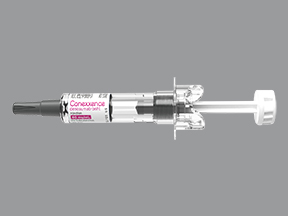 CONEXXENCE 60 MG/ML SYRINGE
The following indications for CONEXXENCE (denosumab-bnht) have been approved by the FDA:
Indications:
Glucocorticoid-induced osteoporosis
Loss of bone mineral density (BMD) due to androgen deprivation therapy
Loss of bone mineral density (BMD) due to aromatase inhibitor therapy
Osteoporosis in male patient
Osteoporosis in postmenopausal woman at high risk for fracture
Professional Synonyms:
Androgen ablation induced osteoporosis or osteopenia
Androgen deprivation induced osteoporosis or osteopenia
Androgen suppression induced osteoporosis or osteopenia
Bone loss from androgen ablation
Bone loss from aromatase inhibitor
Glucocorticoid hormone-induced osteoporosis
Glucocorticoid induced osteoporosis
Glycocorticoid-induced osteoporosis
Loss of BMD due to aromatase inhibitor therapy
Osteoporosis in men
Osteoporosis or osteopenia due to ADT
Osteoporosis or osteopenia due to androgen ablation therapy
Osteoporosis or osteopenia due to aromatase inhibitor therapy
Postmenopausal osteoporosis in woman with high fracture risk
Postmenopausal osteoporosis with high fracture risk
Indications:
Glucocorticoid-induced osteoporosis
Loss of bone mineral density (BMD) due to androgen deprivation therapy
Loss of bone mineral density (BMD) due to aromatase inhibitor therapy
Osteoporosis in male patient
Osteoporosis in postmenopausal woman at high risk for fracture
Professional Synonyms:
Androgen ablation induced osteoporosis or osteopenia
Androgen deprivation induced osteoporosis or osteopenia
Androgen suppression induced osteoporosis or osteopenia
Bone loss from androgen ablation
Bone loss from aromatase inhibitor
Glucocorticoid hormone-induced osteoporosis
Glucocorticoid induced osteoporosis
Glycocorticoid-induced osteoporosis
Loss of BMD due to aromatase inhibitor therapy
Osteoporosis in men
Osteoporosis or osteopenia due to ADT
Osteoporosis or osteopenia due to androgen ablation therapy
Osteoporosis or osteopenia due to aromatase inhibitor therapy
Postmenopausal osteoporosis in woman with high fracture risk
Postmenopausal osteoporosis with high fracture risk
The following dosing information is available for CONEXXENCE (denosumab-bnht):
Correct preexisting hypocalcemia prior to treatment initiation. Supplementation with calcium and vitamin D may be required during treatment. All patients treated with denosumab products for osteoporosis or bone loss indications should receive 1000 mg of calcium daily and >=400 IU of vitamin D daily.
Administer denosumab products by subcutaneous injection using single-dose prefilled syringes and/or single-use vials; refer to the prescribing information of the individual denosumab product for available dosage forms. Subcutaneous injections of denosumab should be made into the upper arm, upper thigh, or abdomen. Do not administer IV, or by IM or intradermal injection.
Refer to the individual denosumab product labeling for storage information. Do not use after the expiration date stated on the label. Do not shake denosumab products vigorously.
Refer to the individual denosumab product labeling for storage information. Do not use after the expiration date stated on the label. Do not shake denosumab products vigorously.
| DRUG LABEL | DOSING TYPE | DOSING INSTRUCTIONS |
|---|---|---|
| CONEXXENCE 60 MG/ML SYRINGE | Maintenance | Adults inject 1 milliliter (60 mg) by subcutaneous route every 6 months in the upper arm, upper thigh or abdomen |
No generic dosing information available.
The following drug interaction information is available for CONEXXENCE (denosumab-bnht):
There are 0 contraindications.
There are 2 severe interactions.
These drug interactions can produce serious consequences in most patients. Actions required for severe interactions include, but are not limited to, discontinuing one or both agents, adjusting dosage, altering administration scheduling, and providing additional patient monitoring. Review the full interaction monograph for more information.
| Drug Interaction | Drug Names |
|---|---|
| IgG Antibodies and Derivatives/Efgartigimod-alfa SEVERITY LEVEL: 2-Severe Interaction: Action is required to reduce the risk of severe adverse interaction. MECHANISM OF ACTION: The neonatal Fc receptor (FcRn) prevents catabolism and mediates recycling of IgG and albumin, which leads to their long persistence in the body.(1,2) Efgartigimod-alfa binds to FcRn and may decrease systemic exposure of other ligands of FcRn, like immunoglobulins and IgG-based antibodies.(3) CLINICAL EFFECTS: The effectiveness of medicines that bind to FcRn may be decreased.(3) PREDISPOSING FACTORS: None determined. PATIENT MANAGEMENT: The manufacturer of efgartigimod-alfa states that efgartigimod-alfa should not be combined with long-term use of FcRn-binding medications. If the medication is essential for the patient, efgartigimod-alfa should be discontinued.(3) DISCUSSION: Clinical drug interaction studies with efgartigimod-alfa have not been performed. Efgartigimod-alfa may decrease concentrations of compounds that bind to the human FcRn.(3) |
VYVGART, VYVGART HYTRULO |
| IgG Antibodies and Derivatives/Nipocalimab-aahu SEVERITY LEVEL: 2-Severe Interaction: Action is required to reduce the risk of severe adverse interaction. MECHANISM OF ACTION: The neonatal Fc receptor (FcRn) prevents catabolism and mediates recycling of IgG and albumin, which leads to their long persistence in the body.(1,2) Nipocalimab-aahu binds to FcRn and may decrease systemic exposure of other ligands of FcRn, like immunoglobulins and IgG-based antibodies.(3) CLINICAL EFFECTS: The effectiveness of medicines that bind to FcRn may be decreased.(3) PREDISPOSING FACTORS: None determined. PATIENT MANAGEMENT: The manufacturer of nipocalimab-aahu states that nipocalimab-aahu should not be combined with long-term use of FcRn-binding medications. If the medication is essential for the patient, nipocalimab-aahu should be discontinued.(3) DISCUSSION: Clinical drug interaction studies with nipocalimab-aahu have not been performed. Nipocalimab-aahu may decrease concentrations of compounds that bind to the human FcRn.(3) |
IMAAVY |
There are 1 moderate interactions.
The clinician should assess the patient’s characteristics and take action as needed. Actions required for moderate interactions include, but are not limited to, discontinuing one or both agents, adjusting dosage, altering administration.
| Drug Interaction | Drug Names |
|---|---|
| IgG Antibodies and Derivatives/Rozanolixizumab-noli SEVERITY LEVEL: 3-Moderate Interaction: Assess the risk to the patient and take action as needed. MECHANISM OF ACTION: The neonatal Fc receptor (FcRn) prevents catabolism and mediates recycling of IgG and albumin, which leads to their long persistence in the body.(1,2) Rozanolixizumab-noli binds to FcRn and may decrease systemic exposure of other ligands of FcRn, like immunoglobulins and IgG-based antibodies.(3) CLINICAL EFFECTS: The effectiveness of medications that bind to FcRn may be decreased.(3) PREDISPOSING FACTORS: None determined. PATIENT MANAGEMENT: The manufacturer of rozanolixizumab-noli states that concurrent use with medications that bind to the human neonatal Fc receptor (FcRn) should be closely monitored for reduced effectiveness of these medications. If long-term use of such medications is essential for the patient, consider discontinuing rozanolixizumab-noli and use alternative therapies.(3) DISCUSSION: Clinical drug interaction studies with rozanolixizumab-noli have not been performed. Rozanolixizumab-noli may decrease concentrations of compounds that bind to the human FcRn.(3) |
RYSTIGGO |
The following contraindication information is available for CONEXXENCE (denosumab-bnht):
Drug contraindication overview.
*Hypocalcemia (correct preexisting hypocalcemia prior to initiating denosumab products). *History of clinically important hypersensitivity (e.g., systemic hypersensitivity) to denosumab products or any component in the formulation. *Denosumab products labeled for use in the treatment of osteoporosis or bone loss (Prolia(R)) and its biosimilars are contraindicated in pregnant women.
*Hypocalcemia (correct preexisting hypocalcemia prior to initiating denosumab products). *History of clinically important hypersensitivity (e.g., systemic hypersensitivity) to denosumab products or any component in the formulation. *Denosumab products labeled for use in the treatment of osteoporosis or bone loss (Prolia(R)) and its biosimilars are contraindicated in pregnant women.
There are 0 contraindications.
There are 6 severe contraindications.
Adequate patient monitoring is recommended for safer drug use.
| Severe List |
|---|
| Chronic kidney disease stage 4 (severe) GFR 15-29 ml/min |
| Chronic kidney disease stage 5 (failure) GFr<15 ml/min |
| Congenital long QT syndrome |
| Hypocalcemia |
| Infection |
| Pregnancy |
There are 6 moderate contraindications.
Clinically significant contraindication, where the condition can be managed or treated before the drug may be given safely.
| Moderate List |
|---|
| Diabetes mellitus |
| Hypoparathyroidism |
| Invasive dental procedure |
| Kidney disease with likely reduction in glomerular filtration rate (GFr) |
| Periodontitis |
| Thyroid surgery |
The following adverse reaction information is available for CONEXXENCE (denosumab-bnht):
Adverse reaction overview.
Adverse effects reported in clinical trials in >5% of patients receiving denosumab for the treatment of osteoporosis and reported more frequently with the drug than with placebo include back pain, extremity pain, musculoskeletal pain, hypercholesterolemia, and cystitis (in postmenopausal women) or back pain, arthralgia, and nasopharyngitis (in men). Adverse effects reported in clinical trials in >3% of patients receiving denosumab for the treatment of glucocorticoid-induced osteoporosis and reported more frequently with denosumab than with risedronate include back pain, hypertension, bronchitis, and headache. In clinical trials in patients receiving androgen deprivation or aromatase inhibitor therapy, adverse effects reported in >=10% of patients receiving denosumab for treatment of bone loss and reported more frequently with the drug than with placebo include arthralgia and back pain.
Musculoskeletal and extremity pain have also been reported. Adverse effects reported in clinical trials in >=25% of patients with bone metastases from solid tumors receiving denosumab include fatigue/asthenia, hypophosphatemia, and nausea. Adverse effects reported in clinical trials in >=10% of patients with multiple myeloma receiving denosumab include diarrhea, nausea, anemia, back pain, thrombocytopenia, peripheral edema, hypocalcemia, upper respiratory infection, rash, and headache.
Adverse effects reported in clinical trials in >=10% of patients receiving denosumab for treatment of giant cell tumor of bone include arthralgia, headache, nausea, back pain, fatigue, and extremity pain. Adverse effects reported in clinical trials in >20% of patients receiving denosumab for bisphosphonate-refractory hypercalcemia of malignancy include nausea, dyspnea, decreased appetite, headache, peripheral edema, vomiting, anemia, constipation, and diarrhea.
Adverse effects reported in clinical trials in >5% of patients receiving denosumab for the treatment of osteoporosis and reported more frequently with the drug than with placebo include back pain, extremity pain, musculoskeletal pain, hypercholesterolemia, and cystitis (in postmenopausal women) or back pain, arthralgia, and nasopharyngitis (in men). Adverse effects reported in clinical trials in >3% of patients receiving denosumab for the treatment of glucocorticoid-induced osteoporosis and reported more frequently with denosumab than with risedronate include back pain, hypertension, bronchitis, and headache. In clinical trials in patients receiving androgen deprivation or aromatase inhibitor therapy, adverse effects reported in >=10% of patients receiving denosumab for treatment of bone loss and reported more frequently with the drug than with placebo include arthralgia and back pain.
Musculoskeletal and extremity pain have also been reported. Adverse effects reported in clinical trials in >=25% of patients with bone metastases from solid tumors receiving denosumab include fatigue/asthenia, hypophosphatemia, and nausea. Adverse effects reported in clinical trials in >=10% of patients with multiple myeloma receiving denosumab include diarrhea, nausea, anemia, back pain, thrombocytopenia, peripheral edema, hypocalcemia, upper respiratory infection, rash, and headache.
Adverse effects reported in clinical trials in >=10% of patients receiving denosumab for treatment of giant cell tumor of bone include arthralgia, headache, nausea, back pain, fatigue, and extremity pain. Adverse effects reported in clinical trials in >20% of patients receiving denosumab for bisphosphonate-refractory hypercalcemia of malignancy include nausea, dyspnea, decreased appetite, headache, peripheral edema, vomiting, anemia, constipation, and diarrhea.
There are 29 severe adverse reactions.
| More Frequent | Less Frequent |
|---|---|
|
Dyspnea |
Hypertension Hypokalemia Hypomagnesemia |
| Rare/Very Rare |
|---|
|
Anaphylaxis Angina Aseptic necrosis of jaw bone Atypical femoral fracture Cataracts Cellulitis Cholesteatoma of external ear Dental abscess DRESS syndrome Endocarditis Erysipelas Hypercalcemia Hyperparathyroidism Hypersensitivity angiitis Hypersensitivity drug reaction Hypocalcemia Hypotension Infection Malignancy Osteonecrosis of external auditory canal Pancreatitis Polymyalgia rheumatica Severe infection Throat constriction Vasculitis |
There are 51 less severe adverse reactions.
| More Frequent | Less Frequent |
|---|---|
|
Back pain Fatigue General weakness Hypophosphatemia Musculoskeletal pain Nausea Thrombocytopenic disorder |
Allergic dermatitis Anemia Anorexia Arthralgia Bone pain Bronchitis Constipation Cough Cystitis Diarrhea Dizziness Dyspepsia Eczema Flatulence Gastroesophageal reflux disease Headache disorder Hypercholesterolemia Infection of ear Insomnia Pain in extremities Peripheral edema Pharyngitis Pneumonia Pruritus of skin Sciatica Skin inflammation Skin rash Spinal osteoarthritis Upper abdominal pain Upper respiratory infection Urinary tract infection Vertigo Vomiting |
| Rare/Very Rare |
|---|
|
Alopecia Ear itching Earache Erythema Facial edema Hearing loss Herpes zoster Impacted cerumen Lichenoid dermatitis drug eruption Tinnitus Urticaria |
The following precautions are available for CONEXXENCE (denosumab-bnht):
Safety and efficacy of denosumab (Xgeva(R)) and its biosimilars have been established for treatment of giant cell tumor of bone in skeletally mature adolescents (12-16 years of age). Safety and efficacy of denosumab have not been established for any other indication in pediatric patients. Safety and efficacy of denosumab (Prolia(R)) and its biosimilars have not been established in pediatric patients.
Cases of hypercalcemia (some requiring hospitalization and/or complicated by acute kidney injury) have been reported in clinical trials of pediatric patients with osteogenesis imperfecta treated with denosumab. Clinical trials of denosumab in osteogenesis imperfecta were terminated early due to these life-threatening events; efficacy for this indication was not demonstrated. A small clinical trial in pediatric patients with glucocorticoid-induced osteoporosis also did not demonstrate efficacy of denosumab for this indication.
In pediatric patients <4 years of age, denosumab may adversely affect long-bone growth and dentition based on evidence from animal studies. Clinically important hypercalcemia has been reported following discontinuance of denosumab therapy in pediatric patients with growing skeletons who received the drug for treatment of giant cell tumor of bone or for other off-label uses. Based on animal data, denosumab potentially may impair bone growth in children with open growth plates and may inhibit eruption of dentition.
Contraindicated
Severe Precaution
Management or Monitoring Precaution
Cases of hypercalcemia (some requiring hospitalization and/or complicated by acute kidney injury) have been reported in clinical trials of pediatric patients with osteogenesis imperfecta treated with denosumab. Clinical trials of denosumab in osteogenesis imperfecta were terminated early due to these life-threatening events; efficacy for this indication was not demonstrated. A small clinical trial in pediatric patients with glucocorticoid-induced osteoporosis also did not demonstrate efficacy of denosumab for this indication.
In pediatric patients <4 years of age, denosumab may adversely affect long-bone growth and dentition based on evidence from animal studies. Clinically important hypercalcemia has been reported following discontinuance of denosumab therapy in pediatric patients with growing skeletons who received the drug for treatment of giant cell tumor of bone or for other off-label uses. Based on animal data, denosumab potentially may impair bone growth in children with open growth plates and may inhibit eruption of dentition.
Contraindicated
| None |
Severe Precaution
| None |
Management or Monitoring Precaution
| None |
Based on findings from animal studies and the mechanism of action of denosumab, the drug may cause fetal harm if administered to pregnant women. Reproduction studies in monkeys have demonstrated fetal loss, stillbirth, postnatal mortality, evidence of absent lymph nodes, abnormal bone growth, reduced bone strength, reduced hematopoiesis, dental dysplasia, tooth malalignment, and decreased neonatal growth. Some of the observed bone abnormalities recovered once drug exposure ceased following birth.
No evidence of maternal harm was observed prior to labor in the studies. A study in mice found that absence of receptor activator of nuclear factor kappa-B ligand (RANKL; the target of denosumab) resulted in fetal lymph node agenesis and postnatal impairment of bone growth and dentition. Confirm pregnancy status prior to initiation of therapy in females of reproductive potential. Apprise pregnant women and females of reproductive potential of the potential drug-associated risk to the fetus.
No evidence of maternal harm was observed prior to labor in the studies. A study in mice found that absence of receptor activator of nuclear factor kappa-B ligand (RANKL; the target of denosumab) resulted in fetal lymph node agenesis and postnatal impairment of bone growth and dentition. Confirm pregnancy status prior to initiation of therapy in females of reproductive potential. Apprise pregnant women and females of reproductive potential of the potential drug-associated risk to the fetus.
It is not known whether denosumab is distributed into human milk; the effects of the drug on breast-fed infants or on milk production are also unknown. Denosumab is distributed into milk in monkeys in concentrations of <=0.5% of those attained in serum at <=1 month after the last dose.
Studies in pregnant RANKL knockout mice indicate that denosumab exposure during pregnancy may impair maternal mammary gland development and lactation; however, no such impairment was observed in monkeys. The manufacturers of Prolia(R)and its biosimilars recommend to not breast-feed during treatment. The manufacturers of Xgeva(R) and its biosimilars state to consider the developmental and health benefits of breast-feeding along with the mother's clinical need for treatment with a denosumab product and any potential adverse effects on the breast-fed infant from the drug or from the underlying maternal condition.
Studies in pregnant RANKL knockout mice indicate that denosumab exposure during pregnancy may impair maternal mammary gland development and lactation; however, no such impairment was observed in monkeys. The manufacturers of Prolia(R)and its biosimilars recommend to not breast-feed during treatment. The manufacturers of Xgeva(R) and its biosimilars state to consider the developmental and health benefits of breast-feeding along with the mother's clinical need for treatment with a denosumab product and any potential adverse effects on the breast-fed infant from the drug or from the underlying maternal condition.
The manufacturer makes no specific dosage recommendations for geriatric patients. When the total number of patients studied in clinical trials of denosumab for osteoporosis or bone loss indications is considered, 76% were >=65 years of age, while 27% were >=75 years of age; in clinical trials in men with osteoporosis or in patients with glucocorticoid-induced osteoporosis, 55 or 47%, respectively, of patients were >=65 years of age, while 16 or 17%, respectively, were >=75 years of age. Of the total number of patients studied in clinical trials of denosumab for cancer-related indications, 44-45% were >=65 years of age, while 16-17% were >=75 years of age. Although no overall differences in efficacy or safety were observed between geriatric and younger patients and other clinical experience has revealed no evidence of age-related differences, the possibility that some older patients may exhibit increased sensitivity to the drug cannot be ruled out.
The following prioritized warning is available for CONEXXENCE (denosumab-bnht):
WARNING: Denosumab may cause serious (rarely fatal) low calcium levels and may also worsen low calcium levels, especially if you have kidney problems. You may also be at increased risk if you have a history of low blood calcium levels (hypocalcemia), thyroid/parathyroid problems/surgery, or stomach/intestinal problems (such as malabsorption/surgery). Take calcium and vitamin D as directed by your doctor to help prevent low levels of calcium.
Your doctor will order blood tests before your first injection and during treatment to monitor you closely. Tell your doctor right away if you have any symptoms of low calcium such as severe muscle spasms/cramps, mental/mood changes (such as irritability or confusion), numbness/tingling (especially around lips/mouth or in fingers/toes), fast/irregular heartbeat, severe dizziness/fainting, or seizures.
WARNING: Denosumab may cause serious (rarely fatal) low calcium levels and may also worsen low calcium levels, especially if you have kidney problems. You may also be at increased risk if you have a history of low blood calcium levels (hypocalcemia), thyroid/parathyroid problems/surgery, or stomach/intestinal problems (such as malabsorption/surgery). Take calcium and vitamin D as directed by your doctor to help prevent low levels of calcium.
Your doctor will order blood tests before your first injection and during treatment to monitor you closely. Tell your doctor right away if you have any symptoms of low calcium such as severe muscle spasms/cramps, mental/mood changes (such as irritability or confusion), numbness/tingling (especially around lips/mouth or in fingers/toes), fast/irregular heartbeat, severe dizziness/fainting, or seizures.
The following icd codes are available for CONEXXENCE (denosumab-bnht)'s list of indications:
| Glucocorticoid-induced osteoporosis | |
| M80.8 | Other osteoporosis with current pathological fracture |
| M80.80 | Other osteoporosis with current pathological fracture, unspecified site |
| M80.80xA | Other osteoporosis with current pathological fracture, unspecified site, initial encounter for fracture |
| M80.80xD | Other osteoporosis with current pathological fracture, unspecified site, subsequent encounter for fracture with routine healing |
| M80.80xG | Other osteoporosis with current pathological fracture, unspecified site, subsequent encounter for fracture with delayed healing |
| M80.80xK | Other osteoporosis with current pathological fracture, unspecified site, subsequent encounter for fracture with nonunion |
| M80.80xP | Other osteoporosis with current pathological fracture, unspecified site, subsequent encounter for fracture with malunion |
| M80.80xS | Other osteoporosis with current pathological fracture, unspecified site, sequela |
| M80.81 | Other osteoporosis with pathological fracture, shoulder |
| M80.811 | Other osteoporosis with current pathological fracture, right shoulder |
| M80.811A | Other osteoporosis with current pathological fracture, right shoulder, initial encounter for fracture |
| M80.811D | Other osteoporosis with current pathological fracture, right shoulder, subsequent encounter for fracture with routine healing |
| M80.811G | Other osteoporosis with current pathological fracture, right shoulder, subsequent encounter for fracture with delayed healing |
| M80.811K | Other osteoporosis with current pathological fracture, right shoulder, subsequent encounter for fracture with nonunion |
| M80.811P | Other osteoporosis with current pathological fracture, right shoulder, subsequent encounter for fracture with malunion |
| M80.811S | Other osteoporosis with current pathological fracture, right shoulder, sequela |
| M80.812 | Other osteoporosis with current pathological fracture, left shoulder |
| M80.812A | Other osteoporosis with current pathological fracture, left shoulder, initial encounter for fracture |
| M80.812D | Other osteoporosis with current pathological fracture, left shoulder, subsequent encounter for fracture with routine healing |
| M80.812G | Other osteoporosis with current pathological fracture, left shoulder, subsequent encounter for fracture with delayed healing |
| M80.812K | Other osteoporosis with current pathological fracture, left shoulder, subsequent encounter for fracture with nonunion |
| M80.812P | Other osteoporosis with current pathological fracture, left shoulder, subsequent encounter for fracture with malunion |
| M80.812S | Other osteoporosis with current pathological fracture, left shoulder, sequela |
| M80.819 | Other osteoporosis with current pathological fracture, unspecified shoulder |
| M80.819A | Other osteoporosis with current pathological fracture, unspecified shoulder, initial encounter for fracture |
| M80.819D | Other osteoporosis with current pathological fracture, unspecified shoulder, subsequent encounter for fracture with routine healing |
| M80.819G | Other osteoporosis with current pathological fracture, unspecified shoulder, subsequent encounter for fracture with delayed healing |
| M80.819K | Other osteoporosis with current pathological fracture, unspecified shoulder, subsequent encounter for fracture with nonunion |
| M80.819P | Other osteoporosis with current pathological fracture, unspecified shoulder, subsequent encounter for fracture with malunion |
| M80.819S | Other osteoporosis with current pathological fracture, unspecified shoulder, sequela |
| M80.82 | Other osteoporosis with current pathological fracture, humerus |
| M80.821 | Other osteoporosis with current pathological fracture, right humerus |
| M80.821A | Other osteoporosis with current pathological fracture, right humerus, initial encounter for fracture |
| M80.821D | Other osteoporosis with current pathological fracture, right humerus, subsequent encounter for fracture with routine healing |
| M80.821G | Other osteoporosis with current pathological fracture, right humerus, subsequent encounter for fracture with delayed healing |
| M80.821K | Other osteoporosis with current pathological fracture, right humerus, subsequent encounter for fracture with nonunion |
| M80.821P | Other osteoporosis with current pathological fracture, right humerus, subsequent encounter for fracture with malunion |
| M80.821S | Other osteoporosis with current pathological fracture, right humerus, sequela |
| M80.822 | Other osteoporosis with current pathological fracture, left humerus |
| M80.822A | Other osteoporosis with current pathological fracture, left humerus, initial encounter for fracture |
| M80.822D | Other osteoporosis with current pathological fracture, left humerus, subsequent encounter for fracture with routine healing |
| M80.822G | Other osteoporosis with current pathological fracture, left humerus, subsequent encounter for fracture with delayed healing |
| M80.822K | Other osteoporosis with current pathological fracture, left humerus, subsequent encounter for fracture with nonunion |
| M80.822P | Other osteoporosis with current pathological fracture, left humerus, subsequent encounter for fracture with malunion |
| M80.822S | Other osteoporosis with current pathological fracture, left humerus, sequela |
| M80.829 | Other osteoporosis with current pathological fracture, unspecified humerus |
| M80.829A | Other osteoporosis with current pathological fracture, unspecified humerus, initial encounter for fracture |
| M80.829D | Other osteoporosis with current pathological fracture, unspecified humerus, subsequent encounter for fracture with routine healing |
| M80.829G | Other osteoporosis with current pathological fracture, unspecified humerus, subsequent encounter for fracture with delayed healing |
| M80.829K | Other osteoporosis with current pathological fracture, unspecified humerus, subsequent encounter for fracture with nonunion |
| M80.829P | Other osteoporosis with current pathological fracture, unspecified humerus, subsequent encounter for fracture with malunion |
| M80.829S | Other osteoporosis with current pathological fracture, unspecified humerus, sequela |
| M80.83 | Other osteoporosis with current pathological fracture, forearm |
| M80.831 | Other osteoporosis with current pathological fracture, right forearm |
| M80.831A | Other osteoporosis with current pathological fracture, right forearm, initial encounter for fracture |
| M80.831D | Other osteoporosis with current pathological fracture, right forearm, subsequent encounter for fracture with routine healing |
| M80.831G | Other osteoporosis with current pathological fracture, right forearm, subsequent encounter for fracture with delayed healing |
| M80.831K | Other osteoporosis with current pathological fracture, right forearm, subsequent encounter for fracture with nonunion |
| M80.831P | Other osteoporosis with current pathological fracture, right forearm, subsequent encounter for fracture with malunion |
| M80.831S | Other osteoporosis with current pathological fracture, right forearm, sequela |
| M80.832 | Other osteoporosis with current pathological fracture, left forearm |
| M80.832A | Other osteoporosis with current pathological fracture, left forearm, initial encounter for fracture |
| M80.832D | Other osteoporosis with current pathological fracture, left forearm, subsequent encounter for fracture with routine healing |
| M80.832G | Other osteoporosis with current pathological fracture, left forearm, subsequent encounter for fracture with delayed healing |
| M80.832K | Other osteoporosis with current pathological fracture, left forearm, subsequent encounter for fracture with nonunion |
| M80.832P | Other osteoporosis with current pathological fracture, left forearm, subsequent encounter for fracture with malunion |
| M80.832S | Other osteoporosis with current pathological fracture, left forearm, sequela |
| M80.839 | Other osteoporosis with current pathological fracture, unspecified forearm |
| M80.839A | Other osteoporosis with current pathological fracture, unspecified forearm, initial encounter for fracture |
| M80.839D | Other osteoporosis with current pathological fracture, unspecified forearm, subsequent encounter for fracture with routine healing |
| M80.839G | Other osteoporosis with current pathological fracture, unspecified forearm, subsequent encounter for fracture with delayed healing |
| M80.839K | Other osteoporosis with current pathological fracture, unspecified forearm, subsequent encounter for fracture with nonunion |
| M80.839P | Other osteoporosis with current pathological fracture, unspecified forearm, subsequent encounter for fracture with malunion |
| M80.839S | Other osteoporosis with current pathological fracture, unspecified forearm, sequela |
| M80.84 | Other osteoporosis with current pathological fracture, hand |
| M80.841 | Other osteoporosis with current pathological fracture, right hand |
| M80.841A | Other osteoporosis with current pathological fracture, right hand, initial encounter for fracture |
| M80.841D | Other osteoporosis with current pathological fracture, right hand, subsequent encounter for fracture with routine healing |
| M80.841G | Other osteoporosis with current pathological fracture, right hand, subsequent encounter for fracture with delayed healing |
| M80.841K | Other osteoporosis with current pathological fracture, right hand, subsequent encounter for fracture with nonunion |
| M80.841P | Other osteoporosis with current pathological fracture, right hand, subsequent encounter for fracture with malunion |
| M80.841S | Other osteoporosis with current pathological fracture, right hand, sequela |
| M80.842 | Other osteoporosis with current pathological fracture, left hand |
| M80.842A | Other osteoporosis with current pathological fracture, left hand, initial encounter for fracture |
| M80.842D | Other osteoporosis with current pathological fracture, left hand, subsequent encounter for fracture with routine healing |
| M80.842G | Other osteoporosis with current pathological fracture, left hand, subsequent encounter for fracture with delayed healing |
| M80.842K | Other osteoporosis with current pathological fracture, left hand, subsequent encounter for fracture with nonunion |
| M80.842P | Other osteoporosis with current pathological fracture, left hand, subsequent encounter for fracture with malunion |
| M80.842S | Other osteoporosis with current pathological fracture, left hand, sequela |
| M80.849 | Other osteoporosis with current pathological fracture, unspecified hand |
| M80.849A | Other osteoporosis with current pathological fracture, unspecified hand, initial encounter for fracture |
| M80.849D | Other osteoporosis with current pathological fracture, unspecified hand, subsequent encounter for fracture with routine healing |
| M80.849G | Other osteoporosis with current pathological fracture, unspecified hand, subsequent encounter for fracture with delayed healing |
| M80.849K | Other osteoporosis with current pathological fracture, unspecified hand, subsequent encounter for fracture with nonunion |
| M80.849P | Other osteoporosis with current pathological fracture, unspecified hand, subsequent encounter for fracture with malunion |
| M80.849S | Other osteoporosis with current pathological fracture, unspecified hand, sequela |
| M80.85 | Other osteoporosis with current pathological fracture, femur |
| M80.851 | Other osteoporosis with current pathological fracture, right femur |
| M80.851A | Other osteoporosis with current pathological fracture, right femur, initial encounter for fracture |
| M80.851D | Other osteoporosis with current pathological fracture, right femur, subsequent encounter for fracture with routine healing |
| M80.851G | Other osteoporosis with current pathological fracture, right femur, subsequent encounter for fracture with delayed healing |
| M80.851K | Other osteoporosis with current pathological fracture, right femur, subsequent encounter for fracture with nonunion |
| M80.851P | Other osteoporosis with current pathological fracture, right femur, subsequent encounter for fracture with malunion |
| M80.851S | Other osteoporosis with current pathological fracture, right femur, sequela |
| M80.852 | Other osteoporosis with current pathological fracture, left femur |
| M80.852A | Other osteoporosis with current pathological fracture, left femur, initial encounter for fracture |
| M80.852D | Other osteoporosis with current pathological fracture, left femur, subsequent encounter for fracture with routine healing |
| M80.852G | Other osteoporosis with current pathological fracture, left femur, subsequent encounter for fracture with delayed healing |
| M80.852K | Other osteoporosis with current pathological fracture, left femur, subsequent encounter for fracture with nonunion |
| M80.852P | Other osteoporosis with current pathological fracture, left femur, subsequent encounter for fracture with malunion |
| M80.852S | Other osteoporosis with current pathological fracture, left femur, sequela |
| M80.859 | Other osteoporosis with current pathological fracture, unspecified femur |
| M80.859A | Other osteoporosis with current pathological fracture, unspecified femur, initial encounter for fracture |
| M80.859D | Other osteoporosis with current pathological fracture, unspecified femur, subsequent encounter for fracture with routine healing |
| M80.859G | Other osteoporosis with current pathological fracture, unspecified femur, subsequent encounter for fracture with delayed healing |
| M80.859K | Other osteoporosis with current pathological fracture, unspecified femur, subsequent encounter for fracture with nonunion |
| M80.859P | Other osteoporosis with current pathological fracture, unspecified femur, subsequent encounter for fracture with malunion |
| M80.859S | Other osteoporosis with current pathological fracture, unspecified femur, sequela |
| M80.86 | Other osteoporosis with current pathological fracture, lower leg |
| M80.861 | Other osteoporosis with current pathological fracture, right lower leg |
| M80.861A | Other osteoporosis with current pathological fracture, right lower leg, initial encounter for fracture |
| M80.861D | Other osteoporosis with current pathological fracture, right lower leg, subsequent encounter for fracture with routine healing |
| M80.861G | Other osteoporosis with current pathological fracture, right lower leg, subsequent encounter for fracture with delayed healing |
| M80.861K | Other osteoporosis with current pathological fracture, right lower leg, subsequent encounter for fracture with nonunion |
| M80.861P | Other osteoporosis with current pathological fracture, right lower leg, subsequent encounter for fracture with malunion |
| M80.861S | Other osteoporosis with current pathological fracture, right lower leg, sequela |
| M80.862 | Other osteoporosis with current pathological fracture, left lower leg |
| M80.862A | Other osteoporosis with current pathological fracture, left lower leg, initial encounter for fracture |
| M80.862D | Other osteoporosis with current pathological fracture, left lower leg, subsequent encounter for fracture with routine healing |
| M80.862G | Other osteoporosis with current pathological fracture, left lower leg, subsequent encounter for fracture with delayed healing |
| M80.862K | Other osteoporosis with current pathological fracture, left lower leg, subsequent encounter for fracture with nonunion |
| M80.862P | Other osteoporosis with current pathological fracture, left lower leg, subsequent encounter for fracture with malunion |
| M80.862S | Other osteoporosis with current pathological fracture, left lower leg, sequela |
| M80.869 | Other osteoporosis with current pathological fracture, unspecified lower leg |
| M80.869A | Other osteoporosis with current pathological fracture, unspecified lower leg, initial encounter for fracture |
| M80.869D | Other osteoporosis with current pathological fracture, unspecified lower leg, subsequent encounter for fracture with routine healing |
| M80.869G | Other osteoporosis with current pathological fracture, unspecified lower leg, subsequent encounter for fracture with delayed healing |
| M80.869K | Other osteoporosis with current pathological fracture, unspecified lower leg, subsequent encounter for fracture with nonunion |
| M80.869P | Other osteoporosis with current pathological fracture, unspecified lower leg, subsequent encounter for fracture with malunion |
| M80.869S | Other osteoporosis with current pathological fracture, unspecified lower leg, sequela |
| M80.87 | Other osteoporosis with current pathological fracture, ankle and foot |
| M80.871 | Other osteoporosis with current pathological fracture, right ankle and foot |
| M80.871A | Other osteoporosis with current pathological fracture, right ankle and foot, initial encounter for fracture |
| M80.871D | Other osteoporosis with current pathological fracture, right ankle and foot, subsequent encounter for fracture with routine healing |
| M80.871G | Other osteoporosis with current pathological fracture, right ankle and foot, subsequent encounter for fracture with delayed healing |
| M80.871K | Other osteoporosis with current pathological fracture, right ankle and foot, subsequent encounter for fracture with nonunion |
| M80.871P | Other osteoporosis with current pathological fracture, right ankle and foot, subsequent encounter for fracture with malunion |
| M80.871S | Other osteoporosis with current pathological fracture, right ankle and foot, sequela |
| M80.872 | Other osteoporosis with current pathological fracture, left ankle and foot |
| M80.872A | Other osteoporosis with current pathological fracture, left ankle and foot, initial encounter for fracture |
| M80.872D | Other osteoporosis with current pathological fracture, left ankle and foot, subsequent encounter for fracture with routine healing |
| M80.872G | Other osteoporosis with current pathological fracture, left ankle and foot, subsequent encounter for fracture with delayed healing |
| M80.872K | Other osteoporosis with current pathological fracture, left ankle and foot, subsequent encounter for fracture with nonunion |
| M80.872P | Other osteoporosis with current pathological fracture, left ankle and foot, subsequent encounter for fracture with malunion |
| M80.872S | Other osteoporosis with current pathological fracture, left ankle and foot, sequela |
| M80.879 | Other osteoporosis with current pathological fracture, unspecified ankle and foot |
| M80.879A | Other osteoporosis with current pathological fracture, unspecified ankle and foot, initial encounter for fracture |
| M80.879D | Other osteoporosis with current pathological fracture, unspecified ankle and foot, subsequent encounter for fracture with routine healing |
| M80.879G | Other osteoporosis with current pathological fracture, unspecified ankle and foot, subsequent encounter for fracture with delayed healing |
| M80.879K | Other osteoporosis with current pathological fracture, unspecified ankle and foot, subsequent encounter for fracture with nonunion |
| M80.879P | Other osteoporosis with current pathological fracture, unspecified ankle and foot, subsequent encounter for fracture with malunion |
| M80.879S | Other osteoporosis with current pathological fracture, unspecified ankle and foot, sequela |
| M80.88 | Other osteoporosis with current pathological fracture, vertebra(e) |
| M80.88xA | Other osteoporosis with current pathological fracture, vertebra(e), initial encounter for fracture |
| M80.88xD | Other osteoporosis with current pathological fracture, vertebra(e), subsequent encounter for fracture with routine healing |
| M80.88xG | Other osteoporosis with current pathological fracture, vertebra(e), subsequent encounter for fracture with delayed healing |
| M80.88xK | Other osteoporosis with current pathological fracture, vertebra(e), subsequent encounter for fracture with nonunion |
| M80.88xP | Other osteoporosis with current pathological fracture, vertebra(e), subsequent encounter for fracture with malunion |
| M80.88xS | Other osteoporosis with current pathological fracture, vertebra(e), sequela |
| M80.8A | Other osteoporosis with current pathological fracture, other site |
| M80.8AxA | Other osteoporosis with current pathological fracture, other site, initial encounter for fracture |
| M80.8AxD | Other osteoporosis with current pathological fracture, other site, subsequent encounter for fracture with routine healing |
| M80.8AxG | Other osteoporosis with current pathological fracture, other site, subsequent encounter for fracture with delayed healing |
| M80.8AxK | Other osteoporosis with current pathological fracture, other site, subsequent encounter for fracture with nonunion |
| M80.8AxP | Other osteoporosis with current pathological fracture, other site, subsequent encounter for fracture with malunion |
| M80.8AxS | Other osteoporosis with current pathological fracture, other site, sequela |
| M80.8B | Other osteoporosis with current pathological fracture, pelvis |
| M80.8B1 | Other osteoporosis with current pathological fracture, right pelvis |
| M80.8B1A | Other osteoporosis with current pathological fracture, right pelvis, initial encounter for fracture |
| M80.8B1D | Other osteoporosis with current pathological fracture, right pelvis, subsequent encounter for fracture with routine healing |
| M80.8B1G | Other osteoporosis with current pathological fracture, right pelvis, subsequent encounter for fracture with delayed healing |
| M80.8B1K | Other osteoporosis with current pathological fracture, right pelvis, subsequent encounter for fracture with nonunion |
| M80.8B1P | Other osteoporosis with current pathological fracture, right pelvis, subsequent encounter for fracture with malunion |
| M80.8B1S | Other osteoporosis with current pathological fracture, right pelvis, sequela |
| M80.8B2 | Other osteoporosis with current pathological fracture, left pelvis |
| M80.8B2A | Other osteoporosis with current pathological fracture, left pelvis, initial encounter for fracture |
| M80.8B2D | Other osteoporosis with current pathological fracture, left pelvis, subsequent encounter for fracture with routine healing |
| M80.8B2G | Other osteoporosis with current pathological fracture, left pelvis, subsequent encounter for fracture with delayed healing |
| M80.8B2K | Other osteoporosis with current pathological fracture, left pelvis, subsequent encounter for fracture with nonunion |
| M80.8B2P | Other osteoporosis with current pathological fracture, left pelvis, subsequent encounter for fracture with malunion |
| M80.8B2S | Other osteoporosis with current pathological fracture, left pelvis, sequela |
| M80.8B9 | Other osteoporosis with current pathological fracture, unspecified pelvis |
| M80.8B9A | Other osteoporosis with current pathological fracture, unspecified pelvis, initial encounter for fracture |
| M80.8B9D | Other osteoporosis with current pathological fracture, unspecified pelvis, subsequent encounter for fracture with routine healing |
| M80.8B9G | Other osteoporosis with current pathological fracture, unspecified pelvis, subsequent encounter for fracture with delayed healing |
| M80.8B9K | Other osteoporosis with current pathological fracture, unspecified pelvis, subsequent encounter for fracture with nonunion |
| M80.8B9P | Other osteoporosis with current pathological fracture, unspecified pelvis, subsequent encounter for fracture with malunion |
| M80.8B9S | Other osteoporosis with current pathological fracture, unspecified pelvis, sequela |
| Loss of bone density due to androgen deprivation therapy | |
| M81.8 | Other osteoporosis without current pathological fracture |
| Loss of bone density due to aromatase inhibitor therapy | |
| M81.8 | Other osteoporosis without current pathological fracture |
| Z79.811 | Long term (current) use of aromatase inhibitors |
| Osteoporosis in male patient | |
| M80 | Osteoporosis with current pathological fracture |
| M80.0 | Age-related osteoporosis with current pathological fracture |
| M80.00 | Age-related osteoporosis with current pathological fracture, unspecified site |
| M80.00xA | Age-related osteoporosis with current pathological fracture, unspecified site, initial encounter for fracture |
| M80.00xD | Age-related osteoporosis with current pathological fracture, unspecified site, subsequent encounter for fracture with routine healing |
| M80.00xG | Age-related osteoporosis with current pathological fracture, unspecified site, subsequent encounter for fracture with delayed healing |
| M80.00xK | Age-related osteoporosis with current pathological fracture, unspecified site, subsequent encounter for fracture with nonunion |
| M80.00xP | Age-related osteoporosis with current pathological fracture, unspecified site, subsequent encounter for fracture with malunion |
| M80.00xS | Age-related osteoporosis with current pathological fracture, unspecified site, sequela |
| M80.01 | Age-related osteoporosis with current pathological fracture, shoulder |
| M80.011 | Age-related osteoporosis with current pathological fracture, right shoulder |
| M80.011A | Age-related osteoporosis with current pathological fracture, right shoulder, initial encounter for fracture |
| M80.011D | Age-related osteoporosis with current pathological fracture, right shoulder, subsequent encounter for fracture with routine healing |
| M80.011G | Age-related osteoporosis with current pathological fracture, right shoulder, subsequent encounter for fracture with delayed healing |
| M80.011K | Age-related osteoporosis with current pathological fracture, right shoulder, subsequent encounter for fracture with nonunion |
| M80.011P | Age-related osteoporosis with current pathological fracture, right shoulder, subsequent encounter for fracture with malunion |
| M80.011S | Age-related osteoporosis with current pathological fracture, right shoulder, sequela |
| M80.012 | Age-related osteoporosis with current pathological fracture, left shoulder |
| M80.012A | Age-related osteoporosis with current pathological fracture, left shoulder, initial encounter for fracture |
| M80.012D | Age-related osteoporosis with current pathological fracture, left shoulder, subsequent encounter for fracture with routine healing |
| M80.012G | Age-related osteoporosis with current pathological fracture, left shoulder, subsequent encounter for fracture with delayed healing |
| M80.012K | Age-related osteoporosis with current pathological fracture, left shoulder, subsequent encounter for fracture with nonunion |
| M80.012P | Age-related osteoporosis with current pathological fracture, left shoulder, subsequent encounter for fracture with malunion |
| M80.012S | Age-related osteoporosis with current pathological fracture, left shoulder, sequela |
| M80.019 | Age-related osteoporosis with current pathological fracture, unspecified shoulder |
| M80.019A | Age-related osteoporosis with current pathological fracture, unspecified shoulder, initial encounter for fracture |
| M80.019D | Age-related osteoporosis with current pathological fracture, unspecified shoulder, subsequent encounter for fracture with routine healing |
| M80.019G | Age-related osteoporosis with current pathological fracture, unspecified shoulder, subsequent encounter for fracture with delayed healing |
| M80.019K | Age-related osteoporosis with current pathological fracture, unspecified shoulder, subsequent encounter for fracture with nonunion |
| M80.019P | Age-related osteoporosis with current pathological fracture, unspecified shoulder, subsequent encounter for fracture with malunion |
| M80.019S | Age-related osteoporosis with current pathological fracture, unspecified shoulder, sequela |
| M80.02 | Age-related osteoporosis with current pathological fracture, humerus |
| M80.021 | Age-related osteoporosis with current pathological fracture, right humerus |
| M80.021A | Age-related osteoporosis with current pathological fracture, right humerus, initial encounter for fracture |
| M80.021D | Age-related osteoporosis with current pathological fracture, right humerus, subsequent encounter for fracture with routine healing |
| M80.021G | Age-related osteoporosis with current pathological fracture, right humerus, subsequent encounter for fracture with delayed healing |
| M80.021K | Age-related osteoporosis with current pathological fracture, right humerus, subsequent encounter for fracture with nonunion |
| M80.021P | Age-related osteoporosis with current pathological fracture, right humerus, subsequent encounter for fracture with malunion |
| M80.021S | Age-related osteoporosis with current pathological fracture, right humerus, sequela |
| M80.022 | Age-related osteoporosis with current pathological fracture, left humerus |
| M80.022A | Age-related osteoporosis with current pathological fracture, left humerus, initial encounter for fracture |
| M80.022D | Age-related osteoporosis with current pathological fracture, left humerus, subsequent encounter for fracture with routine healing |
| M80.022G | Age-related osteoporosis with current pathological fracture, left humerus, subsequent encounter for fracture with delayed healing |
| M80.022K | Age-related osteoporosis with current pathological fracture, left humerus, subsequent encounter for fracture with nonunion |
| M80.022P | Age-related osteoporosis with current pathological fracture, left humerus, subsequent encounter for fracture with malunion |
| M80.022S | Age-related osteoporosis with current pathological fracture, left humerus, sequela |
| M80.029 | Age-related osteoporosis with current pathological fracture, unspecified humerus |
| M80.029A | Age-related osteoporosis with current pathological fracture, unspecified humerus, initial encounter for fracture |
| M80.029D | Age-related osteoporosis with current pathological fracture, unspecified humerus, subsequent encounter for fracture with routine healing |
| M80.029G | Age-related osteoporosis with current pathological fracture, unspecified humerus, subsequent encounter for fracture with delayed healing |
| M80.029K | Age-related osteoporosis with current pathological fracture, unspecified humerus, subsequent encounter for fracture with nonunion |
| M80.029P | Age-related osteoporosis with current pathological fracture, unspecified humerus, subsequent encounter for fracture with malunion |
| M80.029S | Age-related osteoporosis with current pathological fracture, unspecified humerus, sequela |
| M80.03 | Age-related osteoporosis with current pathological fracture, forearm |
| M80.031 | Age-related osteoporosis with current pathological fracture, right forearm |
| M80.031A | Age-related osteoporosis with current pathological fracture, right forearm, initial encounter for fracture |
| M80.031D | Age-related osteoporosis with current pathological fracture, right forearm, subsequent encounter for fracture with routine healing |
| M80.031G | Age-related osteoporosis with current pathological fracture, right forearm, subsequent encounter for fracture with delayed healing |
| M80.031K | Age-related osteoporosis with current pathological fracture, right forearm, subsequent encounter for fracture with nonunion |
| M80.031P | Age-related osteoporosis with current pathological fracture, right forearm, subsequent encounter for fracture with malunion |
| M80.031S | Age-related osteoporosis with current pathological fracture, right forearm, sequela |
| M80.032 | Age-related osteoporosis with current pathological fracture, left forearm |
| M80.032A | Age-related osteoporosis with current pathological fracture, left forearm, initial encounter for fracture |
| M80.032D | Age-related osteoporosis with current pathological fracture, left forearm, subsequent encounter for fracture with routine healing |
| M80.032G | Age-related osteoporosis with current pathological fracture, left forearm, subsequent encounter for fracture with delayed healing |
| M80.032K | Age-related osteoporosis with current pathological fracture, left forearm, subsequent encounter for fracture with nonunion |
| M80.032P | Age-related osteoporosis with current pathological fracture, left forearm, subsequent encounter for fracture with malunion |
| M80.032S | Age-related osteoporosis with current pathological fracture, left forearm, sequela |
| M80.039 | Age-related osteoporosis with current pathological fracture, unspecified forearm |
| M80.039A | Age-related osteoporosis with current pathological fracture, unspecified forearm, initial encounter for fracture |
| M80.039D | Age-related osteoporosis with current pathological fracture, unspecified forearm, subsequent encounter for fracture with routine healing |
| M80.039G | Age-related osteoporosis with current pathological fracture, unspecified forearm, subsequent encounter for fracture with delayed healing |
| M80.039K | Age-related osteoporosis with current pathological fracture, unspecified forearm, subsequent encounter for fracture with nonunion |
| M80.039P | Age-related osteoporosis with current pathological fracture, unspecified forearm, subsequent encounter for fracture with malunion |
| M80.039S | Age-related osteoporosis with current pathological fracture, unspecified forearm, sequela |
| M80.04 | Age-related osteoporosis with current pathological fracture, hand |
| M80.041 | Age-related osteoporosis with current pathological fracture, right hand |
| M80.041A | Age-related osteoporosis with current pathological fracture, right hand, initial encounter for fracture |
| M80.041D | Age-related osteoporosis with current pathological fracture, right hand, subsequent encounter for fracture with routine healing |
| M80.041G | Age-related osteoporosis with current pathological fracture, right hand, subsequent encounter for fracture with delayed healing |
| M80.041K | Age-related osteoporosis with current pathological fracture, right hand, subsequent encounter for fracture with nonunion |
| M80.041P | Age-related osteoporosis with current pathological fracture, right hand, subsequent encounter for fracture with malunion |
| M80.041S | Age-related osteoporosis with current pathological fracture, right hand, sequela |
| M80.042 | Age-related osteoporosis with current pathological fracture, left hand |
| M80.042A | Age-related osteoporosis with current pathological fracture, left hand, initial encounter for fracture |
| M80.042D | Age-related osteoporosis with current pathological fracture, left hand, subsequent encounter for fracture with routine healing |
| M80.042G | Age-related osteoporosis with current pathological fracture, left hand, subsequent encounter for fracture with delayed healing |
| M80.042K | Age-related osteoporosis with current pathological fracture, left hand, subsequent encounter for fracture with nonunion |
| M80.042P | Age-related osteoporosis with current pathological fracture, left hand, subsequent encounter for fracture with malunion |
| M80.042S | Age-related osteoporosis with current pathological fracture, left hand, sequela |
| M80.049 | Age-related osteoporosis with current pathological fracture, unspecified hand |
| M80.049A | Age-related osteoporosis with current pathological fracture, unspecified hand, initial encounter for fracture |
| M80.049D | Age-related osteoporosis with current pathological fracture, unspecified hand, subsequent encounter for fracture with routine healing |
| M80.049G | Age-related osteoporosis with current pathological fracture, unspecified hand, subsequent encounter for fracture with delayed healing |
| M80.049K | Age-related osteoporosis with current pathological fracture, unspecified hand, subsequent encounter for fracture with nonunion |
| M80.049P | Age-related osteoporosis with current pathological fracture, unspecified hand, subsequent encounter for fracture with malunion |
| M80.049S | Age-related osteoporosis with current pathological fracture, unspecified hand, sequela |
| M80.05 | Age-related osteoporosis with current pathological fracture, femur |
| M80.051 | Age-related osteoporosis with current pathological fracture, right femur |
| M80.051A | Age-related osteoporosis with current pathological fracture, right femur, initial encounter for fracture |
| M80.051D | Age-related osteoporosis with current pathological fracture, right femur, subsequent encounter for fracture with routine healing |
| M80.051G | Age-related osteoporosis with current pathological fracture, right femur, subsequent encounter for fracture with delayed healing |
| M80.051K | Age-related osteoporosis with current pathological fracture, right femur, subsequent encounter for fracture with nonunion |
| M80.051P | Age-related osteoporosis with current pathological fracture, right femur, subsequent encounter for fracture with malunion |
| M80.051S | Age-related osteoporosis with current pathological fracture, right femur, sequela |
| M80.052 | Age-related osteoporosis with current pathological fracture, left femur |
| M80.052A | Age-related osteoporosis with current pathological fracture, left femur, initial encounter for fracture |
| M80.052D | Age-related osteoporosis with current pathological fracture, left femur, subsequent encounter for fracture with routine healing |
| M80.052G | Age-related osteoporosis with current pathological fracture, left femur, subsequent encounter for fracture with delayed healing |
| M80.052K | Age-related osteoporosis with current pathological fracture, left femur, subsequent encounter for fracture with nonunion |
| M80.052P | Age-related osteoporosis with current pathological fracture, left femur, subsequent encounter for fracture with malunion |
| M80.052S | Age-related osteoporosis with current pathological fracture, left femur, sequela |
| M80.059 | Age-related osteoporosis with current pathological fracture, unspecified femur |
| M80.059A | Age-related osteoporosis with current pathological fracture, unspecified femur, initial encounter for fracture |
| M80.059D | Age-related osteoporosis with current pathological fracture, unspecified femur, subsequent encounter for fracture with routine healing |
| M80.059G | Age-related osteoporosis with current pathological fracture, unspecified femur, subsequent encounter for fracture with delayed healing |
| M80.059K | Age-related osteoporosis with current pathological fracture, unspecified femur, subsequent encounter for fracture with nonunion |
| M80.059P | Age-related osteoporosis with current pathological fracture, unspecified femur, subsequent encounter for fracture with malunion |
| M80.059S | Age-related osteoporosis with current pathological fracture, unspecified femur, sequela |
| M80.06 | Age-related osteoporosis with current pathological fracture, lower leg |
| M80.061 | Age-related osteoporosis with current pathological fracture, right lower leg |
| M80.061A | Age-related osteoporosis with current pathological fracture, right lower leg, initial encounter for fracture |
| M80.061D | Age-related osteoporosis with current pathological fracture, right lower leg, subsequent encounter for fracture with routine healing |
| M80.061G | Age-related osteoporosis with current pathological fracture, right lower leg, subsequent encounter for fracture with delayed healing |
| M80.061K | Age-related osteoporosis with current pathological fracture, right lower leg, subsequent encounter for fracture with nonunion |
| M80.061P | Age-related osteoporosis with current pathological fracture, right lower leg, subsequent encounter for fracture with malunion |
| M80.061S | Age-related osteoporosis with current pathological fracture, right lower leg, sequela |
| M80.062 | Age-related osteoporosis with current pathological fracture, left lower leg |
| M80.062A | Age-related osteoporosis with current pathological fracture, left lower leg, initial encounter for fracture |
| M80.062D | Age-related osteoporosis with current pathological fracture, left lower leg, subsequent encounter for fracture with routine healing |
| M80.062G | Age-related osteoporosis with current pathological fracture, left lower leg, subsequent encounter for fracture with delayed healing |
| M80.062K | Age-related osteoporosis with current pathological fracture, left lower leg, subsequent encounter for fracture with nonunion |
| M80.062P | Age-related osteoporosis with current pathological fracture, left lower leg, subsequent encounter for fracture with malunion |
| M80.062S | Age-related osteoporosis with current pathological fracture, left lower leg, sequela |
| M80.069 | Age-related osteoporosis with current pathological fracture, unspecified lower leg |
| M80.069A | Age-related osteoporosis with current pathological fracture, unspecified lower leg, initial encounter for fracture |
| M80.069D | Age-related osteoporosis with current pathological fracture, unspecified lower leg, subsequent encounter for fracture with routine healing |
| M80.069G | Age-related osteoporosis with current pathological fracture, unspecified lower leg, subsequent encounter for fracture with delayed healing |
| M80.069K | Age-related osteoporosis with current pathological fracture, unspecified lower leg, subsequent encounter for fracture with nonunion |
| M80.069P | Age-related osteoporosis with current pathological fracture, unspecified lower leg, subsequent encounter for fracture with malunion |
| M80.069S | Age-related osteoporosis with current pathological fracture, unspecified lower leg, sequela |
| M80.07 | Age-related osteoporosis with current pathological fracture, ankle and foot |
| M80.071 | Age-related osteoporosis with current pathological fracture, right ankle and foot |
| M80.071A | Age-related osteoporosis with current pathological fracture, right ankle and foot, initial encounter for fracture |
| M80.071D | Age-related osteoporosis with current pathological fracture, right ankle and foot, subsequent encounter for fracture with routine healing |
| M80.071G | Age-related osteoporosis with current pathological fracture, right ankle and foot, subsequent encounter for fracture with delayed healing |
| M80.071K | Age-related osteoporosis with current pathological fracture, right ankle and foot, subsequent encounter for fracture with nonunion |
| M80.071P | Age-related osteoporosis with current pathological fracture, right ankle and foot, subsequent encounter for fracture with malunion |
| M80.071S | Age-related osteoporosis with current pathological fracture, right ankle and foot, sequela |
| M80.072 | Age-related osteoporosis with current pathological fracture, left ankle and foot |
| M80.072A | Age-related osteoporosis with current pathological fracture, left ankle and foot, initial encounter for fracture |
| M80.072D | Age-related osteoporosis with current pathological fracture, left ankle and foot, subsequent encounter for fracture with routine healing |
| M80.072G | Age-related osteoporosis with current pathological fracture, left ankle and foot, subsequent encounter for fracture with delayed healing |
| M80.072K | Age-related osteoporosis with current pathological fracture, left ankle and foot, subsequent encounter for fracture with nonunion |
| M80.072P | Age-related osteoporosis with current pathological fracture, left ankle and foot, subsequent encounter for fracture with malunion |
| M80.072S | Age-related osteoporosis with current pathological fracture, left ankle and foot, sequela |
| M80.079 | Age-related osteoporosis with current pathological fracture, unspecified ankle and foot |
| M80.079A | Age-related osteoporosis with current pathological fracture, unspecified ankle and foot, initial encounter for fracture |
| M80.079D | Age-related osteoporosis with current pathological fracture, unspecified ankle and foot, subsequent encounter for fracture with routine healing |
| M80.079G | Age-related osteoporosis with current pathological fracture, unspecified ankle and foot, subsequent encounter for fracture with delayed healing |
| M80.079K | Age-related osteoporosis with current pathological fracture, unspecified ankle and foot, subsequent encounter for fracture with nonunion |
| M80.079P | Age-related osteoporosis with current pathological fracture, unspecified ankle and foot, subsequent encounter for fracture with malunion |
| M80.079S | Age-related osteoporosis with current pathological fracture, unspecified ankle and foot, sequela |
| M80.08 | Age-related osteoporosis with current pathological fracture, vertebra(e) |
| M80.08xA | Age-related osteoporosis with current pathological fracture, vertebra(e), initial encounter for fracture |
| M80.08xD | Age-related osteoporosis with current pathological fracture, vertebra(e), subsequent encounter for fracture with routine healing |
| M80.08xG | Age-related osteoporosis with current pathological fracture, vertebra(e), subsequent encounter for fracture with delayed healing |
| M80.08xK | Age-related osteoporosis with current pathological fracture, vertebra(e), subsequent encounter for fracture with nonunion |
| M80.08xP | Age-related osteoporosis with current pathological fracture, vertebra(e), subsequent encounter for fracture with malunion |
| M80.08xS | Age-related osteoporosis with current pathological fracture, vertebra(e), sequela |
| M80.0A | Age-related osteoporosis with current pathological fracture, other site |
| M80.0AxA | Age-related osteoporosis with current pathological fracture, other site, initial encounter for fracture |
| M80.0AxD | Age-related osteoporosis with current pathological fracture, other site, subsequent encounter for fracture with routine healing |
| M80.0AxG | Age-related osteoporosis with current pathological fracture, other site, subsequent encounter for fracture with delayed healing |
| M80.0AxK | Age-related osteoporosis with current pathological fracture, other site, subsequent encounter for fracture with nonunion |
| M80.0AxP | Age-related osteoporosis with current pathological fracture, other site, subsequent encounter for fracture with malunion |
| M80.0AxS | Age-related osteoporosis with current pathological fracture, other site, sequela |
| M80.0B | Age-related osteoporosis with current pathological fracture, pelvis |
| M80.0B1 | Age-related osteoporosis with current pathological fracture, right pelvis |
| M80.0B1A | Age-related osteoporosis with current pathological fracture, right pelvis, initial encounter for fracture |
| M80.0B1D | Age-related osteoporosis with current pathological fracture, right pelvis, subsequent encounter for fracture with routine healing |
| M80.0B1G | Age-related osteoporosis with current pathological fracture, right pelvis, subsequent encounter for fracture with delayed healing |
| M80.0B1K | Age-related osteoporosis with current pathological fracture, right pelvis, subsequent encounter for fracture with nonunion |
| M80.0B1P | Age-related osteoporosis with current pathological fracture, right pelvis, subsequent encounter for fracture with malunion |
| M80.0B1S | Age-related osteoporosis with current pathological fracture, right pelvis, sequela |
| M80.0B2 | Age-related osteoporosis with current pathological fracture, left pelvis |
| M80.0B2A | Age-related osteoporosis with current pathological fracture, left pelvis, initial encounter for fracture |
| M80.0B2D | Age-related osteoporosis with current pathological fracture, left pelvis, subsequent encounter for fracture with routine healing |
| M80.0B2G | Age-related osteoporosis with current pathological fracture, left pelvis, subsequent encounter for fracture with delayed healing |
| M80.0B2K | Age-related osteoporosis with current pathological fracture, left pelvis, subsequent encounter for fracture with nonunion |
| M80.0B2P | Age-related osteoporosis with current pathological fracture, left pelvis, subsequent encounter for fracture with malunion |
| M80.0B2S | Age-related osteoporosis with current pathological fracture, left pelvis, sequela |
| M80.0B9 | Age-related osteoporosis with current pathological fracture, unspecified pelvis |
| M80.0B9A | Age-related osteoporosis with current pathological fracture, unspecified pelvis, initial encounter for fracture |
| M80.0B9D | Age-related osteoporosis with current pathological fracture, unspecified pelvis, subsequent encounter for fracture with routine healing |
| M80.0B9G | Age-related osteoporosis with current pathological fracture, unspecified pelvis, subsequent encounter for fracture with delayed healing |
| M80.0B9K | Age-related osteoporosis with current pathological fracture, unspecified pelvis, subsequent encounter for fracture with nonunion |
| M80.0B9P | Age-related osteoporosis with current pathological fracture, unspecified pelvis, subsequent encounter for fracture with malunion |
| M80.0B9S | Age-related osteoporosis with current pathological fracture, unspecified pelvis, sequela |
| M80.8 | Other osteoporosis with current pathological fracture |
| M80.80 | Other osteoporosis with current pathological fracture, unspecified site |
| M80.80xA | Other osteoporosis with current pathological fracture, unspecified site, initial encounter for fracture |
| M80.80xD | Other osteoporosis with current pathological fracture, unspecified site, subsequent encounter for fracture with routine healing |
| M80.80xG | Other osteoporosis with current pathological fracture, unspecified site, subsequent encounter for fracture with delayed healing |
| M80.80xK | Other osteoporosis with current pathological fracture, unspecified site, subsequent encounter for fracture with nonunion |
| M80.80xP | Other osteoporosis with current pathological fracture, unspecified site, subsequent encounter for fracture with malunion |
| M80.80xS | Other osteoporosis with current pathological fracture, unspecified site, sequela |
| M80.81 | Other osteoporosis with pathological fracture, shoulder |
| M80.811 | Other osteoporosis with current pathological fracture, right shoulder |
| M80.811A | Other osteoporosis with current pathological fracture, right shoulder, initial encounter for fracture |
| M80.811D | Other osteoporosis with current pathological fracture, right shoulder, subsequent encounter for fracture with routine healing |
| M80.811G | Other osteoporosis with current pathological fracture, right shoulder, subsequent encounter for fracture with delayed healing |
| M80.811K | Other osteoporosis with current pathological fracture, right shoulder, subsequent encounter for fracture with nonunion |
| M80.811P | Other osteoporosis with current pathological fracture, right shoulder, subsequent encounter for fracture with malunion |
| M80.811S | Other osteoporosis with current pathological fracture, right shoulder, sequela |
| M80.812 | Other osteoporosis with current pathological fracture, left shoulder |
| M80.812A | Other osteoporosis with current pathological fracture, left shoulder, initial encounter for fracture |
| M80.812D | Other osteoporosis with current pathological fracture, left shoulder, subsequent encounter for fracture with routine healing |
| M80.812G | Other osteoporosis with current pathological fracture, left shoulder, subsequent encounter for fracture with delayed healing |
| M80.812K | Other osteoporosis with current pathological fracture, left shoulder, subsequent encounter for fracture with nonunion |
| M80.812P | Other osteoporosis with current pathological fracture, left shoulder, subsequent encounter for fracture with malunion |
| M80.812S | Other osteoporosis with current pathological fracture, left shoulder, sequela |
| M80.819 | Other osteoporosis with current pathological fracture, unspecified shoulder |
| M80.819A | Other osteoporosis with current pathological fracture, unspecified shoulder, initial encounter for fracture |
| M80.819D | Other osteoporosis with current pathological fracture, unspecified shoulder, subsequent encounter for fracture with routine healing |
| M80.819G | Other osteoporosis with current pathological fracture, unspecified shoulder, subsequent encounter for fracture with delayed healing |
| M80.819K | Other osteoporosis with current pathological fracture, unspecified shoulder, subsequent encounter for fracture with nonunion |
| M80.819P | Other osteoporosis with current pathological fracture, unspecified shoulder, subsequent encounter for fracture with malunion |
| M80.819S | Other osteoporosis with current pathological fracture, unspecified shoulder, sequela |
| M80.82 | Other osteoporosis with current pathological fracture, humerus |
| M80.821 | Other osteoporosis with current pathological fracture, right humerus |
| M80.821A | Other osteoporosis with current pathological fracture, right humerus, initial encounter for fracture |
| M80.821D | Other osteoporosis with current pathological fracture, right humerus, subsequent encounter for fracture with routine healing |
| M80.821G | Other osteoporosis with current pathological fracture, right humerus, subsequent encounter for fracture with delayed healing |
| M80.821K | Other osteoporosis with current pathological fracture, right humerus, subsequent encounter for fracture with nonunion |
| M80.821P | Other osteoporosis with current pathological fracture, right humerus, subsequent encounter for fracture with malunion |
| M80.821S | Other osteoporosis with current pathological fracture, right humerus, sequela |
| M80.822 | Other osteoporosis with current pathological fracture, left humerus |
| M80.822A | Other osteoporosis with current pathological fracture, left humerus, initial encounter for fracture |
| M80.822D | Other osteoporosis with current pathological fracture, left humerus, subsequent encounter for fracture with routine healing |
| M80.822G | Other osteoporosis with current pathological fracture, left humerus, subsequent encounter for fracture with delayed healing |
| M80.822K | Other osteoporosis with current pathological fracture, left humerus, subsequent encounter for fracture with nonunion |
| M80.822P | Other osteoporosis with current pathological fracture, left humerus, subsequent encounter for fracture with malunion |
| M80.822S | Other osteoporosis with current pathological fracture, left humerus, sequela |
| M80.829 | Other osteoporosis with current pathological fracture, unspecified humerus |
| M80.829A | Other osteoporosis with current pathological fracture, unspecified humerus, initial encounter for fracture |
| M80.829D | Other osteoporosis with current pathological fracture, unspecified humerus, subsequent encounter for fracture with routine healing |
| M80.829G | Other osteoporosis with current pathological fracture, unspecified humerus, subsequent encounter for fracture with delayed healing |
| M80.829K | Other osteoporosis with current pathological fracture, unspecified humerus, subsequent encounter for fracture with nonunion |
| M80.829P | Other osteoporosis with current pathological fracture, unspecified humerus, subsequent encounter for fracture with malunion |
| M80.829S | Other osteoporosis with current pathological fracture, unspecified humerus, sequela |
| M80.83 | Other osteoporosis with current pathological fracture, forearm |
| M80.831 | Other osteoporosis with current pathological fracture, right forearm |
| M80.831A | Other osteoporosis with current pathological fracture, right forearm, initial encounter for fracture |
| M80.831D | Other osteoporosis with current pathological fracture, right forearm, subsequent encounter for fracture with routine healing |
| M80.831G | Other osteoporosis with current pathological fracture, right forearm, subsequent encounter for fracture with delayed healing |
| M80.831K | Other osteoporosis with current pathological fracture, right forearm, subsequent encounter for fracture with nonunion |
| M80.831P | Other osteoporosis with current pathological fracture, right forearm, subsequent encounter for fracture with malunion |
| M80.831S | Other osteoporosis with current pathological fracture, right forearm, sequela |
| M80.832 | Other osteoporosis with current pathological fracture, left forearm |
| M80.832A | Other osteoporosis with current pathological fracture, left forearm, initial encounter for fracture |
| M80.832D | Other osteoporosis with current pathological fracture, left forearm, subsequent encounter for fracture with routine healing |
| M80.832G | Other osteoporosis with current pathological fracture, left forearm, subsequent encounter for fracture with delayed healing |
| M80.832K | Other osteoporosis with current pathological fracture, left forearm, subsequent encounter for fracture with nonunion |
| M80.832P | Other osteoporosis with current pathological fracture, left forearm, subsequent encounter for fracture with malunion |
| M80.832S | Other osteoporosis with current pathological fracture, left forearm, sequela |
| M80.839 | Other osteoporosis with current pathological fracture, unspecified forearm |
| M80.839A | Other osteoporosis with current pathological fracture, unspecified forearm, initial encounter for fracture |
| M80.839D | Other osteoporosis with current pathological fracture, unspecified forearm, subsequent encounter for fracture with routine healing |
| M80.839G | Other osteoporosis with current pathological fracture, unspecified forearm, subsequent encounter for fracture with delayed healing |
| M80.839K | Other osteoporosis with current pathological fracture, unspecified forearm, subsequent encounter for fracture with nonunion |
| M80.839P | Other osteoporosis with current pathological fracture, unspecified forearm, subsequent encounter for fracture with malunion |
| M80.839S | Other osteoporosis with current pathological fracture, unspecified forearm, sequela |
| M80.84 | Other osteoporosis with current pathological fracture, hand |
| M80.841 | Other osteoporosis with current pathological fracture, right hand |
| M80.841A | Other osteoporosis with current pathological fracture, right hand, initial encounter for fracture |
| M80.841D | Other osteoporosis with current pathological fracture, right hand, subsequent encounter for fracture with routine healing |
| M80.841G | Other osteoporosis with current pathological fracture, right hand, subsequent encounter for fracture with delayed healing |
| M80.841K | Other osteoporosis with current pathological fracture, right hand, subsequent encounter for fracture with nonunion |
| M80.841P | Other osteoporosis with current pathological fracture, right hand, subsequent encounter for fracture with malunion |
| M80.841S | Other osteoporosis with current pathological fracture, right hand, sequela |
| M80.842 | Other osteoporosis with current pathological fracture, left hand |
| M80.842A | Other osteoporosis with current pathological fracture, left hand, initial encounter for fracture |
| M80.842D | Other osteoporosis with current pathological fracture, left hand, subsequent encounter for fracture with routine healing |
| M80.842G | Other osteoporosis with current pathological fracture, left hand, subsequent encounter for fracture with delayed healing |
| M80.842K | Other osteoporosis with current pathological fracture, left hand, subsequent encounter for fracture with nonunion |
| M80.842P | Other osteoporosis with current pathological fracture, left hand, subsequent encounter for fracture with malunion |
| M80.842S | Other osteoporosis with current pathological fracture, left hand, sequela |
| M80.849 | Other osteoporosis with current pathological fracture, unspecified hand |
| M80.849A | Other osteoporosis with current pathological fracture, unspecified hand, initial encounter for fracture |
| M80.849D | Other osteoporosis with current pathological fracture, unspecified hand, subsequent encounter for fracture with routine healing |
| M80.849G | Other osteoporosis with current pathological fracture, unspecified hand, subsequent encounter for fracture with delayed healing |
| M80.849K | Other osteoporosis with current pathological fracture, unspecified hand, subsequent encounter for fracture with nonunion |
| M80.849P | Other osteoporosis with current pathological fracture, unspecified hand, subsequent encounter for fracture with malunion |
| M80.849S | Other osteoporosis with current pathological fracture, unspecified hand, sequela |
| M80.85 | Other osteoporosis with current pathological fracture, femur |
| M80.851 | Other osteoporosis with current pathological fracture, right femur |
| M80.851A | Other osteoporosis with current pathological fracture, right femur, initial encounter for fracture |
| M80.851D | Other osteoporosis with current pathological fracture, right femur, subsequent encounter for fracture with routine healing |
| M80.851G | Other osteoporosis with current pathological fracture, right femur, subsequent encounter for fracture with delayed healing |
| M80.851K | Other osteoporosis with current pathological fracture, right femur, subsequent encounter for fracture with nonunion |
| M80.851P | Other osteoporosis with current pathological fracture, right femur, subsequent encounter for fracture with malunion |
| M80.851S | Other osteoporosis with current pathological fracture, right femur, sequela |
| M80.852 | Other osteoporosis with current pathological fracture, left femur |
| M80.852A | Other osteoporosis with current pathological fracture, left femur, initial encounter for fracture |
| M80.852D | Other osteoporosis with current pathological fracture, left femur, subsequent encounter for fracture with routine healing |
| M80.852G | Other osteoporosis with current pathological fracture, left femur, subsequent encounter for fracture with delayed healing |
| M80.852K | Other osteoporosis with current pathological fracture, left femur, subsequent encounter for fracture with nonunion |
| M80.852P | Other osteoporosis with current pathological fracture, left femur, subsequent encounter for fracture with malunion |
| M80.852S | Other osteoporosis with current pathological fracture, left femur, sequela |
| M80.859 | Other osteoporosis with current pathological fracture, unspecified femur |
| M80.859A | Other osteoporosis with current pathological fracture, unspecified femur, initial encounter for fracture |
| M80.859D | Other osteoporosis with current pathological fracture, unspecified femur, subsequent encounter for fracture with routine healing |
| M80.859G | Other osteoporosis with current pathological fracture, unspecified femur, subsequent encounter for fracture with delayed healing |
| M80.859K | Other osteoporosis with current pathological fracture, unspecified femur, subsequent encounter for fracture with nonunion |
| M80.859P | Other osteoporosis with current pathological fracture, unspecified femur, subsequent encounter for fracture with malunion |
| M80.859S | Other osteoporosis with current pathological fracture, unspecified femur, sequela |
| M80.86 | Other osteoporosis with current pathological fracture, lower leg |
| M80.861 | Other osteoporosis with current pathological fracture, right lower leg |
| M80.861A | Other osteoporosis with current pathological fracture, right lower leg, initial encounter for fracture |
| M80.861D | Other osteoporosis with current pathological fracture, right lower leg, subsequent encounter for fracture with routine healing |
| M80.861G | Other osteoporosis with current pathological fracture, right lower leg, subsequent encounter for fracture with delayed healing |
| M80.861K | Other osteoporosis with current pathological fracture, right lower leg, subsequent encounter for fracture with nonunion |
| M80.861P | Other osteoporosis with current pathological fracture, right lower leg, subsequent encounter for fracture with malunion |
| M80.861S | Other osteoporosis with current pathological fracture, right lower leg, sequela |
| M80.862 | Other osteoporosis with current pathological fracture, left lower leg |
| M80.862A | Other osteoporosis with current pathological fracture, left lower leg, initial encounter for fracture |
| M80.862D | Other osteoporosis with current pathological fracture, left lower leg, subsequent encounter for fracture with routine healing |
| M80.862G | Other osteoporosis with current pathological fracture, left lower leg, subsequent encounter for fracture with delayed healing |
| M80.862K | Other osteoporosis with current pathological fracture, left lower leg, subsequent encounter for fracture with nonunion |
| M80.862P | Other osteoporosis with current pathological fracture, left lower leg, subsequent encounter for fracture with malunion |
| M80.862S | Other osteoporosis with current pathological fracture, left lower leg, sequela |
| M80.869 | Other osteoporosis with current pathological fracture, unspecified lower leg |
| M80.869A | Other osteoporosis with current pathological fracture, unspecified lower leg, initial encounter for fracture |
| M80.869D | Other osteoporosis with current pathological fracture, unspecified lower leg, subsequent encounter for fracture with routine healing |
| M80.869G | Other osteoporosis with current pathological fracture, unspecified lower leg, subsequent encounter for fracture with delayed healing |
| M80.869K | Other osteoporosis with current pathological fracture, unspecified lower leg, subsequent encounter for fracture with nonunion |
| M80.869P | Other osteoporosis with current pathological fracture, unspecified lower leg, subsequent encounter for fracture with malunion |
| M80.869S | Other osteoporosis with current pathological fracture, unspecified lower leg, sequela |
| M80.87 | Other osteoporosis with current pathological fracture, ankle and foot |
| M80.871 | Other osteoporosis with current pathological fracture, right ankle and foot |
| M80.871A | Other osteoporosis with current pathological fracture, right ankle and foot, initial encounter for fracture |
| M80.871D | Other osteoporosis with current pathological fracture, right ankle and foot, subsequent encounter for fracture with routine healing |
| M80.871G | Other osteoporosis with current pathological fracture, right ankle and foot, subsequent encounter for fracture with delayed healing |
| M80.871K | Other osteoporosis with current pathological fracture, right ankle and foot, subsequent encounter for fracture with nonunion |
| M80.871P | Other osteoporosis with current pathological fracture, right ankle and foot, subsequent encounter for fracture with malunion |
| M80.871S | Other osteoporosis with current pathological fracture, right ankle and foot, sequela |
| M80.872 | Other osteoporosis with current pathological fracture, left ankle and foot |
| M80.872A | Other osteoporosis with current pathological fracture, left ankle and foot, initial encounter for fracture |
| M80.872D | Other osteoporosis with current pathological fracture, left ankle and foot, subsequent encounter for fracture with routine healing |
| M80.872G | Other osteoporosis with current pathological fracture, left ankle and foot, subsequent encounter for fracture with delayed healing |
| M80.872K | Other osteoporosis with current pathological fracture, left ankle and foot, subsequent encounter for fracture with nonunion |
| M80.872P | Other osteoporosis with current pathological fracture, left ankle and foot, subsequent encounter for fracture with malunion |
| M80.872S | Other osteoporosis with current pathological fracture, left ankle and foot, sequela |
| M80.879 | Other osteoporosis with current pathological fracture, unspecified ankle and foot |
| M80.879A | Other osteoporosis with current pathological fracture, unspecified ankle and foot, initial encounter for fracture |
| M80.879D | Other osteoporosis with current pathological fracture, unspecified ankle and foot, subsequent encounter for fracture with routine healing |
| M80.879G | Other osteoporosis with current pathological fracture, unspecified ankle and foot, subsequent encounter for fracture with delayed healing |
| M80.879K | Other osteoporosis with current pathological fracture, unspecified ankle and foot, subsequent encounter for fracture with nonunion |
| M80.879P | Other osteoporosis with current pathological fracture, unspecified ankle and foot, subsequent encounter for fracture with malunion |
| M80.879S | Other osteoporosis with current pathological fracture, unspecified ankle and foot, sequela |
| M80.88 | Other osteoporosis with current pathological fracture, vertebra(e) |
| M80.88xA | Other osteoporosis with current pathological fracture, vertebra(e), initial encounter for fracture |
| M80.88xD | Other osteoporosis with current pathological fracture, vertebra(e), subsequent encounter for fracture with routine healing |
| M80.88xG | Other osteoporosis with current pathological fracture, vertebra(e), subsequent encounter for fracture with delayed healing |
| M80.88xK | Other osteoporosis with current pathological fracture, vertebra(e), subsequent encounter for fracture with nonunion |
| M80.88xP | Other osteoporosis with current pathological fracture, vertebra(e), subsequent encounter for fracture with malunion |
| M80.88xS | Other osteoporosis with current pathological fracture, vertebra(e), sequela |
| M80.8A | Other osteoporosis with current pathological fracture, other site |
| M80.8AxA | Other osteoporosis with current pathological fracture, other site, initial encounter for fracture |
| M80.8AxD | Other osteoporosis with current pathological fracture, other site, subsequent encounter for fracture with routine healing |
| M80.8AxG | Other osteoporosis with current pathological fracture, other site, subsequent encounter for fracture with delayed healing |
| M80.8AxK | Other osteoporosis with current pathological fracture, other site, subsequent encounter for fracture with nonunion |
| M80.8AxP | Other osteoporosis with current pathological fracture, other site, subsequent encounter for fracture with malunion |
| M80.8AxS | Other osteoporosis with current pathological fracture, other site, sequela |
| M80.8B | Other osteoporosis with current pathological fracture, pelvis |
| M80.8B1 | Other osteoporosis with current pathological fracture, right pelvis |
| M80.8B1A | Other osteoporosis with current pathological fracture, right pelvis, initial encounter for fracture |
| M80.8B1D | Other osteoporosis with current pathological fracture, right pelvis, subsequent encounter for fracture with routine healing |
| M80.8B1G | Other osteoporosis with current pathological fracture, right pelvis, subsequent encounter for fracture with delayed healing |
| M80.8B1K | Other osteoporosis with current pathological fracture, right pelvis, subsequent encounter for fracture with nonunion |
| M80.8B1P | Other osteoporosis with current pathological fracture, right pelvis, subsequent encounter for fracture with malunion |
| M80.8B1S | Other osteoporosis with current pathological fracture, right pelvis, sequela |
| M80.8B2 | Other osteoporosis with current pathological fracture, left pelvis |
| M80.8B2A | Other osteoporosis with current pathological fracture, left pelvis, initial encounter for fracture |
| M80.8B2D | Other osteoporosis with current pathological fracture, left pelvis, subsequent encounter for fracture with routine healing |
| M80.8B2G | Other osteoporosis with current pathological fracture, left pelvis, subsequent encounter for fracture with delayed healing |
| M80.8B2K | Other osteoporosis with current pathological fracture, left pelvis, subsequent encounter for fracture with nonunion |
| M80.8B2P | Other osteoporosis with current pathological fracture, left pelvis, subsequent encounter for fracture with malunion |
| M80.8B2S | Other osteoporosis with current pathological fracture, left pelvis, sequela |
| M80.8B9 | Other osteoporosis with current pathological fracture, unspecified pelvis |
| M80.8B9A | Other osteoporosis with current pathological fracture, unspecified pelvis, initial encounter for fracture |
| M80.8B9D | Other osteoporosis with current pathological fracture, unspecified pelvis, subsequent encounter for fracture with routine healing |
| M80.8B9G | Other osteoporosis with current pathological fracture, unspecified pelvis, subsequent encounter for fracture with delayed healing |
| M80.8B9K | Other osteoporosis with current pathological fracture, unspecified pelvis, subsequent encounter for fracture with nonunion |
| M80.8B9P | Other osteoporosis with current pathological fracture, unspecified pelvis, subsequent encounter for fracture with malunion |
| M80.8B9S | Other osteoporosis with current pathological fracture, unspecified pelvis, sequela |
| M81 | Osteoporosis without current pathological fracture |
| M81.0 | Age-related osteoporosis without current pathological fracture |
| M81.8 | Other osteoporosis without current pathological fracture |
| Postmenopausal osteoporosis and high fracture risk | |
| M80.0 | Age-related osteoporosis with current pathological fracture |
| M80.00 | Age-related osteoporosis with current pathological fracture, unspecified site |
| M80.00xA | Age-related osteoporosis with current pathological fracture, unspecified site, initial encounter for fracture |
| M80.00xD | Age-related osteoporosis with current pathological fracture, unspecified site, subsequent encounter for fracture with routine healing |
| M80.00xG | Age-related osteoporosis with current pathological fracture, unspecified site, subsequent encounter for fracture with delayed healing |
| M80.00xK | Age-related osteoporosis with current pathological fracture, unspecified site, subsequent encounter for fracture with nonunion |
| M80.00xP | Age-related osteoporosis with current pathological fracture, unspecified site, subsequent encounter for fracture with malunion |
| M80.00xS | Age-related osteoporosis with current pathological fracture, unspecified site, sequela |
| M80.01 | Age-related osteoporosis with current pathological fracture, shoulder |
| M80.011 | Age-related osteoporosis with current pathological fracture, right shoulder |
| M80.011A | Age-related osteoporosis with current pathological fracture, right shoulder, initial encounter for fracture |
| M80.011D | Age-related osteoporosis with current pathological fracture, right shoulder, subsequent encounter for fracture with routine healing |
| M80.011G | Age-related osteoporosis with current pathological fracture, right shoulder, subsequent encounter for fracture with delayed healing |
| M80.011K | Age-related osteoporosis with current pathological fracture, right shoulder, subsequent encounter for fracture with nonunion |
| M80.011P | Age-related osteoporosis with current pathological fracture, right shoulder, subsequent encounter for fracture with malunion |
| M80.011S | Age-related osteoporosis with current pathological fracture, right shoulder, sequela |
| M80.012 | Age-related osteoporosis with current pathological fracture, left shoulder |
| M80.012A | Age-related osteoporosis with current pathological fracture, left shoulder, initial encounter for fracture |
| M80.012D | Age-related osteoporosis with current pathological fracture, left shoulder, subsequent encounter for fracture with routine healing |
| M80.012G | Age-related osteoporosis with current pathological fracture, left shoulder, subsequent encounter for fracture with delayed healing |
| M80.012K | Age-related osteoporosis with current pathological fracture, left shoulder, subsequent encounter for fracture with nonunion |
| M80.012P | Age-related osteoporosis with current pathological fracture, left shoulder, subsequent encounter for fracture with malunion |
| M80.012S | Age-related osteoporosis with current pathological fracture, left shoulder, sequela |
| M80.019 | Age-related osteoporosis with current pathological fracture, unspecified shoulder |
| M80.019A | Age-related osteoporosis with current pathological fracture, unspecified shoulder, initial encounter for fracture |
| M80.019D | Age-related osteoporosis with current pathological fracture, unspecified shoulder, subsequent encounter for fracture with routine healing |
| M80.019G | Age-related osteoporosis with current pathological fracture, unspecified shoulder, subsequent encounter for fracture with delayed healing |
| M80.019K | Age-related osteoporosis with current pathological fracture, unspecified shoulder, subsequent encounter for fracture with nonunion |
| M80.019P | Age-related osteoporosis with current pathological fracture, unspecified shoulder, subsequent encounter for fracture with malunion |
| M80.019S | Age-related osteoporosis with current pathological fracture, unspecified shoulder, sequela |
| M80.02 | Age-related osteoporosis with current pathological fracture, humerus |
| M80.021 | Age-related osteoporosis with current pathological fracture, right humerus |
| M80.021A | Age-related osteoporosis with current pathological fracture, right humerus, initial encounter for fracture |
| M80.021D | Age-related osteoporosis with current pathological fracture, right humerus, subsequent encounter for fracture with routine healing |
| M80.021G | Age-related osteoporosis with current pathological fracture, right humerus, subsequent encounter for fracture with delayed healing |
| M80.021K | Age-related osteoporosis with current pathological fracture, right humerus, subsequent encounter for fracture with nonunion |
| M80.021P | Age-related osteoporosis with current pathological fracture, right humerus, subsequent encounter for fracture with malunion |
| M80.021S | Age-related osteoporosis with current pathological fracture, right humerus, sequela |
| M80.022 | Age-related osteoporosis with current pathological fracture, left humerus |
| M80.022A | Age-related osteoporosis with current pathological fracture, left humerus, initial encounter for fracture |
| M80.022D | Age-related osteoporosis with current pathological fracture, left humerus, subsequent encounter for fracture with routine healing |
| M80.022G | Age-related osteoporosis with current pathological fracture, left humerus, subsequent encounter for fracture with delayed healing |
| M80.022K | Age-related osteoporosis with current pathological fracture, left humerus, subsequent encounter for fracture with nonunion |
| M80.022P | Age-related osteoporosis with current pathological fracture, left humerus, subsequent encounter for fracture with malunion |
| M80.022S | Age-related osteoporosis with current pathological fracture, left humerus, sequela |
| M80.029 | Age-related osteoporosis with current pathological fracture, unspecified humerus |
| M80.029A | Age-related osteoporosis with current pathological fracture, unspecified humerus, initial encounter for fracture |
| M80.029D | Age-related osteoporosis with current pathological fracture, unspecified humerus, subsequent encounter for fracture with routine healing |
| M80.029G | Age-related osteoporosis with current pathological fracture, unspecified humerus, subsequent encounter for fracture with delayed healing |
| M80.029K | Age-related osteoporosis with current pathological fracture, unspecified humerus, subsequent encounter for fracture with nonunion |
| M80.029P | Age-related osteoporosis with current pathological fracture, unspecified humerus, subsequent encounter for fracture with malunion |
| M80.029S | Age-related osteoporosis with current pathological fracture, unspecified humerus, sequela |
| M80.03 | Age-related osteoporosis with current pathological fracture, forearm |
| M80.031 | Age-related osteoporosis with current pathological fracture, right forearm |
| M80.031A | Age-related osteoporosis with current pathological fracture, right forearm, initial encounter for fracture |
| M80.031D | Age-related osteoporosis with current pathological fracture, right forearm, subsequent encounter for fracture with routine healing |
| M80.031G | Age-related osteoporosis with current pathological fracture, right forearm, subsequent encounter for fracture with delayed healing |
| M80.031K | Age-related osteoporosis with current pathological fracture, right forearm, subsequent encounter for fracture with nonunion |
| M80.031P | Age-related osteoporosis with current pathological fracture, right forearm, subsequent encounter for fracture with malunion |
| M80.031S | Age-related osteoporosis with current pathological fracture, right forearm, sequela |
| M80.032 | Age-related osteoporosis with current pathological fracture, left forearm |
| M80.032A | Age-related osteoporosis with current pathological fracture, left forearm, initial encounter for fracture |
| M80.032D | Age-related osteoporosis with current pathological fracture, left forearm, subsequent encounter for fracture with routine healing |
| M80.032G | Age-related osteoporosis with current pathological fracture, left forearm, subsequent encounter for fracture with delayed healing |
| M80.032K | Age-related osteoporosis with current pathological fracture, left forearm, subsequent encounter for fracture with nonunion |
| M80.032P | Age-related osteoporosis with current pathological fracture, left forearm, subsequent encounter for fracture with malunion |
| M80.032S | Age-related osteoporosis with current pathological fracture, left forearm, sequela |
| M80.039 | Age-related osteoporosis with current pathological fracture, unspecified forearm |
| M80.039A | Age-related osteoporosis with current pathological fracture, unspecified forearm, initial encounter for fracture |
| M80.039D | Age-related osteoporosis with current pathological fracture, unspecified forearm, subsequent encounter for fracture with routine healing |
| M80.039G | Age-related osteoporosis with current pathological fracture, unspecified forearm, subsequent encounter for fracture with delayed healing |
| M80.039K | Age-related osteoporosis with current pathological fracture, unspecified forearm, subsequent encounter for fracture with nonunion |
| M80.039P | Age-related osteoporosis with current pathological fracture, unspecified forearm, subsequent encounter for fracture with malunion |
| M80.039S | Age-related osteoporosis with current pathological fracture, unspecified forearm, sequela |
| M80.04 | Age-related osteoporosis with current pathological fracture, hand |
| M80.041 | Age-related osteoporosis with current pathological fracture, right hand |
| M80.041A | Age-related osteoporosis with current pathological fracture, right hand, initial encounter for fracture |
| M80.041D | Age-related osteoporosis with current pathological fracture, right hand, subsequent encounter for fracture with routine healing |
| M80.041G | Age-related osteoporosis with current pathological fracture, right hand, subsequent encounter for fracture with delayed healing |
| M80.041K | Age-related osteoporosis with current pathological fracture, right hand, subsequent encounter for fracture with nonunion |
| M80.041P | Age-related osteoporosis with current pathological fracture, right hand, subsequent encounter for fracture with malunion |
| M80.041S | Age-related osteoporosis with current pathological fracture, right hand, sequela |
| M80.042 | Age-related osteoporosis with current pathological fracture, left hand |
| M80.042A | Age-related osteoporosis with current pathological fracture, left hand, initial encounter for fracture |
| M80.042D | Age-related osteoporosis with current pathological fracture, left hand, subsequent encounter for fracture with routine healing |
| M80.042G | Age-related osteoporosis with current pathological fracture, left hand, subsequent encounter for fracture with delayed healing |
| M80.042K | Age-related osteoporosis with current pathological fracture, left hand, subsequent encounter for fracture with nonunion |
| M80.042P | Age-related osteoporosis with current pathological fracture, left hand, subsequent encounter for fracture with malunion |
| M80.042S | Age-related osteoporosis with current pathological fracture, left hand, sequela |
| M80.049 | Age-related osteoporosis with current pathological fracture, unspecified hand |
| M80.049A | Age-related osteoporosis with current pathological fracture, unspecified hand, initial encounter for fracture |
| M80.049D | Age-related osteoporosis with current pathological fracture, unspecified hand, subsequent encounter for fracture with routine healing |
| M80.049G | Age-related osteoporosis with current pathological fracture, unspecified hand, subsequent encounter for fracture with delayed healing |
| M80.049K | Age-related osteoporosis with current pathological fracture, unspecified hand, subsequent encounter for fracture with nonunion |
| M80.049P | Age-related osteoporosis with current pathological fracture, unspecified hand, subsequent encounter for fracture with malunion |
| M80.049S | Age-related osteoporosis with current pathological fracture, unspecified hand, sequela |
| M80.05 | Age-related osteoporosis with current pathological fracture, femur |
| M80.051 | Age-related osteoporosis with current pathological fracture, right femur |
| M80.051A | Age-related osteoporosis with current pathological fracture, right femur, initial encounter for fracture |
| M80.051D | Age-related osteoporosis with current pathological fracture, right femur, subsequent encounter for fracture with routine healing |
| M80.051G | Age-related osteoporosis with current pathological fracture, right femur, subsequent encounter for fracture with delayed healing |
| M80.051K | Age-related osteoporosis with current pathological fracture, right femur, subsequent encounter for fracture with nonunion |
| M80.051P | Age-related osteoporosis with current pathological fracture, right femur, subsequent encounter for fracture with malunion |
| M80.051S | Age-related osteoporosis with current pathological fracture, right femur, sequela |
| M80.052 | Age-related osteoporosis with current pathological fracture, left femur |
| M80.052A | Age-related osteoporosis with current pathological fracture, left femur, initial encounter for fracture |
| M80.052D | Age-related osteoporosis with current pathological fracture, left femur, subsequent encounter for fracture with routine healing |
| M80.052G | Age-related osteoporosis with current pathological fracture, left femur, subsequent encounter for fracture with delayed healing |
| M80.052K | Age-related osteoporosis with current pathological fracture, left femur, subsequent encounter for fracture with nonunion |
| M80.052P | Age-related osteoporosis with current pathological fracture, left femur, subsequent encounter for fracture with malunion |
| M80.052S | Age-related osteoporosis with current pathological fracture, left femur, sequela |
| M80.059 | Age-related osteoporosis with current pathological fracture, unspecified femur |
| M80.059A | Age-related osteoporosis with current pathological fracture, unspecified femur, initial encounter for fracture |
| M80.059D | Age-related osteoporosis with current pathological fracture, unspecified femur, subsequent encounter for fracture with routine healing |
| M80.059G | Age-related osteoporosis with current pathological fracture, unspecified femur, subsequent encounter for fracture with delayed healing |
| M80.059K | Age-related osteoporosis with current pathological fracture, unspecified femur, subsequent encounter for fracture with nonunion |
| M80.059P | Age-related osteoporosis with current pathological fracture, unspecified femur, subsequent encounter for fracture with malunion |
| M80.059S | Age-related osteoporosis with current pathological fracture, unspecified femur, sequela |
| M80.06 | Age-related osteoporosis with current pathological fracture, lower leg |
| M80.061 | Age-related osteoporosis with current pathological fracture, right lower leg |
| M80.061A | Age-related osteoporosis with current pathological fracture, right lower leg, initial encounter for fracture |
| M80.061D | Age-related osteoporosis with current pathological fracture, right lower leg, subsequent encounter for fracture with routine healing |
| M80.061G | Age-related osteoporosis with current pathological fracture, right lower leg, subsequent encounter for fracture with delayed healing |
| M80.061K | Age-related osteoporosis with current pathological fracture, right lower leg, subsequent encounter for fracture with nonunion |
| M80.061P | Age-related osteoporosis with current pathological fracture, right lower leg, subsequent encounter for fracture with malunion |
| M80.061S | Age-related osteoporosis with current pathological fracture, right lower leg, sequela |
| M80.062 | Age-related osteoporosis with current pathological fracture, left lower leg |
| M80.062A | Age-related osteoporosis with current pathological fracture, left lower leg, initial encounter for fracture |
| M80.062D | Age-related osteoporosis with current pathological fracture, left lower leg, subsequent encounter for fracture with routine healing |
| M80.062G | Age-related osteoporosis with current pathological fracture, left lower leg, subsequent encounter for fracture with delayed healing |
| M80.062K | Age-related osteoporosis with current pathological fracture, left lower leg, subsequent encounter for fracture with nonunion |
| M80.062P | Age-related osteoporosis with current pathological fracture, left lower leg, subsequent encounter for fracture with malunion |
| M80.062S | Age-related osteoporosis with current pathological fracture, left lower leg, sequela |
| M80.069 | Age-related osteoporosis with current pathological fracture, unspecified lower leg |
| M80.069A | Age-related osteoporosis with current pathological fracture, unspecified lower leg, initial encounter for fracture |
| M80.069D | Age-related osteoporosis with current pathological fracture, unspecified lower leg, subsequent encounter for fracture with routine healing |
| M80.069G | Age-related osteoporosis with current pathological fracture, unspecified lower leg, subsequent encounter for fracture with delayed healing |
| M80.069K | Age-related osteoporosis with current pathological fracture, unspecified lower leg, subsequent encounter for fracture with nonunion |
| M80.069P | Age-related osteoporosis with current pathological fracture, unspecified lower leg, subsequent encounter for fracture with malunion |
| M80.069S | Age-related osteoporosis with current pathological fracture, unspecified lower leg, sequela |
| M80.07 | Age-related osteoporosis with current pathological fracture, ankle and foot |
| M80.071 | Age-related osteoporosis with current pathological fracture, right ankle and foot |
| M80.071A | Age-related osteoporosis with current pathological fracture, right ankle and foot, initial encounter for fracture |
| M80.071D | Age-related osteoporosis with current pathological fracture, right ankle and foot, subsequent encounter for fracture with routine healing |
| M80.071G | Age-related osteoporosis with current pathological fracture, right ankle and foot, subsequent encounter for fracture with delayed healing |
| M80.071K | Age-related osteoporosis with current pathological fracture, right ankle and foot, subsequent encounter for fracture with nonunion |
| M80.071P | Age-related osteoporosis with current pathological fracture, right ankle and foot, subsequent encounter for fracture with malunion |
| M80.071S | Age-related osteoporosis with current pathological fracture, right ankle and foot, sequela |
| M80.072 | Age-related osteoporosis with current pathological fracture, left ankle and foot |
| M80.072A | Age-related osteoporosis with current pathological fracture, left ankle and foot, initial encounter for fracture |
| M80.072D | Age-related osteoporosis with current pathological fracture, left ankle and foot, subsequent encounter for fracture with routine healing |
| M80.072G | Age-related osteoporosis with current pathological fracture, left ankle and foot, subsequent encounter for fracture with delayed healing |
| M80.072K | Age-related osteoporosis with current pathological fracture, left ankle and foot, subsequent encounter for fracture with nonunion |
| M80.072P | Age-related osteoporosis with current pathological fracture, left ankle and foot, subsequent encounter for fracture with malunion |
| M80.072S | Age-related osteoporosis with current pathological fracture, left ankle and foot, sequela |
| M80.079 | Age-related osteoporosis with current pathological fracture, unspecified ankle and foot |
| M80.079A | Age-related osteoporosis with current pathological fracture, unspecified ankle and foot, initial encounter for fracture |
| M80.079D | Age-related osteoporosis with current pathological fracture, unspecified ankle and foot, subsequent encounter for fracture with routine healing |
| M80.079G | Age-related osteoporosis with current pathological fracture, unspecified ankle and foot, subsequent encounter for fracture with delayed healing |
| M80.079K | Age-related osteoporosis with current pathological fracture, unspecified ankle and foot, subsequent encounter for fracture with nonunion |
| M80.079P | Age-related osteoporosis with current pathological fracture, unspecified ankle and foot, subsequent encounter for fracture with malunion |
| M80.079S | Age-related osteoporosis with current pathological fracture, unspecified ankle and foot, sequela |
| M80.08 | Age-related osteoporosis with current pathological fracture, vertebra(e) |
| M80.08xA | Age-related osteoporosis with current pathological fracture, vertebra(e), initial encounter for fracture |
| M80.08xD | Age-related osteoporosis with current pathological fracture, vertebra(e), subsequent encounter for fracture with routine healing |
| M80.08xG | Age-related osteoporosis with current pathological fracture, vertebra(e), subsequent encounter for fracture with delayed healing |
| M80.08xK | Age-related osteoporosis with current pathological fracture, vertebra(e), subsequent encounter for fracture with nonunion |
| M80.08xP | Age-related osteoporosis with current pathological fracture, vertebra(e), subsequent encounter for fracture with malunion |
| M80.08xS | Age-related osteoporosis with current pathological fracture, vertebra(e), sequela |
| M80.0A | Age-related osteoporosis with current pathological fracture, other site |
| M80.0AxA | Age-related osteoporosis with current pathological fracture, other site, initial encounter for fracture |
| M80.0AxD | Age-related osteoporosis with current pathological fracture, other site, subsequent encounter for fracture with routine healing |
| M80.0AxG | Age-related osteoporosis with current pathological fracture, other site, subsequent encounter for fracture with delayed healing |
| M80.0AxK | Age-related osteoporosis with current pathological fracture, other site, subsequent encounter for fracture with nonunion |
| M80.0AxP | Age-related osteoporosis with current pathological fracture, other site, subsequent encounter for fracture with malunion |
| M80.0AxS | Age-related osteoporosis with current pathological fracture, other site, sequela |
| M80.0B | Age-related osteoporosis with current pathological fracture, pelvis |
| M80.0B1 | Age-related osteoporosis with current pathological fracture, right pelvis |
| M80.0B1A | Age-related osteoporosis with current pathological fracture, right pelvis, initial encounter for fracture |
| M80.0B1D | Age-related osteoporosis with current pathological fracture, right pelvis, subsequent encounter for fracture with routine healing |
| M80.0B1G | Age-related osteoporosis with current pathological fracture, right pelvis, subsequent encounter for fracture with delayed healing |
| M80.0B1K | Age-related osteoporosis with current pathological fracture, right pelvis, subsequent encounter for fracture with nonunion |
| M80.0B1P | Age-related osteoporosis with current pathological fracture, right pelvis, subsequent encounter for fracture with malunion |
| M80.0B1S | Age-related osteoporosis with current pathological fracture, right pelvis, sequela |
| M80.0B2 | Age-related osteoporosis with current pathological fracture, left pelvis |
| M80.0B2A | Age-related osteoporosis with current pathological fracture, left pelvis, initial encounter for fracture |
| M80.0B2D | Age-related osteoporosis with current pathological fracture, left pelvis, subsequent encounter for fracture with routine healing |
| M80.0B2G | Age-related osteoporosis with current pathological fracture, left pelvis, subsequent encounter for fracture with delayed healing |
| M80.0B2K | Age-related osteoporosis with current pathological fracture, left pelvis, subsequent encounter for fracture with nonunion |
| M80.0B2P | Age-related osteoporosis with current pathological fracture, left pelvis, subsequent encounter for fracture with malunion |
| M80.0B2S | Age-related osteoporosis with current pathological fracture, left pelvis, sequela |
| M80.0B9 | Age-related osteoporosis with current pathological fracture, unspecified pelvis |
| M80.0B9A | Age-related osteoporosis with current pathological fracture, unspecified pelvis, initial encounter for fracture |
| M80.0B9D | Age-related osteoporosis with current pathological fracture, unspecified pelvis, subsequent encounter for fracture with routine healing |
| M80.0B9G | Age-related osteoporosis with current pathological fracture, unspecified pelvis, subsequent encounter for fracture with delayed healing |
| M80.0B9K | Age-related osteoporosis with current pathological fracture, unspecified pelvis, subsequent encounter for fracture with nonunion |
| M80.0B9P | Age-related osteoporosis with current pathological fracture, unspecified pelvis, subsequent encounter for fracture with malunion |
| M80.0B9S | Age-related osteoporosis with current pathological fracture, unspecified pelvis, sequela |
| M81.0 | Age-related osteoporosis without current pathological fracture |
| Z87.310 | Personal history of (healed) osteoporosis fracture |
Formulary Reference Tool