
Please wait while the formulary information is being retrieved.
Drug overview for FEIBA (anti-inhibitor coagulant complex):
Generic name: ANTI-INHIBITOR COAGULANT COMPLEX
Drug class: Antihemophilic Inhibitor Products
Therapeutic class: Hematological Agents
Anti-inhibitor coagulant complex, also referred to as activated prothrombin complex concentrate (APCC) is a preparation containing precursor and activated forms of blood coagulation factors II, VII, IX, and X prepared from pooled human venous plasma.
Anti-inhibitor coagulant complex is used for the prevention and control of hemorrhagic episodes in patients with hemophilia A (antihemophilic factor (factor VIII) deficiency; classic hemophilia) or hemophilia B (factor IX deficiency; Christmas disease) who have developed inhibitor antibodies (alloantibodies) to factor VIII or factor IX. The drug also is used in the management of bleeding in patients with acquired hemophilia who have spontaneously acquired inhibitors (autoantibodies) to factor VIII, XI, or XII. Anti-inhibitor coagulant complex also has been used in patients with von Willebrand disease who have inhibitors.
DRUG IMAGES
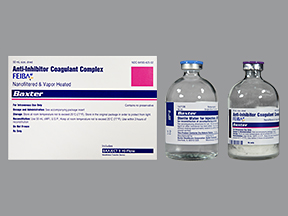 FEIBA 2,500 UNIT (NOMINAL)
The following indications for FEIBA (anti-inhibitor coagulant complex) have been approved by the FDA:
Indications:
Bleeding episode in hemophilia A
Bleeding episode in hemophilia B
Bleeding prevention in hemophilia
Professional Synonyms:
Bleeding prophylaxis in hemophilia
Hemorrhage prophylaxis in hemophilia
Hemorrhaging in hemophilia A
Hemorrhaging in hemophilia B
Indications:
Bleeding episode in hemophilia A
Bleeding episode in hemophilia B
Bleeding prevention in hemophilia
Professional Synonyms:
Bleeding prophylaxis in hemophilia
Hemorrhage prophylaxis in hemophilia
Hemorrhaging in hemophilia A
Hemorrhaging in hemophilia B
The following dosing information is available for FEIBA (anti-inhibitor coagulant complex):
Dosage of anti-inhibitor coagulant complex is not well defined and therefore should be individualized carefully based on clinical response. Response to anti-inhibitor coagulant complex varies depending on the type of hemorrhage and shows considerable interindividual variation; response to the drug does not necessarily correlate with the patient's plasma levels of inhibitor. There is no laboratory test that can reliably be used to monitor effectiveness of anti-inhibitor coagulant complex therapy.
Dosage of Feiba(R) VH is expressed in terms of Feiba(R) VH units of activity.
The dosage range of Feiba(R) VH recommended by the manufacturer is 50-100 units/kg. Because laboratory and/or clinical signs of disseminated intravascular coagulation (DIC) have been reported in patients receiving high doses of Feiba(R) VH, the manufacturer states that single doses of the drug should not exceed 100 units/kg and daily dosages should not exceed 200 units/kg. Patients receiving more than 100 units/kg should be monitored for the development of DIC and/or symptoms of acute coronary ischemia.
High doses of Feiba(R) VH should be given only as long as absolutely necessary to stop bleeding.
For the management of joint hemorrhage, the manufacturer of Feiba(R) VH recommends that a dose of 50 units/kg be given every 12 hours; dosage may be increased to 100 units/kg every 12 hours if necessary. Treatment should be continued until there are clear signs of clinical improvement (e.g., relief of pain, reduction of swelling, mobilization of the joint).
For the management of mucous membrane bleeding, the manufacturer of Feiba(R) VH states that 50 units/kg may be given every 6 hours while monitoring the patient's hematocrit and observing carefully for visible bleeding. If this dosage is insufficient and hemorrhage does not stop, the manufacturer states that dosage may be increased to 100 units/kg every 6 hours for 2 doses; however, dosage should not exceed 200 units/kg daily.
For the management of serious soft tissue hemorrhage, such as retroperitoneal bleeding, Feiba(R) VH doses of 100 units/kg may be given every 12 hours up to a maximum daily dosage of 200 units/kg. Severe hemorrhages, such as CNS bleeding, have been managed effectively with doses of 100 units/kg given every 12 hours; if necessary, these doses may be given every 6 hours until clear evidence of clinical improvement is achieved.
No enhanced Administration information available for this drug.
No dosing information available.
No generic dosing information available.
The following drug interaction information is available for FEIBA (anti-inhibitor coagulant complex):
There are 0 contraindications.
There are 1 severe interactions.
These drug interactions can produce serious consequences in most patients. Actions required for severe interactions include, but are not limited to, discontinuing one or both agents, adjusting dosage, altering administration scheduling, and providing additional patient monitoring. Review the full interaction monograph for more information.
| Drug Interaction | Drug Names |
|---|---|
| Antifibrinolytics/Factor IX; Anti-Inhibitor Coagulant Conc SEVERITY LEVEL: 2-Severe Interaction: Action is required to reduce the risk of severe adverse interaction. MECHANISM OF ACTION: Concurrent use may result in additive or synergistic effects on the coagulation pathways.(1-3) CLINICAL EFFECTS: Concurrent use may result in thrombosis.(1-3) PREDISPOSING FACTORS: None determined. PATIENT MANAGEMENT: The manufacturer of aminocaproic acid states that aminocaproic acid should not be administered concomitantly with Factor IX Complex concentrates or Anti-inhibitor Coagulant concentrates.(1) The US manufacturer of tranexamic acid states that concomitant use with Factor IX Complex concentrates or with Anti-inhibitor Coagulant concentrates should be avoided.(2,3) The Japanese manufacturer of tranexamic acid recommends caution when coadministered with drugs such as coagulation factor agents as coagulation may be further activated at sites with enhanced local fibrinolysis.(4) Concurrent use may be warranted in select patients with hemophilia A or hemophilia B or in select major trauma scenarios. Monitor patients closely for signs of thrombosis, disseminated intravascular coagulation, and hypercoagulability if concurrent use is deemed necessary.(5-13) DISCUSSION: There is very limited data on the risk of thrombosis with combination therapy. In a study, eight hemophilia B patients undergoing dental extraction procedures received combination therapy with aminocaproic acid or tranexamic acid and monoclonal antibody purified factor IX for bleeding prophylaxis. All patients achieved hemostasis without clinical evidence of thrombosis as well as no changes were seen in hemoglobin, hematocrit, or in markers of hemostatic system activation.(5) In a study, seven hemophilia A patients with inhibitors and one with acquired hemophilia patient received activated prothrombin complex concentrate (APCC) and tranexamic acid for management of bleeding episodes and prevention of hemorrhage during surgery. Hemostatic outcomes were rated excellent or good in 10 out of 11 (91%) treatment episodes. No episodes of thrombosis or disseminated intravascular coagulation occurred during treatment.(6) A study in six hemophilia A patients and five healthy volunteers evaluated the use of tranexamic acid as an adjunct to APCC to control bleeding. Patients who received tranexamic acid had a significant increase in maximum clot firmness compared to healthy controls. No clinical or laboratory signs of thromboembolic events, disseminated intravascular coagulation, or hypercoagulability were observed.(7) In a retrospective cohort of 76 patients who received PCC for bleeding not caused by anticoagulation, some patients received additional hemostatic agents (protamine (59%), desmopressin (43%), and tranexamic acid (42%). Eight patients (11%) suffered thromboembolic complications but this was not stratified by the hemostatic agent.(8) In a prospective case crossover study, five healthy volunteers and six hemophilia patients with inhibitors received tranexamic acid with single-dose activated PCC or with recombinant activated factor VII. There were no thromboembolic events during the study.(9) In a double-blind, randomized, placebo-controlled superiority trial to investigate the efficacy and safety of 4-factor prothrombin complex concentrate (4F-PCC) administration in trauma patients at risk of massive transfusion, a significantly higher risk of thromboembolic events occurred in the 4F-PCC group compared to the placebo group (35% vs 24%; relative risk 1.48 [95% CI, 1.04-2.10]). This was observed despite more frequent use of tranexamic acid in the placebo group (86% vs 76%).(10) Case reports reviewed the use of recombinant factor VIIa and FEIBA in 4 patients with severe hemophilia with inhibitors who underwent major surgery. The patients were also treated with tranexamic acid. Non-surgical bleeding was encountered in 4 of 8 surgical procedures. The overall outcome was good for all procedures.(11) In a retrospective cohort of 112 ambulatory tooth extractions in 23 hemophilia patients using a coagulation factor replacement therapy in combination with tranexamic acid, only one episode of mild postoperative bleeding occurred after seven days in a patient who did not have good treatment compliance.(12) In a prospective study evaluating the use of initial hemoglobin levels as a guideline for the initial treatment of clotting disorders in multiple trauma patients, 25 patients received a combination of hemostatic agents (fibrinogen (100%), PCC (96%), desmopressin (56%), tranexamic acid (52%), and factor VIIa (44%). Of the 25 patients treated, 16 (64%) survived. Two patients (8%) suffered thromboembolic complications but this was not stratified by the hemostatic agent. One patient survived after developing a grade II pulmonary embolism caused by deep leg vein trombosis and one patient died from multi-organ failure after developing multiple small vessel thrombosis.(13) |
AMICAR, AMINOCAPROIC ACID, CYKLOKAPRON, MELZARA, TRANEXAMIC ACID, TRANEXAMIC ACID-NACL |
There are 0 moderate interactions.
The following contraindication information is available for FEIBA (anti-inhibitor coagulant complex):
Drug contraindication overview.
No enhanced Contraindications information available for this drug.
No enhanced Contraindications information available for this drug.
There are 0 contraindications.
There are 3 severe contraindications.
Adequate patient monitoring is recommended for safer drug use.
| Severe List |
|---|
| Disseminated intravascular coagulation |
| Thromboembolic disorder |
| Thrombotic disorder |
There are 0 moderate contraindications.
The following adverse reaction information is available for FEIBA (anti-inhibitor coagulant complex):
Adverse reaction overview.
No enhanced Common Adverse Effects information available for this drug.
No enhanced Common Adverse Effects information available for this drug.
There are 15 severe adverse reactions.
| More Frequent | Less Frequent |
|---|---|
|
Acute myocardial infarction Disseminated intravascular coagulation Thromboembolic disorder Thrombotic disorder |
Anaphylaxis Chest tightness Chills Drug fever Dyspnea Hypotension Skin rash |
| Rare/Very Rare |
|---|
|
Angioedema Bronchospastic pulmonary disease Paresthesia Pulmonary thromboembolism |
There are 10 less severe adverse reactions.
| More Frequent | Less Frequent |
|---|---|
| None. |
Pruritus of skin Urticaria Wheezing |
| Rare/Very Rare |
|---|
|
Acute abdominal pain Flushing Hypertension Injection site pain Malaise Sensation of warmth Tachycardia |
The following precautions are available for FEIBA (anti-inhibitor coagulant complex):
No enhanced Pediatric Use information available for this drug.
Contraindicated
Severe Precaution
Management or Monitoring Precaution
Contraindicated
| None |
Severe Precaution
| None |
Management or Monitoring Precaution
| None |
Animal reproduction studies have not been performed to date with anti-inhibitor coagulant complex. It is not known whether anti-inhibitor coagulant complex can affect reproductive capacity or can cause fetal harm when administered to pregnant women, and the drug should be used during pregnancy only when clearly needed.
No enhanced Lactation information available for this drug.
No enhanced Geriatric Use information available for this drug.
The following prioritized warning is available for FEIBA (anti-inhibitor coagulant complex):
No warning message for this drug.
No warning message for this drug.
The following icd codes are available for FEIBA (anti-inhibitor coagulant complex)'s list of indications:
| Bleeding episode in hemophilia A | |
| D66 | Hereditary factor VIII deficiency |
| Z14.02 | Symptomatic hemophilia A carrier |
| Bleeding episode in hemophilia B | |
| D67 | Hereditary factor IX deficiency |
| Bleeding prevention in hemophilia | |
| D66 | Hereditary factor VIII deficiency |
| D67 | Hereditary factor IX deficiency |
| D68.311 | Acquired hemophilia |
| Z14.02 | Symptomatic hemophilia A carrier |
Formulary Reference Tool