Please wait while the formulary information is being retrieved.
Drug overview for DEFEROXAMINE MESYLATE (deferoxamine mesylate):
Generic name: DEFEROXAMINE MESYLATE (deff-er-OX-uh-meen)
Drug class: Iron Chelating Agents
Therapeutic class: Antidotes and other Reversal Agents
Deferoxamine is a heavy metal antagonist that chelates iron and aluminum.
No enhanced Uses information available for this drug.
Generic name: DEFEROXAMINE MESYLATE (deff-er-OX-uh-meen)
Drug class: Iron Chelating Agents
Therapeutic class: Antidotes and other Reversal Agents
Deferoxamine is a heavy metal antagonist that chelates iron and aluminum.
No enhanced Uses information available for this drug.
DRUG IMAGES
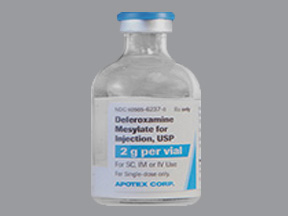 DEFEROXAMINE 2 GRAM VIAL
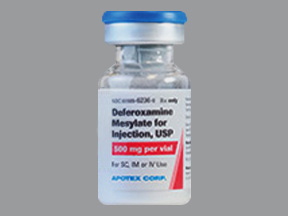 DEFEROXAMINE 500 MG VIAL
The following indications for DEFEROXAMINE MESYLATE (deferoxamine mesylate) have been approved by the FDA:
Indications:
Chronic iron overload due to repeated blood transfusions
Iron toxicity
Professional Synonyms:
Acute iron poisoning
Secondary iron overload from multiple blood transfusions
Transfusion hemosiderosis
Transfusion-induced iron overload
Transfusional hemosiderosis
Transfusional iron overload
Indications:
Chronic iron overload due to repeated blood transfusions
Iron toxicity
Professional Synonyms:
Acute iron poisoning
Secondary iron overload from multiple blood transfusions
Transfusion hemosiderosis
Transfusion-induced iron overload
Transfusional hemosiderosis
Transfusional iron overload
The following dosing information is available for DEFEROXAMINE MESYLATE (deferoxamine mesylate):
No enhanced Dosing information available for this drug.
No enhanced Administration information available for this drug.
| DRUG LABEL | DOSING TYPE | DOSING INSTRUCTIONS |
|---|---|---|
| DEFEROXAMINE 500 MG VIAL | Maintenance | Adults inject 500 mg by intramuscular route once daily |
| DEFEROXAMINE 2 GRAM VIAL | Maintenance | Adults inject 500 mg by intramuscular route once daily |
| DRUG LABEL | DOSING TYPE | DOSING INSTRUCTIONS |
|---|---|---|
| DEFEROXAMINE 2 GRAM VIAL | Maintenance | Adults inject 500 mg by intramuscular route once daily |
| DEFEROXAMINE 500 MG VIAL | Maintenance | Adults inject 500 mg by intramuscular route once daily |
The following drug interaction information is available for DEFEROXAMINE MESYLATE (deferoxamine mesylate):
There are 0 contraindications.
There are 2 severe interactions.
These drug interactions can produce serious consequences in most patients. Actions required for severe interactions include, but are not limited to, discontinuing one or both agents, adjusting dosage, altering administration scheduling, and providing additional patient monitoring. Review the full interaction monograph for more information.
| Drug Interaction | Drug Names |
|---|---|
| Sodium Iodide I 131/Myelosuppressives; Immunomodulators SEVERITY LEVEL: 2-Severe Interaction: Action is required to reduce the risk of severe adverse interaction. MECHANISM OF ACTION: Sodium iodide I 131 can cause depression of the hematopoetic system. Myelosuppressives and immunomodulators also suppress the immune system.(1) CLINICAL EFFECTS: Concurrent use of sodium iodide I 131 with agents that cause bone marrow depression, including myelosuppressives or immunomodulators, may result in an enhanced risk of hematologic disorders, including anemia, blood dyscrasias, bone marrow depression, leukopenia, and thrombocytopenia. Bone marrow depression may increase the risk of serious infections and bleeding.(1) PREDISPOSING FACTORS: None determined. PATIENT MANAGEMENT: The US manufacturer of sodium iodide I 131 states that concurrent use with bone marrow depressants may enhance the depression of the hematopoetic system caused by large doses of sodium iodide I 131.(1) Sodium iodide I 131 causes a dose-dependent bone marrow suppression, including neutropenia or thrombocytopenia, in the 3 to 5 weeks following administration. Patients may be at increased risk of infections or bleeding during this time. Monitor complete blood counts within one month of therapy. If results indicate leukopenia or thrombocytopenia, dosimetry should be used to determine a safe sodium iodide I 131 activity.(1) DISCUSSION: Hematologic disorders including death have been reported with sodium iodide I 131. The most common hematologic disorders reported include anemia, blood dyscrasias, bone marrow depression, leukopenia, and thrombocytopenia.(1) |
HICON, SODIUM IODIDE I-131 |
| Exagamglogene Autotemcel/Iron Chelators SEVERITY LEVEL: 2-Severe Interaction: Action is required to reduce the risk of severe adverse interaction. MECHANISM OF ACTION: Treatment with exagamglogene autotemcel requires hematopoietic stem cell (HSC) mobilization which can suppress the immune system. CLINICAL EFFECTS: Iron chelators should be held prior to and after infusion with exagamglogene autotemcel. PREDISPOSING FACTORS: None determined. PATIENT MANAGEMENT: Iron chelators should be discontinued 7 days prior to initiation of mobilization or conditioning. Avoid myelosuppressive iron chelators for six months after exagamglogene autotemcel infusion. Avoid non-myelosuppressive iron chelators for three months after exagamglogene autotemcel infusion. If iron chelation is needed, consider phlebotomy in lieu of iron chelation when appropriate.(1) DISCUSSION: In preparation for infusion of exagamglogene autotemcel, iron chelation should be discontinued 7 days prior to initiation of mobilization or conditioning.(1) |
CASGEVY |
There are 3 moderate interactions.
The clinician should assess the patient’s characteristics and take action as needed. Actions required for moderate interactions include, but are not limited to, discontinuing one or both agents, adjusting dosage, altering administration.
| Drug Interaction | Drug Names |
|---|---|
| Deferoxamine/Ascorbic Acid (Vitamin C) SEVERITY LEVEL: 3-Moderate Interaction: Assess the risk to the patient and take action as needed. MECHANISM OF ACTION: It is believed that ascorbic acid increases the iron available for chelation from an labile intracellular iron pool. Ascorbic acid may then facilitate iron-induced oxidative tissue damage.(1) CLINICAL EFFECTS: Dietary ascorbic acid may increase the absorption of dietary iron. Supplemental ascorbic acid therapy given during chelation therapy may improve iron output;(1-9) however, excessive dosages may result in cardiac toxicity from iron-induced oxidative tissue damage.(1,2,11-13) PREDISPOSING FACTORS: None determined. PATIENT MANAGEMENT: Ascorbic acid intake is often restricted in patients with iron overload; however, it has been used in conjunction with deferoxamine to increase iron excretion.(2) Supplemental ascorbic acid therapy should only be initiated after one month of deferoxamine therapy. Ascorbic acid therapy should only be given in patients receiving deferoxamine regularly and the dose should be given after the infusion has started. The dosage of ascorbic acid should be limited to 50 mg daily in children under 10 years of age; 100 mg daily in older children; and 200 mg daily, in divided doses, in adults.(2) Cardiac function should be monitored in patients receiving concurrent therapy. Discontinue ascorbic acid therapy in patients who develop cardiac dysfunction.(2) DISCUSSION: Supplemental ascorbic acid therapy given during chelation therapy has been shown to improve iron output,(1-9) possibly by increasing iron available for chelation from an labile intracellular iron pool.(1) However, dosages in excess of 500 mg daily have been associated with cardiac dysfunction.(1,2,11-13) |
ASCOR, ASCORBIC ACID, INFUVITE ADULT, INFUVITE ADULT VIAL 1, INFUVITE PEDIATRIC, INFUVITE PEDIATRIC VIAL 1, MOVIPREP, PEG3350-SOD SUL-NACL-KCL-ASB-C, PLENVU, VAXCHORA BUFFER COMPONENT |
| Deferoxamine/Prochlorperazine SEVERITY LEVEL: 3-Moderate Interaction: Assess the risk to the patient and take action as needed. MECHANISM OF ACTION: Although the exact mechanism is unclear, the combination of deferoxamine and prochlorperazine appears to have additive or synergistic pharmacodynamic effects on central nervous system(CNS) dopamine activity.(1) Iron is required for normal dopamine cycling in central nervous system (CNS) neurons; iron deficiency has been associated with dopamine-mediated neuropsychiatric disease.(2-5) Deferoxamine chelation of iron in dopamine neurons may lead to diminished neural activity(1) while prochlorperazine may further decrease dopamine activity via blockade of dopamine binding sites.(6) CLINICAL EFFECTS: Concurrent treatment with therapeutic doses of deferoxamine and prochlorperazine has resulted in loss of consciousness.(7,8) PREDISPOSING FACTORS: Patients with normal or low iron stores may have an increased risk for toxicity.(7) The elderly are more susceptible to adverse effects from prochlorperazine.(6) PATIENT MANAGEMENT: Although the incidence of this interaction is unknown, given the potential severity of the interaction it would be prudent, particularly in patients with normal or low iron stores, to use alternative antiemetics (e.g. ondansetron or other 5-HT3 receptor antagonists) in patients receiving deferoxamine. The Australian manufacturer of prochlorperazine states that simultaneous administration of deferoxamine and prochlorperazine is contraindicated.(9) DISCUSSION: In a pilot study,(7) deferoxamine was prescribed for patients with progressive rheumatologic disease based upon proposed antiinflammatory effects. Deferoxamine was administered subcutaneously over 8-12 hours, 5 days per week, for a maximum of 3 weeks. Two patients who experienced nausea received prochlorperazine resulting in a loss of consciousness. Case details: - A 75 year old woman with symmetrical synovitis had pretreatment tests which included C-reactive protein (CRP) 155 mg/L, ferritin 88 mcg/L, hemoglobin (Hb) 9.2 g/dL. She received 42 grams of deferoxamine over three weeks. During the last day of treatment she complained of nausea and took 5 doses of 5 mg oral prochlorperazine over 29 hours. Twelve hours after the last dose she became drowsy, progressing to a significant impairment of consciousness; at times she was only partially responsive to painful stimuli. Electrolyte, liver function, blood glucose tests and CT of the brain were normal during this time. The patient recovered after 3 days without apparent long term sequelae. - A 58 year old, 67kg man with severe peripheral polyarthritis had pretreatment tests which included CRP 10 mg/L, ferritin 78 mcg/L and Hb 15 g/dL. He received twelve 3 gram deferoxamine infusions during the study period. On the last day of treatment he complained of nausea during the infusion and received 2 doses of prochlorperazine 12.5mg IM in a 13 hour period. The deferoxamine was stopped early due to mental status changes. He gradually lost consciousness over a 6 hour period and was only minimally responsive to painful stimuli for 2 days. During this time brisk reflexes, spontaneous limb movement and clonus were observed. Electrolyte, liver function and blood glucose tests, lumbar puncture, and CT of the brain were normal during this time. Subsequently he gradually returned to normal over a 4 day period. These cases of unexpected toxicity prompted an interaction study with iron-deficient and iron-replete rats who were given intraperitoneal deferoxamine and prochlorperazine. Given individually, neither drug impaired consciousness, but the combination led to either movement only in response to stimuli, or total loss of consciousness. Consciousness was regained by 36 hours in the iron-deficient group and 12 hours in the iron-replete group.(7) |
COMPAZINE, COMPRO, PROCHLORPERAZINE, PROCHLORPERAZINE EDISYLATE, PROCHLORPERAZINE MALEATE |
| Lovotibeglogene Autotemcel/Iron Chelators SEVERITY LEVEL: 3-Moderate Interaction: Assess the risk to the patient and take action as needed. MECHANISM OF ACTION: Treatment with lovotibeglogene autotemcel requires hematopoietic stem cell (HSC) mobilization which can suppress the immune system. CLINICAL EFFECTS: Iron chelators should be held prior to and after infusion with lovotibeglogene autotemcel. PREDISPOSING FACTORS: None determined. PATIENT MANAGEMENT: Iron chelators should be discontinued 7 days prior to initiation of mobilization or conditioning. Avoid myelosuppressive iron chelators for six months after lovotibeglogene autotemcel infusion. Avoid non-myelosuppressive iron chelators for three months after lovotibeglogene autotemcel infusion. If iron chelation is needed, consider phlebotomy in lieu of iron chelation when appropriate.(1) DISCUSSION: In preparation for infusion of lovotibeglogene autotemcel, iron chelation should be discontinued 7 days prior to initiation of mobilization or conditioning.(1) |
LYFGENIA |
The following contraindication information is available for DEFEROXAMINE MESYLATE (deferoxamine mesylate):
Drug contraindication overview.
No enhanced Contraindications information available for this drug.
No enhanced Contraindications information available for this drug.
There are 1 contraindications.
Absolute contraindication.
| Contraindication List |
|---|
| Lactation |
There are 6 severe contraindications.
Adequate patient monitoring is recommended for safer drug use.
| Severe List |
|---|
| Anuria |
| Chronic kidney disease stage 4 (severe) GFR 15-29 ml/min |
| Chronic kidney disease stage 5 (failure) GFr<15 ml/min |
| Mucormycosis |
| Optic neuritis |
| Pyelonephritis |
There are 5 moderate contraindications.
Clinically significant contraindication, where the condition can be managed or treated before the drug may be given safely.
| Moderate List |
|---|
| Aluminum toxicity |
| Cataracts |
| Hearing loss |
| Seizure disorder |
| Tinnitus |
The following adverse reaction information is available for DEFEROXAMINE MESYLATE (deferoxamine mesylate):
Adverse reaction overview.
No enhanced Common Adverse Effects information available for this drug.
No enhanced Common Adverse Effects information available for this drug.
There are 17 severe adverse reactions.
| More Frequent | Less Frequent |
|---|---|
|
Auditory neurotoxicity Hypotension Mucormycosis Shock Tachycardia Yersinia pseudotuberculosis infection |
Hypocalcemia Thrombocytopenic disorder |
| Rare/Very Rare |
|---|
|
Abnormal hepatic function tests Acute respiratory distress syndrome Angioedema Cataracts Leukopenia Night blindness Optic neuritis Seizure disorder Urticaria |
There are 20 less severe adverse reactions.
| More Frequent | Less Frequent |
|---|---|
|
Blurred vision Injection site sequelae Pruritus of skin Skin rash |
Acute abdominal pain Diarrhea Dysuria Fever Flushing Urine discoloration |
| Rare/Very Rare |
|---|
|
Acute renal failure Corneal opacity Dizziness Injection site inflammation Muscle spasm Nausea Paresthesia Peripheral motor neuropathy Peripheral sensory neuropathy Visual field defect |
The following precautions are available for DEFEROXAMINE MESYLATE (deferoxamine mesylate):
No enhanced Pediatric Use information available for this drug.
Contraindicated
Severe Precaution
Management or Monitoring Precaution
Contraindicated
| None |
Severe Precaution
| None |
Management or Monitoring Precaution
| None |
In teratogenicity studies, deferoxamine mesylate appeared to cause delayed ossification and skeletal anomalies in 2 animal species at dosages up to 4.5 times the maximum dosage recommended for humans. For this reason, the drug should not be administered to pregnant women (especially during early pregnancy) or women who may become pregnant unless the potential benefits outweigh the possible risks to the fetus.
It is not known whether deferoxamine is distributed into milk. Because many drugs are distributed into milk, caution should be exercised when deferoxamine is used in nursing women.
No enhanced Geriatric Use information available for this drug.
The following prioritized warning is available for DEFEROXAMINE MESYLATE (deferoxamine mesylate):
No warning message for this drug.
No warning message for this drug.
The following icd codes are available for DEFEROXAMINE MESYLATE (deferoxamine mesylate)'s list of indications:
| Chronic iron overload due to repeated blood transfusions | |
| E83.111 | Hemochromatosis due to repeated red blood cell transfusions |
| Iron toxicity | |
| T45.4x1A | Poisoning by iron and its compounds, accidental (unintentional), initial encounter |
| T45.4x2A | Poisoning by iron and its compounds, intentional self-harm, initial encounter |
| T45.4x3A | Poisoning by iron and its compounds, assault, initial encounter |
| T45.4x4A | Poisoning by iron and its compounds, undetermined, initial encounter |
Formulary Reference Tool